01 / 21

Torque and Work

Understand how rotational forces do work, connecting \( \tau \), \( \theta \), and \( W \) to solve real-world physics problems.

AP Physics 1

What Is Torque?

Torque is the rotational equivalent of force. It measures how effectively a force causes an object to rotate about an axis. The farther the force is from the pivot and the more perpendicular it is, the greater the torque.

\( r \) : Lever Arm
Distance from the axis of rotation to the point where force is applied (in meters).
\( \theta \) : Angle
Angle between the position vector \( \vec{r} \) and the force vector \( \vec{F} \).

Visualizing Torque

Pivot \( r \) \( F \) \( \theta \) \( F\sin\theta \) Only the perpendicular component of F creates torque

What Is Work?

Work is energy transferred to or from an object by a force acting through a displacement. In linear motion, the formula is straightforward.

Positive Work
Force and displacement in the same direction: energy is added to the system.
Negative Work
Force opposes displacement: energy is removed from the system (e.g., friction).
Zero Work
Force is perpendicular to displacement: \( \cos 90^\circ = 0 \), so no energy transfer.

Work Done by Torque

Just as a linear force does work over a displacement \( d \), a torque does work as it rotates an object through an angular displacement \( \Delta\theta \).

Illustrating the relationship

This separate introductory illustration uses the stated force and distance values.
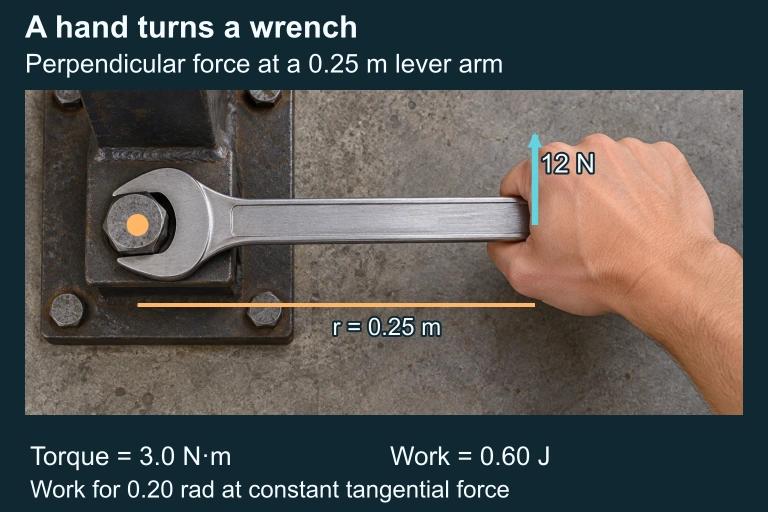
A 12 N perpendicular force on a 0.25 m wrench produces 3 N·m torque and does 0.60 J over 0.20 rad.

A separate worked example

The following source example uses its own apparatus and numbers; its companion figure appears with the solution.

A uniform solid disk (grinding wheel) has mass m = 8.0 kg and radius R = 0.25 m. A constant tangential force F = 40 N is applied at the rim for exactly 3 full revolutions, starting from rest. We want to find: (a) the torque, (b) the work done, and (c) the final angular velocity.

Show answer and explanation

Step 2 — Calculate the Torque: The force is tangential (perpendicular to the radius), so θ = 90° and sin 90° = 1. Thus τ = rF sin θ = (0.25 m)(40 N)(1) = 10 N·m. τ = 10 N·m Step 3 — Convert Revolutions to Radians: Angular displacement Δθ = 3 rev × 2π rad/rev = 6π rad ≈ 18.85 rad. Always convert to radians before computing work. Δθ = 6π rad Step 4 — Compute Rotational Work: W = τΔθ = (10 N·m)(6π rad) = 60π J ≈ 188.5 J. This is the energy transferred to the wheel by the applied force. W ≈ 188.5 J Step 5 — Find the Final Angular Velocity: The moment of inertia of a solid disk is I = ½mR² = ½(8.0 kg)(0.25 m)² = 0.25 kg·m². Applying the work–energy theorem with ω_(i) = 0: W = ½Iω_(f)². Solving: ω_(f) = √(2W/I) = √(2 × 60π / 0.25) = √(480π) ≈ 38.8 rad/s. ω_f ≈ 38.8 rad/s Step 6 — Verify Units and Reasonableness: Converting to RPM: (38.8 rad/s)(60 s/min)/(2π rad/rev) ≈ 370 RPM. This is a realistic speed for a small grinding wheel. The units check out: N·m × rad = J, and √(J / kg·m²) = √(s⁻²) = rad/s ✓.
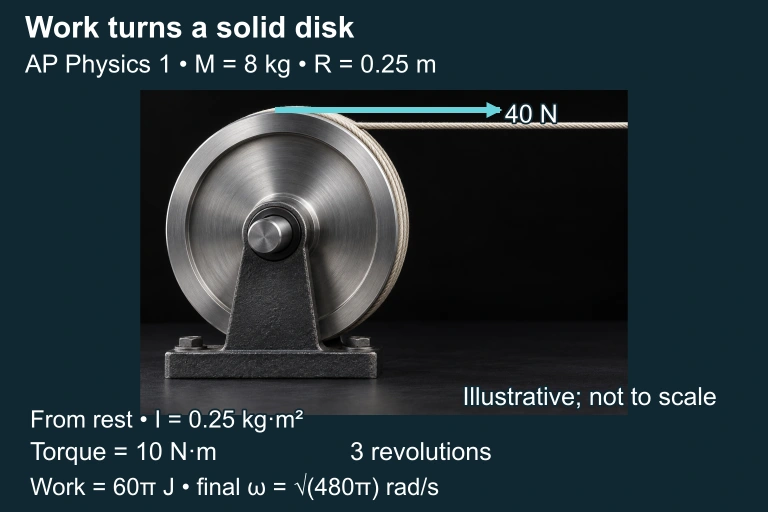
AP Physics 1 • M = 8 kg • R = 0.25 m; illustrative apparatus not to scale.

The Core Equation

\( r \) \( F \) \( \Delta\theta \) Rotational Work \( W = \tau\,\Delta\theta \) Units: Joules (J)

A constant torque \( \tau \) applied through an angular displacement \( \Delta\theta \) transfers energy \( W = \tau\,\Delta\theta \). This is the rotational analog of \( W = Fd \).

Power entering and leaving a flywheel
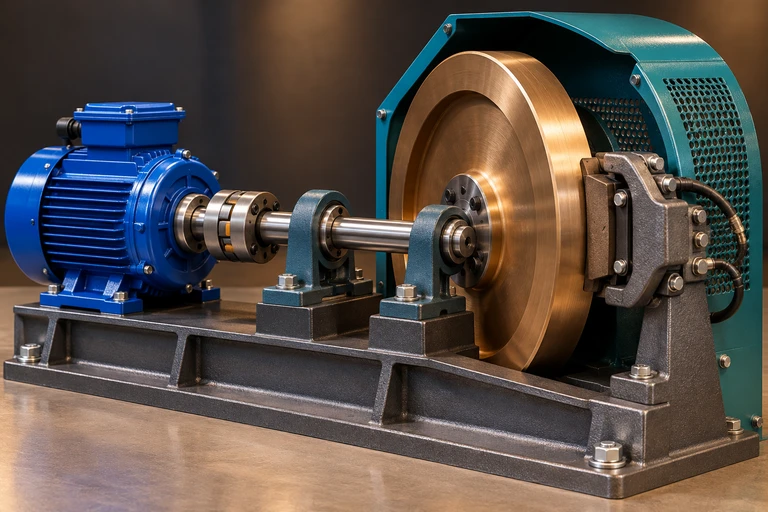
A blue motor drives a gold flywheel through a continuous horizontal shaft with two bearings. A fixed brake caliper contacts the wheel rim inside a partial protective guard.A flywheel stores kinetic energy as it rotates. Net torque changes that energy through rotational work, while drive and load torques can transfer power even at steady speed.

Work under a torque–angle graph
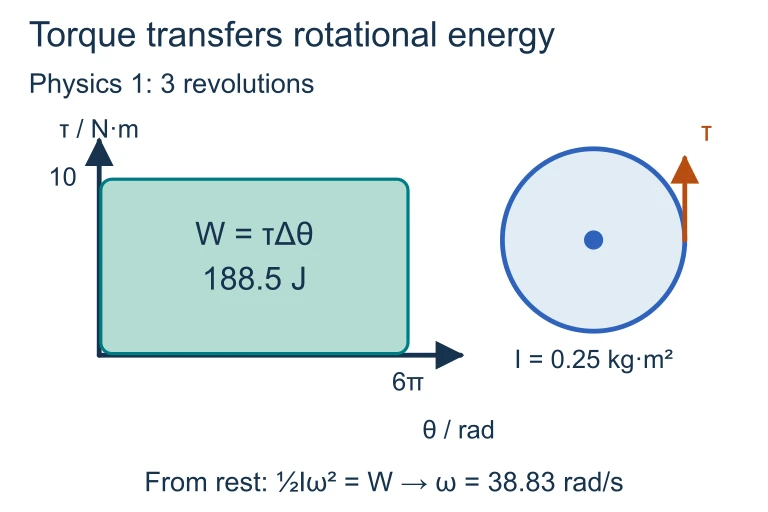
Work under a torque–angle graph. A constant 10 N·m net torque through 6π radians transfers 60π J. Starting from rest with I = 0.25 kg·m², the disk reaches about 38.83 rad/s.A constant 10 N·m net torque through 6π radians transfers 60π J. Starting from rest with I = 0.25 kg·m², the disk reaches about 38.83 rad/s.

Linear vs Rotational Work

Linear Rotational
Cause of Motion Force \( F \) Torque \( \tau \)
Displacement Distance \( d \) Angle \( \Delta\theta \) (rad)
Work Formula \( W = Fd\cos\theta \) \( W = \tau\,\Delta\theta \)
Kinetic Energy \( \frac{1}{2}mv^2 \) \( \frac{1}{2}I\omega^2 \)
Units Joules (J) Joules (J)

Torque vs Force: Key Differences

Torque \( \tau \)
Causes angular acceleration. Depends on where and at what angle the force is applied. Unit: N·m (not Joules).
Force \( F \)
Causes linear acceleration. Acts on the center of mass regardless of application point. Unit: N.

Rotational Kinetic Energy

A spinning object possesses rotational kinetic energy determined by its moment of inertia and angular speed:

How to Solve Torque-Work Problems

1
Identify the axis of rotation and the forces acting on the object.
2
Calculate the torque: \( \tau = rF\sin\theta \). Find the lever arm and the angle between \( \vec{r} \) and \( \vec{F} \).
3
Determine angular displacement \( \Delta\theta \) in radians. Convert from degrees or revolutions if needed.
4
Compute work: \( W = \tau\,\Delta\theta \). If torque varies, use the work-energy theorem instead.
5
Check units and sign. Positive work speeds up rotation; negative work slows it down.

Example 1: Wrench on a Bolt

A mechanic applies a force of \( F = 40 \text{ N} \) at the end of a \( r = 0.25 \text{ m} \) wrench, perpendicular to the handle. The bolt turns through \( \Delta\theta = 2\pi \text{ rad} \) (one full revolution). How much work is done?

\( r = 0.25 \text{ m} \) \( 40 \text{ N} \)

Example 2: Braking a Wheel

A spinning wheel with \( I = 2.0 \mathrm{ kg\,m}^2 \) is rotating at \( \omega_i = 10 \text{ rad/s} \). A braking torque of \( \tau = -5 \mathrm{ N\,m} \) is applied. How much work does the brake do to bring the wheel to rest?

1
Initial KE: \( KE_i = \frac{1}{2}I\omega_i^2 = \frac{1}{2}(2.0)(10)^2 = \) \( 100 \text{ J} \)
2
Final KE: \( KE_f = 0 \text{ J} \) (wheel is at rest, \( \omega_f = 0 \))
3
Work-energy theorem: \( W = \Delta KE = 0 - 100 = \) \( -100 \text{ J} \)

Example 3: Force at an Angle

A \( r = 0.50 \text{ m} \) door handle has a force of \( F = 20 \text{ N} \) applied at \( 60^\circ \) to the door surface. The door swings through \( 90^\circ \). Find the work done.

1
Calculate torque: \( \tau = rF\sin\theta = (0.50)(20)\sin 60^\circ = 10 \times 0.866 = \) \( 8.66 \mathrm{ N\,m} \)
2
Convert angle to radians: \( \Delta\theta = 90^\circ \times \frac{\pi}{180} = \frac{\pi}{2} \text{ rad} \)
3
Compute work: \( W = \tau\,\Delta\theta = (8.66)\!\left(\frac{\pi}{2}\right) = \) \( 13.6 \text{ J} \)

Rotational Power

Power is the rate at which work is done. For rotational motion, the relationship connects torque directly to angular velocity:

Linear Analog
\( P = Fv \) : Force times velocity
Rotational Analog
\( P = \tau\omega \) : Torque times angular velocity

Common Mistakes

✕ Using Degrees for \( \Delta\theta \)
The formula \( W = \tau\,\Delta\theta \) requires radians. Forgetting to convert from degrees gives answers off by a factor of \( \frac{\pi}{180} \).
✕ Confusing N·m with J
Torque is measured in N·m but is not energy. Only when torque acts through an angle does it produce work in Joules.
✕ Ignoring \( \sin\theta \) in Torque
If force is not perpendicular to the lever arm, you must include \( \sin\theta \). Only the perpendicular component creates torque.

Summary of Key Formulas

Quantity Formula Units
Torque \( \tau = rF\sin\theta \) N·m
Rotational Work \( W = \tau\,\Delta\theta \) J
Rotational KE \( KE = \frac{1}{2}I\omega^2 \) J
Work-Energy Theorem \( W_{\text{net}} = \Delta KE_{\text{rot}} \) J
Rotational Power \( P = \tau\,\omega \) W

Question 1 of 5

A constant torque of \( 12 \mathrm{ N\,m} \) rotates a wheel through \( 5 \) complete revolutions. How much work is done by the torque?

Question 2 of 5

A force of \( 30 \text{ N} \) is applied at the end of a \( 0.4 \text{ m} \) wrench at \( 90^\circ \) to the handle. What is the torque?

Question 3 of 5

A flywheel has moment of inertia \( I = 4 \mathrm{ kg\,m}^2 \) and spins at \( \omega = 6 \text{ rad/s} \). A brake brings it to rest. What is the work done by the brake?

Question 4 of 5

A motor provides a torque of \( 25 \mathrm{ N\,m} \) to a shaft spinning at \( 40 \text{ rad/s} \). What is the power output of the motor?

Question 5 of 5

A force of \( 50 \text{ N} \) is applied at the end of a \( 0.6 \text{ m} \) lever arm at \( 30^\circ \) to the arm. What is the torque?