Understanding
Torque
Master the rotational equivalent of force: learn how forces cause objects to spin, and how lever arm, force, and angle determine the twisting effect.
What Is Torque?
Torque is the rotational analog of force. While a net force causes linear acceleration, a net torque causes angular acceleration. Every time you open a door, turn a wrench, or spin a merry-go-round, you are applying torque.
The Three Ingredients
Visualizing Torque
The Torque Equation
$$ \tau = r \, F \sin\theta $$
Vector Form: Cross Product
$$ \vec{\tau} = \vec{r} \times \vec{F} $$
Torque is fundamentally a vector quantity. Its direction is determined by the right-hand rule: curl the fingers of your right hand from \( \vec{r} \) toward \( \vec{F} \), and your thumb points in the direction of \( \vec{\tau} \).
Torque vs. Force
| Force | Torque | |
|---|---|---|
| Symbol | \( \vec{F} \) | \( \vec{\tau} \) |
| Units | Newtons (N) | Newton-meters (N·m) |
| Effect | Linear acceleration | Angular acceleration |
| Newton's 2nd Law | \( \vec{F}_{\text{net}} = m\vec{a} \) | \( \vec{\tau}_{\text{net}} = I\vec{\alpha} \) |
| Depends on pivot? | No | Yes |
Sign Convention for Torque
How to Calculate Torque
Example 1: Perpendicular Force
Example 2: Force at an Angle
Example 3: Rotational Equilibrium
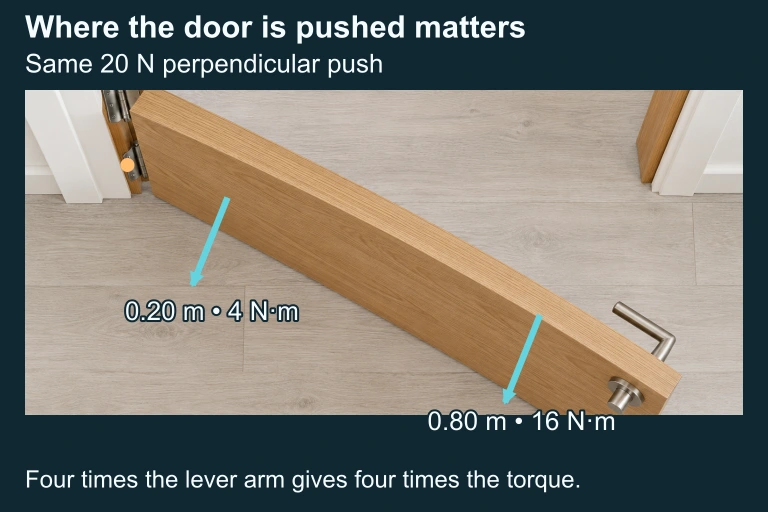
Illustrating the relationship
This separate introductory illustration uses the stated force and distance values.
A separate worked example
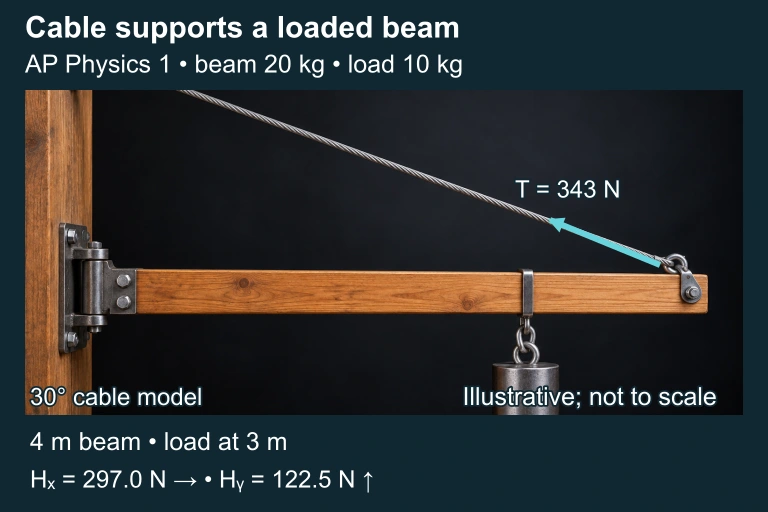
The following source example uses its own apparatus and numbers; its companion figure appears with the solution.
A uniform horizontal beam of length L = 4.0 m and mass M = 20 kg is attached to a wall by a hinge at its left end. A cable attached to the right end of the beam makes an angle of 30° above the horizontal and holds the beam in static equilibrium. A block of mass m = 10 kg hangs from the beam at a point 3.0 m from the hinge. Find the tension T in the cable.
Show answer and explanation
Step 2 — Identify Forces and Pivot: Three forces produce torque about the hinge: (1) the weight of the beam, Mg, acting downward at the center of mass (L/2 = 2.0 m from the hinge); (2) the weight of the block, mg, acting downward at 3.0 m from the hinge; (3) the tension T in the cable, acting at 30° above horizontal at the end of the beam (4.0 m from the hinge). The hinge force is eliminated by choosing the hinge as the pivot, since its lever arm is zero. Step 3 — Write the Torque Equation: Setting counterclockwise as positive and applying Στ = 0 about the hinge: T × L × sin 30° − Mg × (L/2) − mg × (3.0 m) = 0 Step 4 — Substitute Known Values: Inserting the given values with g = 9.8 m/s²: T × 4.0 × sin 30° − (20)(9.8)(2.0) − (10)(9.8)(3.0) = 0 → T × 2.0 − 392 − 294 = 0 Step 5 — Solve for T: Combining and solving for T: 2.0T = 686 → T = 343 N ≈ 340 N Step 6 — Check Reasonableness: The total weight supported is (20 + 10)(9.8) = 294 N. The tension (343 N) exceeds this because the cable acts at only 30°—its vertical component is T sin 30° = 171.5 N, meaning the hinge must supply the remaining vertical support. The cable tension must be large to compensate for the small angle, which is physically consistent.
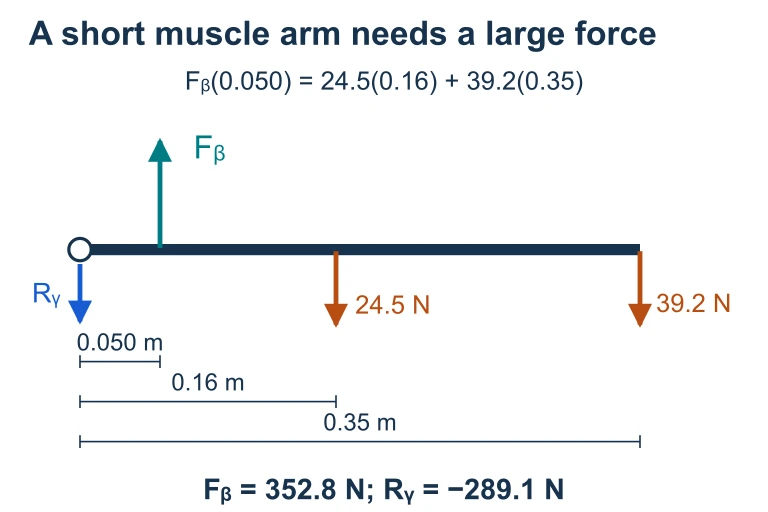
Muscle force is amplified by a short anatomical moment arm

A short muscle moment arm requires a large muscle force to balance the hand load. In the vertical-pull model, both the torque balance about the elbow and the vertical force balance must hold.Forearm torque and force balance
A short muscle moment arm requires a large muscle force to balance the hand load. In the vertical-pull model, both the torque balance about the elbow and the vertical force balance must hold.Newton's 2nd Law for Rotation
$$ \sum \tau = I\alpha $$
The Moment Arm Shortcut
Instead of computing \( rF\sin\theta \), you can find the perpendicular distance from the pivot to the line of action of the force. This perpendicular distance is the moment arm \( r_\perp \).
Common Mistakes
Summary of Key Relationships
| Concept | Linear | Rotational |
|---|---|---|
| Cause of acceleration | Force \( F \) | Torque \( \tau \) |
| Inertia | Mass \( m \) | Moment of inertia \( I \) |
| Acceleration | \( a \) (\(\text{m/s}^2\)) | \( \alpha \) (\(\text{rad/s}^2\)) |
| Newton's 2nd Law | \( F_{\text{net}} = ma \) | \( \tau_{\text{net}} = I\alpha \) |
| Equilibrium | \( \sum F = 0 \) | \( \sum \tau = 0 \) |
| Units | \(\text{N}\) | \(\text{N} \cdot \text{m}\) |
Question 1 of 5
A force of 40 N is applied perpendicularly at the end of a 0.3 m wrench. What is the magnitude of the torque?
Question 2 of 5
A 100 N force is applied at an angle of 30° to a 2.0 m lever arm. What is the torque?
Question 3 of 5
A force is applied directly through the pivot point of a rotating beam. What is the torque produced?
Question 4 of 5
A seesaw is balanced with a 60 N child sitting 1.5 m from the fulcrum. A second child sits 2.0 m from the fulcrum on the other side. What is the weight of the second child?
Question 5 of 5
A net torque of 24 N·m acts on a wheel with moment of inertia \( I = 4.0 \) kg·m². What is the angular acceleration?