01 / 20

Systems & Center of Mass

Learn how to define a system of objects, calculate the center of mass, and understand why it governs the motion of complex systems.

AP Physics 1

What is a System?

A system is a collection of objects that we choose to analyze together. Everything outside the system is the surroundings. The boundary we draw determines which forces are internal (between objects in the system) and which are external (from the surroundings).

SYSTEM BOUNDARY
\(m_1\)
\(m_2\)
Internal forces External External

Why Do Systems Matter?

Simplification
A complex collection of objects can be treated as a single point particle located at the center of mass.
Conservation Laws
When net external force is zero, the total momentum of the system is conserved: collisions, explosions, and more.
Predictive Power
The center of mass moves as if all mass were concentrated there with all external forces applied to it.

Defining the Center of Mass

The center of mass (CM) is the mass-weighted average position of all the particles in a system. It is the single point where we can consider all the mass to be concentrated for translational motion analysis.

x
\(m_1\)
\(x_1\)
\(m_2\)
\(x_2\)
\(m_3\)
\(x_3\)
CM
\(x_{\text{cm}} = \frac{m_1 x_1 + m_2 x_2 + m_3 x_3}{m_1 + m_2 + m_3}\)

The Center of Mass Formula

\( m_i \)
Mass of each individual object in the system (kg)
\( x_i, y_i \)
Position coordinates of each object (m)
\( M \)
Total system mass: \( M = \sum m_i \)

Additional worked example

The following is a separate example from the long-form lesson. Its values may differ from the example already on this slide.

A 4.0 kg cart sits at x = 2.0 m on a frictionless track, and a 6.0 kg cart sits at x = 7.0 m. A compressed spring between them is released. Where is the center of mass, and what happens to it after the spring fires?

Show answer and explanation

Step 1 — Identify the System and Given Values: Define the system as both carts plus the spring. Given: m₁ = 4.0 kg at x₁ = 2.0 m, m₂ = 6.0 kg at x₂ = 7.0 m. Total mass M = 4.0 + 6.0 = 10.0 kg. The track is frictionless and horizontal, so the only external forces (gravity and the normal force) are vertical and balanced — the net external horizontal force is zero. Step 2 — Calculate the Center-of-Mass Position: Apply the center-of-mass formula: x_cm = (m₁x₁ + m₂x₂) / M = (4.0 × 2.0 + 6.0 × 7.0) / 10.0 = (8.0 + 42.0) / 10.0 = 50.0 / 10.0. x_cm = 5.0 m Step 3 — Analyze the Motion After the Spring Fires: The spring force is internal to the system (it acts between the two carts). Since the net external horizontal force is zero, ΣF_ext = 0, and therefore a_cm = 0. The center of mass does not accelerate — its velocity remains zero (the system started from rest). v_cm = 0 m/s — the center of mass stays at x = 5.0 m Step 4 — Interpret Physically: After the spring fires, the 4.0 kg cart moves to the left and the 6.0 kg cart moves to the right. Despite each cart having a nonzero velocity, the mass-weighted average position — the center of mass — remains stationary at x = 5.0 m. This is a direct consequence of momentum conservation: the total momentum was zero before the release and must remain zero afterward.
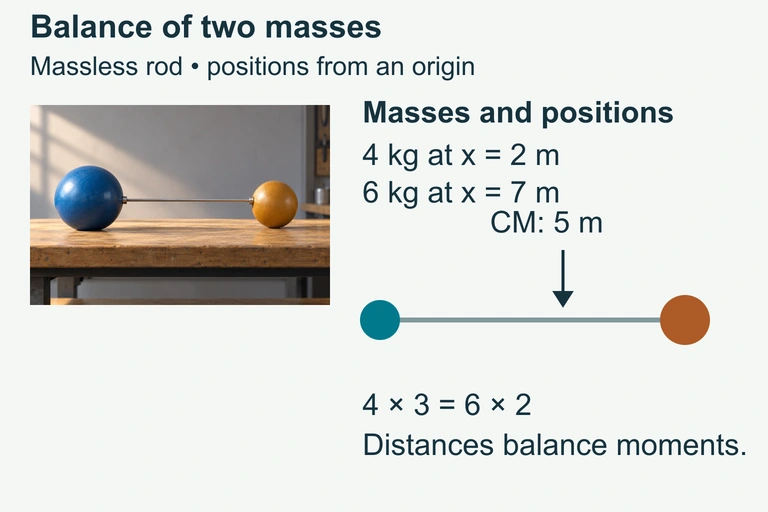
Masses 4 kg at 2 m and 6 kg at 7 m have center of mass at 5 m: 4 × 3 = 6 × 2. The rigid-rod picture is a positional analogy.

Newton's Second Law for Systems

The center of mass of a system accelerates as if all external forces act on a single point particle of total mass \( M \):

1
If \(\vec{F}_{ \text{ext, net}} = 0\): The CM moves at constant velocity (or stays at rest). Total momentum is conserved.
2
If \(\vec{F}_{ \text{ext, net}} \neq 0\): The CM accelerates in the direction of the net external force.

Internal vs External Forces

Internal Forces External Forces
Definition Forces between objects within the system Forces from objects outside the system
Newton's 3rd Law Always cancel in pairs No guaranteed cancellation
Effect on CM None: cannot change \(\vec{v}_{ \text{cm}}\) Can accelerate the CM
Effect on momentum Redistributes among objects Changes total system momentum
Example Forces skaters exert on each other during push-off Gravity, normal force from ground

How to Find the Center of Mass

1
Choose a coordinate system. Pick an origin and axes that simplify calculations (e.g., place one mass at the origin).
2
List each mass and its position. Record \( m_i \), \( x_i \), and \( y_i \) for every object in the system.
3
Compute numerators. For each axis: \( \sum m_i x_i \) and \( \sum m_i y_i \).
4
Divide by total mass. \( x_{\text{cm}} = \frac{\sum m_i x_i}{M} \), \( y_{\text{cm}} = \frac{\sum m_i y_i}{M} \).
5
Verify. The CM should lie between the objects, closer to the heavier mass.

Example 1: Two Masses on a Line

A \(3\,\text{kg}\) ball is at \( x = 2\,\text{m} \) and a \(5\,\text{kg}\) ball is at \( x = 8\,\text{m} \). Find the center of mass.

0 2 4 6 8 10 x (m) 3 kg 5 kg CM = 5.75 m

Example 2: Three Masses in 2D

Find the CM of: \(2\,\text{kg}\) at \((0,0)\), \(3\,\text{kg}\) at \((4,0)\), and \(1\,\text{kg}\) at \((2,3)\).

x y 2 4 3 2 kg (0, 0) 3 kg (4, 0) 1 kg (2, 3) CM

Example 3: Velocity of the CM

A \(4\,\text{kg}\) cart moves right at \(3\,\text{m/s}\) and a \(6\,\text{kg}\) cart moves left at \(2\,\text{m/s}\). What is \( v_{\text{cm}} \)?

4 kg +3 m/s 6 kg -2 m/s
\(v_{\text{cm}} = 0\,\text{m/s}\)

CM in Projectile Motion

When a firework explodes in midair, the pieces fly apart. But the center of mass continues on the original parabolic path as if the explosion never happened (assuming only gravity acts).

CM path (parabola) Explosion! CM still here

Open vs Closed vs Isolated Systems

Open Closed Isolated
Mass exchange Yes No No
Energy exchange Yes Yes No
External forces Yes Yes No
Momentum conserved? Generally no Only if \(\vec{F}_{ \text{ext}}=0\) Always
AP Example Rocket ejecting fuel Two carts on a track with friction Two pucks on frictionless ice

CM of Extended Objects

For uniform symmetric objects, the center of mass is at the geometric center. For composite objects, treat each part as a point mass at its own center.

Uniform Rod
CM at the midpoint: \( x_{\text{cm}} = \frac{L}{2} \)
Uniform Disk
CM at the geometric center of the circle
Composite Shape
Break into simpler parts, find each part's CM, then combine

Common Mistakes

Averaging positions
Taking the simple average \( \frac{x_1 + x_2}{2} \) instead of the mass-weighted average. This only works when masses are equal.
Forgetting signs
Velocities and positions can be negative. Always assign a positive direction first and keep signs consistent.
Including internal forces
When applying \( F = Ma_{\text{cm}} \), students include internal forces. Only external forces affect the CM.

Question 1 of 5

A \(2\,\text{kg}\) mass is at \( x = 0 \) and a \(6\,\text{kg}\) mass is at \( x = 8\,\text{m} \). Where is the center of mass?

Question 2 of 5

Two ice skaters push off each other on frictionless ice. The system's center of mass will:

Question 3 of 5

A \(3\,\text{kg}\) object moves right at \( 4\,\text{m/s} \) and a \(1\,\text{kg}\) object moves left at \( 4\,\text{m/s} \). What is \( v_{\text{cm}} \)?

Question 4 of 5

A projectile explodes into three fragments at the top of its arc. In the absence of air resistance, the center of mass of the fragments will:

Question 5 of 5

Three masses lie along the x-axis: \(1\,\text{kg}\) at \( x = 0 \), \(2\,\text{kg}\) at \( x = 3\,\text{m} \), and \(3\,\text{kg}\) at \( x = 6\,\text{m} \). What is \( x_{\text{cm}} \)?