01 / 21

Spring Forces
Hooke's Law & Elastic Energy

Master how springs store energy and exert forces using Hooke's Law, the spring constant, and elastic potential energy.

AP Physics 1

What Is a Spring Force?

A spring force is a contact force exerted by a compressed or stretched spring on an object attached to it. This force always acts to restore the spring to its natural (equilibrium) length, which is why it is called a restoring force.

m Equilibrium stretch \( F_s \) (restoring)

Key Vocabulary

Equilibrium Length
The natural, unstretched length of the spring when no external force is applied.
Displacement \( x \)
How far the spring is stretched or compressed from its equilibrium position.
Spring Constant \( k \)
A measure of stiffness: units of \( \text{N/m} \). A larger \( k \) means a stiffer spring.

Why Do Springs Matter in Physics?

Springs are everywhere: car suspensions, trampolines, atomic bonds, and even the vibrations of molecules. Understanding spring forces lets you analyze oscillatory motion, energy storage, and mechanical systems across all of physics.

Energy Storage
Springs convert kinetic energy to elastic potential energy and back.
Simple Harmonic Motion
Mass-spring systems are the foundation of oscillation and wave physics.
Engineering
Shock absorbers, scales, and clocks all rely on precise spring behavior.

Hooke's Law: The Core Equation

$$ F_s = -kx $$

1
\( F_s \) is the spring force (in Newtons, \( \text{N} \)).
2
\( k \) is the spring constant (in \( \text{N/m} \)): measures stiffness.
3
\( x \) is the displacement from equilibrium (in meters).
4
The negative sign means the force opposes the displacement: it is a restoring force.

Additional worked example

The following is a separate example from the long-form lesson. Its values may differ from the example already on this slide.

A 0.40 kg block is hung from a vertical spring whose spring constant is k = 80 N/m. The spring is initially at its natural length. The block is gently lowered until it reaches a new static equilibrium position. Determine (a) the extension of the spring at equilibrium and (b) the elastic potential energy stored in the spring at this position.

Show answer and explanation

Step 1 — Draw a Free-Body Diagram: At the new equilibrium, the block is at rest, so the net force is zero. Two forces act on the block: the gravitational force Fg = mg downward and the spring force Fₛ = kx upward. Setting the coordinate axis positive upward, the equilibrium condition is ΣF = 0 → kx − mg = 0. Step 2 — Solve for Extension x: From the equilibrium condition: kx = mg, so x = mg/k. Substituting: x = (0.40 kg)(9.8 m/s²) / (80 N/m) = 3.92 / 80. x = 0.049 m = 4.9 cm Step 3 — Calculate Elastic Potential Energy: Using Uₛ = ½kx²: Uₛ = ½(80 N/m)(0.049 m)² = ½(80)(0.002401) = 0.0960 J. Uₛ ≈ 0.096 J Step 4 — Verify Reasonableness: The extension is about 5 cm for a moderately stiff spring supporting a light block—this is physically reasonable. The stored energy (≈ 0.1 J) is modest, which makes sense given the small displacement. We can also check units: (N/m)(m²) = N·m = J ✓. Note that the loss in gravitational PE of the block (mgh = 0.40 × 9.8 × 0.049 ≈ 0.192 J) is twice the elastic PE—the remaining 0.096 J would have been converted to kinetic energy and then dissipated if the block were simply released, but because it was "gently lowered," an external agent absorbed that extra energy.
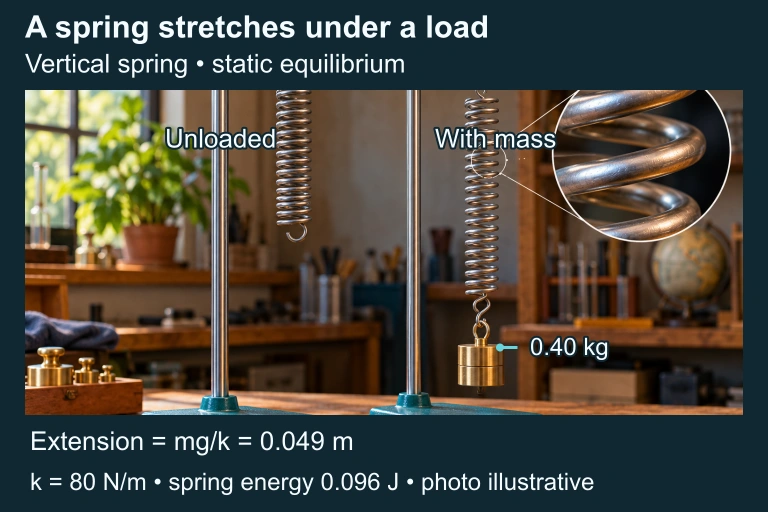
AP Physics 1: gently lowering a 0.40 kg mass on an 80 N/m spring produces equilibrium extension 0.049 m and stored energy 0.096 J. The Physics C incline companion is a separate 2 kg model, also requiring extension.

Visualizing Hooke's Law

\(x\) \(|F_s|\) 0 \( \text{slope} = k \) stiff (large k) soft (small k) Area = Energy stored

Elastic Potential Energy

$$ U_s = \frac{1}{2}kx^2 $$

When you stretch or compress a spring by a displacement \( x \), you do work on the spring. That work is stored as elastic potential energy \( U_s \). This energy can be recovered as kinetic energy when the spring is released.

Quadratic
Energy scales with \( x^2 \): doubling the stretch quadruples the energy.
Always Positive
Whether compressed or stretched, \( U_s \geq 0 \) since \( x^2 \geq 0 \).

Compression vs. Stretch

m compressed \( F_s \) eq. m stretched \( F_s \) eq. \( x < 0 \): Force is positive (+) \( x > 0 \): Force is negative (−) Force always opposes \( x \)

Springs in Series vs. Parallel

Series Parallel
Arrangement End to end Side by side
Effective \( k \) \( \frac{1}{k_{\text{eff}}} = \frac{1}{k_1} + \frac{1}{k_2} \) \( k_{\text{eff}} = k_1 + k_2 \)
Result Softer (smaller \( k \)) Stiffer (larger \( k \))
Force sharing Same force, different \( x \) Same \( x \), forces add

How to Apply Hooke's Law

1
Identify the equilibrium position. This is where the spring has its natural length and no net force acts.
2
Define a coordinate system. Choose positive direction and measure displacement \( x \) from equilibrium.
3
Apply \( F_s = -kx \). Plug in the spring constant \( k \) and the displacement \( x \). The sign tells you the force direction.
4
For energy problems, use \( U_s = \frac{1}{2}kx^2 \). Remember to account for other energy forms (kinetic, gravitational) if present.
5
Check units. \( k \) in \( \text{N/m} \), \( x \) in \( \text{m} \) gives \( F \) in \( \text{N} \) and \( U \) in \( \text{J} \).

Example 1: Finding Spring Force

A spring with \( k = 200 \; \text{N/m} \) is stretched \( 0.15 \; \text{m} \) from its equilibrium position. What is the magnitude and direction of the spring force?

1
Given: \( k = 200 \; \text{N/m} \), \( x = +0.15 \; \text{m} \) (stretched).
2
Apply Hooke's Law: \( F_s = -kx = -(200)(0.15) = -30 \; \text{N} \).
3
Interpret: The negative sign means the force is opposite to the stretch direction. Magnitude: \( 30 \; \text{N} \).

Example 2: Elastic Potential Energy

A toy gun uses a spring with \( k = 800 \; \text{N/m} \) compressed by \( 0.05 \; \text{m} \). How much energy is stored? If the dart has mass \( m = 0.010 \; \text{kg} \), what is its launch speed?

1
Energy stored: \( U_s = \frac{1}{2}kx^2 = \frac{1}{2}(800)(0.05)^2 = 1.0 \; \text{J} \).
2
Conservation of energy: \( U_s = \frac{1}{2}mv^2 \), so \( v = \sqrt{\frac{2U_s}{m}} \).
3
Calculate: \( v = \sqrt{\frac{2(1.0)}{0.010}} = \sqrt{200} \approx 14.1 \; \text{m/s} \).

Example 3: Finding \( k \) from Data

A 4.0 kg block hangs from a vertical spring and stretches it by \( 0.20 \; \text{m} \) at rest. What is the spring constant?

4 kg \( mg \) \( F_s \) 0.20 m

Energy in a Spring System

x Energy 0 -A +A \( U_s = \frac{1}{2}kx^2 \) \( K = \frac{1}{2}mv^2 \) E total

Common Mistakes

✕ Dropping the Negative Sign
Writing \( F = kx \) instead of \( F = -kx \). The negative sign is essential: it tells you the force direction.
✕ Confusing \( x \) with Length
Using the total spring length instead of the displacement from equilibrium. Always use \( x = L - L_0 \).
✕ Wrong Energy Formula
Using \( U = kx \) instead of \( U = \frac{1}{2}kx^2 \). Don't forget the \( \frac{1}{2} \) and the square.

Summary: Spring Force Formulas

Quantity Formula Units
Spring Force \( F_s = -kx \) \( \text{N} \)
Elastic PE \( U_s = \frac{1}{2}kx^2 \) \( \text{J} \)
Spring Constant \( k = \frac{F}{x} \) \( \text{N/m} \)
Period (mass-spring) \( T = 2\pi\sqrt{\frac{m}{k}} \) \( \text{s} \)
Series springs \( \frac{1}{k_\text{eff}} = \frac{1}{k_1} + \frac{1}{k_2} \) \( \text{N/m} \)
Parallel springs \( k_\text{eff} = k_1 + k_2 \) \( \text{N/m} \)

Question 1 of 5

A spring with \( k = 400 \; \text{N/m} \) is compressed by 0.10 m. What is the magnitude of the spring force?

Question 2 of 5

A spring is stretched by 0.20 m and stores 6.0 J of elastic potential energy. What is the spring constant?

Question 3 of 5

A spring is stretched to twice its original displacement. By what factor does the elastic potential energy change?

Question 4 of 5

Two springs, each with \( k = 100 \; \text{N/m} \), are connected in parallel. What is the effective spring constant?

Question 5 of 5

A block on a frictionless surface is attached to a spring (\( k = 500 \; \text{N/m} \)) compressed by 0.08 m and released. What is the block's maximum speed if \( m = 2.0 \; \text{kg} \)?