01 / 20

Rotational
Kinetic Energy

Explore the energy stored in spinning objects, from the formula \( K_r = \tfrac{1}{2}I\omega^2 \) to real-world applications in flywheels, wheels, and planets.

AP Physics 1

What Is Rotational Kinetic Energy?

Every object that spins possesses kinetic energy due to its rotation, even if its center of mass is stationary. This energy depends on how fast the object spins and how its mass is distributed around the axis.

The Two Key Quantities

Moment of Inertia \( I \)
Measures how mass is distributed relative to the rotation axis. Units: \( \text{kg} \cdot \text{m}^2 \). Larger \( I \) means harder to spin up.
Angular Velocity \( \omega \)
How fast the object rotates. Units: \( \text{rad/s} \). Doubling \( \omega \) quadruples the energy because \( \omega \) is squared.

Why Rotational KE Matters

Many everyday systems store significant energy in rotation. Ignoring rotational kinetic energy leads to incorrect predictions about how objects accelerate, how far they roll, or how much work is done on them.

Rolling Objects
A ball rolling downhill converts potential energy into both translational and rotational KE.
Flywheels
Store energy as rotational KE for later use: industrial machines, hybrid vehicles.
Planetary Spin
Earth's rotational KE is about \( 2.6 \times 10^{29} \) J: enough to power civilization for millennia.

Power entering and leaving a flywheel
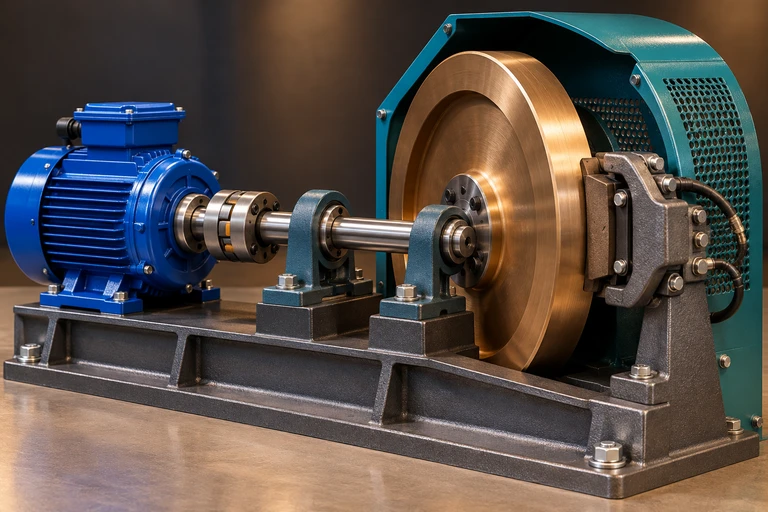
A blue motor drives a gold flywheel through a continuous horizontal shaft with two bearings. A fixed brake caliper contacts the wheel rim inside a partial protective guard.A flywheel stores kinetic energy as it rotates. Net torque changes that energy through rotational work, while drive and load torques can transfer power even at steady speed.

Power transfer at steady speed
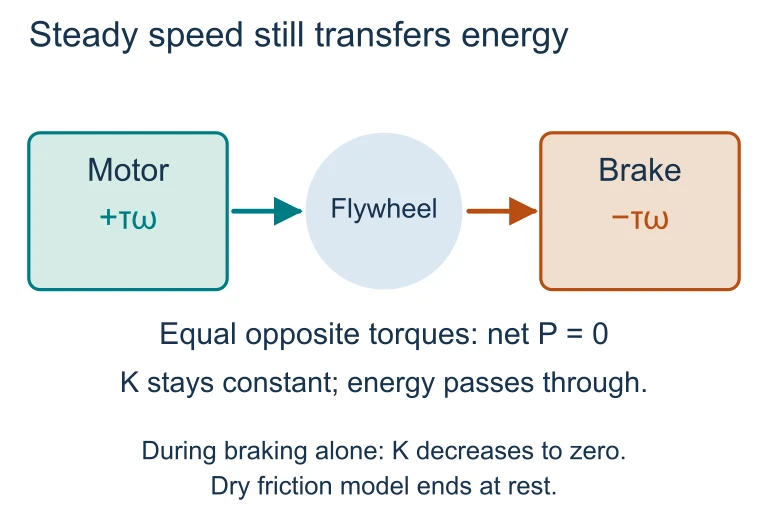
Power transfer at steady speed. Equal drive and brake torques keep angular speed and kinetic energy constant while energy flows through the flywheel. With only a dry-friction brake acting, kinetic energy decreases until the flywheel stops.Equal drive and brake torques keep angular speed and kinetic energy constant while energy flows through the flywheel. With only a dry-friction brake acting, kinetic energy decreases until the flywheel stops.

The Core Formula

$$ K_{\text{rot}} = \frac{1}{2} I \omega^2 $$
\( K_{\text{rot}} \)
Rotational kinetic energy (Joules)
\( I \)
Moment of inertia (\( \text{kg} \cdot \text{m}^2 \))
\( \omega \)
Angular velocity (\( \text{rad/s} \))

Visualizing a Spinning Disk

\( R \)
mass \( M \)
\( \omega \)
axis Solid Disk:
\( I = \tfrac{1}{2}MR^2 \)
Energy:
\( K = \tfrac{1}{4}MR^2\omega^2 \)
\( R \to 2R \implies K \to 4K \)

Common Moments of Inertia

Shape Moment of Inertia Example
Solid sphere \( \tfrac{2}{5}MR^2 \) Bowling ball
Hollow sphere \( \tfrac{2}{3}MR^2 \) Basketball
Solid disk/cylinder \( \tfrac{1}{2}MR^2 \) Wheel
Thin hoop/ring \( MR^2 \) Bicycle tire
Thin rod (center) \( \tfrac{1}{12}ML^2 \) Baton

Translational vs Rotational

Concept Translational Rotational
Inertia Mass \( m \) Moment of inertia \( I \)
Velocity Linear \( v \) Angular \( \omega \)
Kinetic Energy \( \tfrac{1}{2}mv^2 \) \( \tfrac{1}{2}I\omega^2 \)
Momentum \( p = mv \) \( L = I\omega \)
Force / Torque \( F = ma \) \( \tau = I\alpha \)

Rolling: Two Kinds of KE

\( h \)
start
\( \omega \)
\( v \)
$$ Mgh = \frac{1}{2}Mv^2 + \frac{1}{2}I\omega^2 $$

Additional worked example

The following is a separate example from the long-form lesson. Its values may differ from the example already on this slide.

A solid sphere of mass 2.0 kg and radius 0.10 m starts from rest at the top of a ramp of height 3.0 m. It rolls without slipping to the bottom. Using conservation of energy, find the translational speed of the sphere at the bottom and the fraction of total kinetic energy that is rotational.

Show answer and explanation

Step 1 — Identify Known Quantities: Mass M = 2.0 kg, radius R = 0.10 m, height h = 3.0 m, initial speed v₀ = 0. The sphere is solid, so I = ⅖MR². Rolling without slipping gives v = Rω. Step 2 — Write the Energy Conservation Equation: Taking the bottom of the ramp as the reference level: Mgh = ½Mv² + ½Iω². Substitute I = ⅖MR² and ω = v/R: Mgh = ½Mv² + ½(⅖MR²)(v/R)² = ½Mv² + ⅕Mv² Step 3 — Simplify and Solve for v: Mgh = ½Mv² + ⅕Mv² = (7/10)Mv². Cancel M: gh = (7/10)v². Solve: v² = 10gh/7. v = √(10 × 9.8 × 3.0 / 7) = √(42.0) ≈ 6.48 m/s Step 4 — Find the Rotational Fraction: K_rot = ⅕Mv² and K_total = (7/10)Mv². The fraction is K_rot / K_total = (⅕Mv²) / (7/10 Mv²) = (1/5) / (7/10) = 2/7 ≈ 0.286. About 28.6% of the total kinetic energy is rotational. Step 5 — Check the Result: If the sphere were sliding (no rotation), v would be √(2gh) = √(58.8) ≈ 7.67 m/s. The rolling sphere is slower (6.48 m/s) because some gravitational PE is diverted into rotational KE. The 2/7 fraction is geometry-dependent and does not depend on M, R, or h—only on the shape of the object.
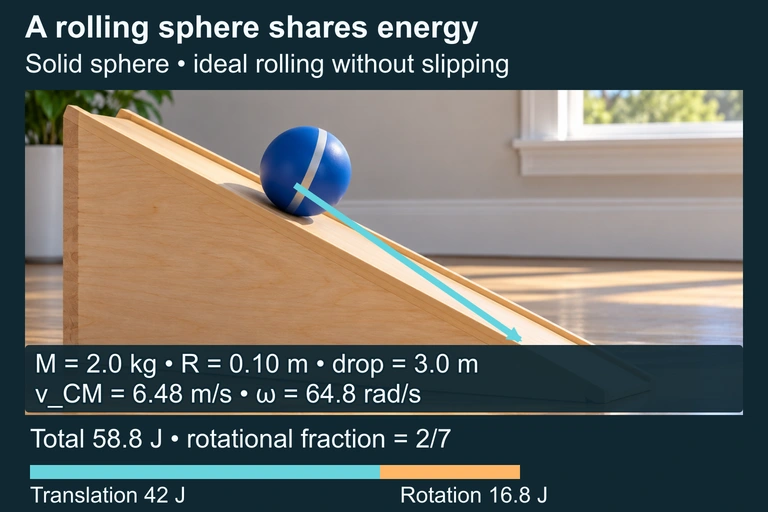
AP Physics 1 solid sphere: M = 2.0 kg, R = 0.10 m and vertical drop 3.0 m. Ideal rolling gives v_CM = 6.48 m/s, ω = 64.8 rad/s, 42 J translation and 16.8 J rotation, totaling 58.8 J. The rotational fraction is 2/7.

How to Solve Problems

1
Identify the object's shape and look up its moment of inertia formula from the table.
2
Convert units: ensure \( \omega \) is in rad/s (not rpm). Use \( \omega = \frac{2\pi \cdot \text{rpm}}{60} \).
3
Compute \( I \) from mass and radius (or length), then plug into \( K = \tfrac{1}{2}I\omega^2 \).
4
For rolling objects, add translational KE: \( K_{\text{total}} = \tfrac{1}{2}mv^2 + \tfrac{1}{2}I\omega^2 \), using \( v = R\omega \).
5
Check units: the answer should be in Joules (\( \text{kg} \cdot \text{m}^2/\text{s}^2 \)).

Example 1: Spinning Wheel

A solid disk of mass \( M = 4 \text{ kg} \) and radius \( R = 0.3 \text{ m} \) spins at \( \omega = 10 \text{ rad/s} \). Find its rotational kinetic energy.

1
Moment of inertia for a solid disk: \( I = \tfrac{1}{2}MR^2 = \tfrac{1}{2}(4)(0.3)^2 = 0.18 \text{ kg}\cdot\text{m}^2 \)
2
Apply the formula: \( K = \tfrac{1}{2}I\omega^2 = \tfrac{1}{2}(0.18)(10)^2 = 9 \text{ J} \)

Example 2: RPM Conversion

A thin hoop of mass \( M = 2 \text{ kg} \) and radius \( R = 0.5 \text{ m} \) spins at 120 rpm. Find its rotational KE.

1
Convert rpm to rad/s: \( \omega = \frac{2\pi(120)}{60} = 4\pi \approx 12.57 \text{ rad/s} \)
2
Hoop: \( I = MR^2 = (2)(0.5)^2 = 0.5 \text{ kg}\cdot\text{m}^2 \)
3
Compute: \( K = \tfrac{1}{2}(0.5)(4\pi)^2 = \tfrac{1}{2}(0.5)(16\pi^2) = 4\pi^2 \approx 39.5 \text{ J} \)

Example 3: Rolling Down a Hill

A solid sphere of mass \( M = 3 \text{ kg} \) and radius \( R = 0.1 \text{ m} \) rolls from rest down a \( h = 2 \text{ m} \) incline. Find its speed at the bottom.

1
Energy conservation: \( Mgh = \tfrac{1}{2}Mv^2 + \tfrac{1}{2}I\omega^2 \). For a solid sphere, \( I = \tfrac{2}{5}MR^2 \).
2
Rolling condition: \( \omega = v/R \). Substituting: \( Mgh = \tfrac{1}{2}Mv^2 + \tfrac{1}{2}\!\cdot\!\tfrac{2}{5}MR^2 \!\cdot\! \tfrac{v^2}{R^2} = \tfrac{1}{2}Mv^2 + \tfrac{1}{5}Mv^2 = \tfrac{7}{10}Mv^2 \)
3
Solve: \( v = \sqrt{\tfrac{10gh}{7}} = \sqrt{\tfrac{10(9.8)(2)}{7}} \approx 5.29 \text{ m/s} \)

Total KE for Rolling Objects

29% 71% Solid Sphere 33% 67% Solid Disk 40% 60% Hollow Sphere 50% 50% Hoop Rotational KE Translational KE

A tactile rolling race with visible mass distribution
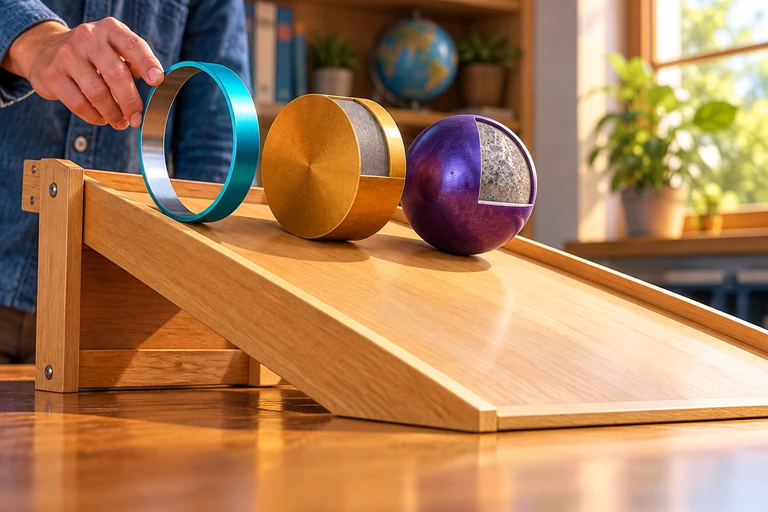
A tabletop ramp with a hoop, disk and sphere, the latter two showing conceptual exposed interiors.At the same center-of-mass height loss, each rolling body has the same total kinetic energy per unit mass. Its rotational inertia determines how that energy divides between translation and rotation.

How rolling energy is divided
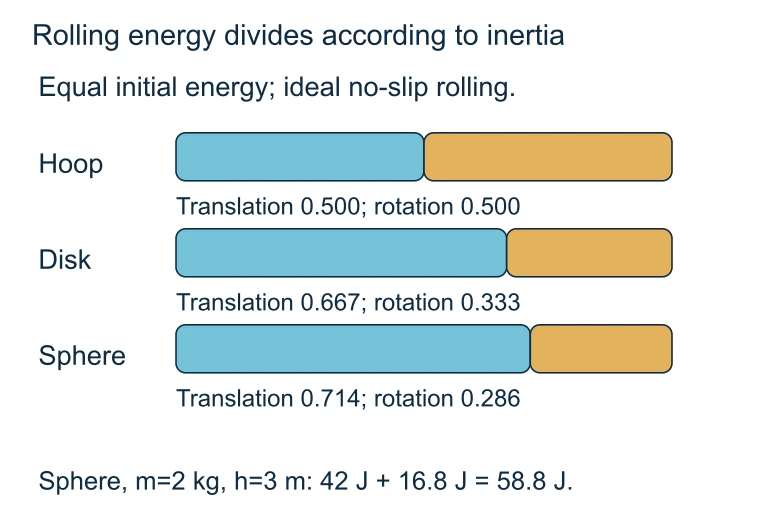
How rolling energy is divided. After the same center-of-mass height loss, the hoop stores half its kinetic energy in rotation, the disk one-third and the solid sphere two-sevenths. For a 2 kg sphere dropping 3 m with g = 9.8 m/s², the parts are 42 J and 16.8 J.After the same center-of-mass height loss, the hoop stores half its kinetic energy in rotation, the disk one-third and the solid sphere two-sevenths. For a 2 kg sphere dropping 3 m with g = 9.8 m/s², the parts are 42 J and 16.8 J.

Common Mistakes

✕ Using rpm Instead of rad/s
The formula requires \( \omega \) in rad/s. Always convert: \( \omega = \frac{2\pi \cdot \text{rpm}}{60} \).
✕ Forgetting Rotational KE
For rolling objects, only using \( \tfrac{1}{2}mv^2 \) ignores the rotational portion and overestimates the speed.
✕ Wrong Moment of Inertia
Using the solid disk formula for a hoop, or vice versa. Always check the shape before selecting \( I \).

Question 1 of 5

A solid disk has moment of inertia \( I = 0.4 \text{ kg}\cdot\text{m}^2 \) and spins at \( \omega = 5 \text{ rad/s} \). What is its rotational kinetic energy?

Question 2 of 5

If the angular velocity of a spinning object is doubled, its rotational kinetic energy:

Question 3 of 5

A hoop and a solid disk have the same mass and radius. Which has the greater moment of inertia?

Question 4 of 5

A flywheel spins at 300 rpm. What is its angular velocity in rad/s?

Question 5 of 5

A solid sphere rolls without slipping down a ramp of height \( h \). Its speed at the bottom is \( v = \sqrt{\tfrac{10gh}{7}} \). What fraction of its total kinetic energy at the bottom is rotational?