01 / 21

Rotational
Kinematics

Explore the physics of spinning objects: angular displacement, velocity, acceleration, and the equations that connect them.

AP Physics 1

What is Rotational Motion?

When an object spins around a fixed axis, every point on that object traces a circular arc. Instead of measuring distance and speed in meters, we use angles and angular rates to describe the motion.

axis \(r\) P O \(\theta\)

The Three Angular Variables

\(\theta\) : Displacement
The angle swept by a rotating object, measured in radians. One full revolution = \(2\pi\) rad.
\(\omega\) : Angular Velocity
Rate of change of angle: \(\omega = \frac{d\theta}{dt}\). Units: \(\text{rad/s}\).
\(\alpha\) : Angular Acceleration
Rate of change of angular velocity: \(\alpha = \frac{d\omega}{dt}\). Units: \(\text{rad/s}^2\).

Why Radians Matter

A radian is defined so that the arc length equals the radius times the angle: \(s = r\theta\). This natural relationship makes every rotational equation clean: no extra conversion factors.

\(r\) \(s = r\) 1 rad Key Link \(s = r\theta\)

Rotational Kinematic Equations

For constant angular acceleration \(\alpha\), three core equations govern the motion, directly paralleling the linear kinematic equations:

1
\(\omega = \omega_0 + \alpha t\)
2
\(\theta = \omega_0 t + \tfrac{1}{2}\alpha t^2\)
3
\(\omega^2 = \omega_0^2 + 2\alpha\theta\)

Additional worked example

The following is a separate example from the long-form lesson. Its values may differ from the example already on this slide.

A bicycle wheel of radius 0.35 m starts from rest and accelerates uniformly at α = 4.0 rad/s² for 6.0 s. Determine (a) the final angular velocity, (b) the total angular displacement in radians and revolutions, and (c) the tangential speed of a point on the rim at t = 6.0 s.

Show answer and explanation

Step 1 — Identify Given Values: ω₀ = 0 (starts from rest), α = 4.0 rad/s², t = 6.0 s, r = 0.35 m. We need ω, θ, and v at t = 6.0 s. Step 2 — Find Final Angular Velocity (Part a): Apply ω = ω₀ + αt. Substituting: ω = 0 + (4.0 rad/s²)(6.0 s). ω = 24 rad/s Step 3 — Find Angular Displacement (Part b): Apply θ = ω₀t + ½αt². Substituting: θ = 0 + ½(4.0)(6.0)² = ½(4.0)(36) = 72 rad. To convert to revolutions, divide by 2π: 72/(2π) ≈ 11.5 rev. θ = 72 rad ≈ 11.5 rev Step 4 — Find Tangential Speed of Rim Point (Part c): Use the bridge equation v = rω. Substituting: v = (0.35 m)(24 rad/s). v = 8.4 m/s Step 5 — Verify & Reflect: Cross-check with the time-independent equation: ω² = ω₀² + 2αθ → 24² = 0 + 2(4.0)(72) → 576 = 576 ✓. The rim speed of 8.4 m/s (about 19 mph) is reasonable for a bicycle wheel accelerating over 6 seconds. Note that a point halfway between the hub and the rim would have only half the tangential speed (4.2 m/s) despite sharing the same ω.
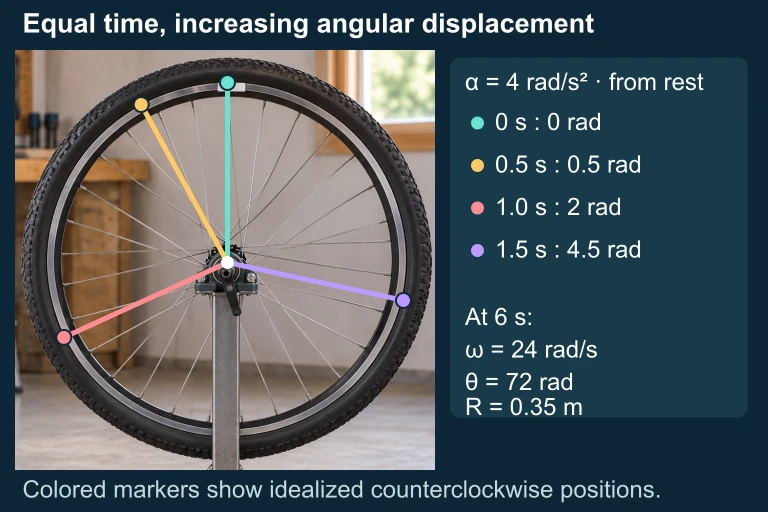
AP Physics 1: a wheel starts from rest with α = 4 rad/s². At times 0, 0.5, 1.0 and 1.5 s, its angles are 0, 0.5, 2.0 and 4.5 rad. The selected centrifuge graph uses a separate AP Physics C time scale and model.

Choosing the Right Equation

Each equation connects four of the five variables. Identify which variable is missing from the problem, then pick the equation that omits it:

Which variable is missing? Missing \(\theta\) \(\omega = \omega_0 + \alpha t\) Missing \(\omega\) \(\theta = \omega_0 t + \tfrac{1}{2}\alpha t^2\) Missing \(t\) \(\omega^2 = \omega_0^2 + 2\alpha\theta\) Five Variables \(\theta\) \(\omega\) \(\omega_0\) \(\alpha\) \(t\)

Linear vs Rotational Analogs

Linear Rotational
Displacement \(x\) \(\theta\)
Velocity \(v\) \(\omega\)
Acceleration \(a\) \(\alpha\)
Equation 1 \(v = v_0 + at\) \(\omega = \omega_0 + \alpha t\)
Equation 2 \(x = v_0 t + \tfrac{1}{2}at^2\) \(\theta = \omega_0 t + \tfrac{1}{2}\alpha t^2\)
Equation 3 \(v^2 = v_0^2 + 2ax\) \(\omega^2 = \omega_0^2 + 2\alpha\theta\)

The Bridge Between Worlds

For a point at radius \(r\) from the axis of rotation, the tangential (linear) quantities link to angular quantities through \(r\):

Arc Length
\(s = r\theta\)
Tangential Velocity
\(v_t = r\omega\)
Tangential Acceleration
\(a_t = r\alpha\)

A tactile rolling race with visible mass distribution
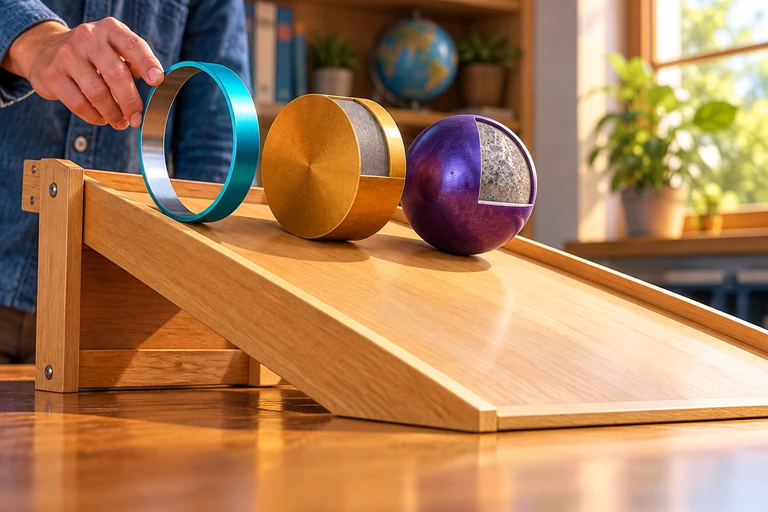
A tabletop ramp with a hoop, disk and sphere, the latter two showing conceptual exposed interiors.For bodies rolling without slipping from the same initial center-of-mass height, mass distribution determines acceleration and the partition of kinetic energy. Equal elapsed time and equal height loss are separate comparisons.

Velocities around a rolling wheel
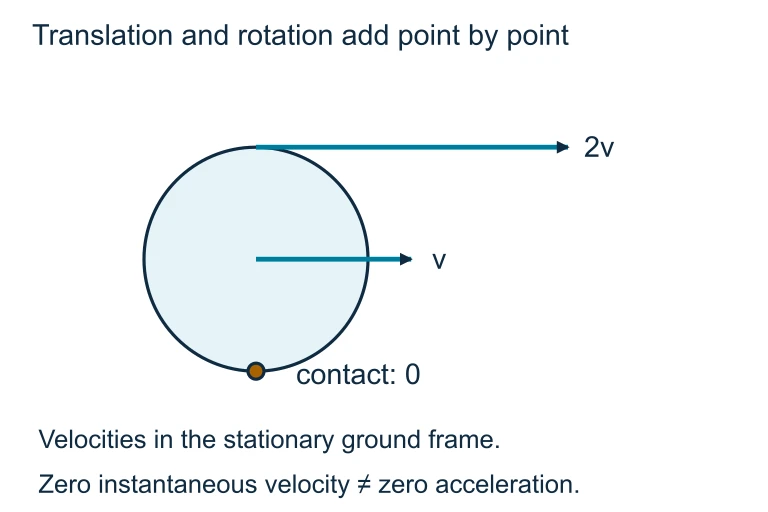
Velocities around a rolling wheel. In the stationary ground frame, translation and rotation combine to give zero velocity at the contact point, v at the center and 2v at the top. Zero instantaneous velocity does not imply zero acceleration.In the stationary ground frame, translation and rotation combine to give zero velocity at the contact point, v at the center and 2v at the top. Zero instantaneous velocity does not imply zero acceleration.

How to Solve a Problem

1
Identify the axis of rotation and confirm \(\alpha\) is constant.
2
List known values: \(\omega_0\), \(\omega\), \(\alpha\), \(\theta\), and \(t\). Convert all angles to radians.
3
Identify the unknown and the missing (unused) variable.
4
Choose the equation that omits the missing variable.
5
Solve algebraically, then check: does the sign make physical sense?

Example 1: Spinning Wheel

A wheel starts from rest and accelerates at \(\alpha = 4.0\;\text{rad/s}^2\) for \(t = 5.0\;\text{s}\). Find the final angular velocity and total angle swept.

1
Knowns: \(\omega_0 = 0\), \(\alpha = 4.0\;\text{rad/s}^2\), \(t = 5.0\;\text{s}\)
2
Find \(\omega\): \(\omega = \omega_0 + \alpha t = 0 + (4.0)(5.0) = \) \(20\;\text{rad/s}\)
3
Find \(\theta\): \(\theta = \omega_0 t + \tfrac{1}{2}\alpha t^2 = 0 + \tfrac{1}{2}(4.0)(5.0)^2 = \) \(50\;\text{rad}\)

Example 2: Braking Fan

A fan blade spins at \(\omega_0 = 30\;\text{rad/s}\) and decelerates to \(\omega = 10\;\text{rad/s}\) over \(\theta = 200\;\text{rad}\). Find the angular acceleration.

1
Missing variable: \(t\) is not given, so use equation 3.
2
Apply: \(\omega^2 = \omega_0^2 + 2\alpha\theta\)
3
Substitute: \(10^2 = 30^2 + 2\alpha(200)\) → \(100 = 900 + 400\alpha\)
4
Solve: \(\alpha = \frac{100 - 900}{400} = \) \(-2.0\;\text{rad/s}^2\)

Example 3: Tangential Speed

A merry-go-round of radius \(r = 3.0\;\text{m}\) rotates at \(\omega = 2.0\;\text{rad/s}\). Find the tangential speed and centripetal acceleration of a child sitting on the edge.

1
Tangential speed: \(v_t = r\omega = (3.0)(2.0) = \) \(6.0\;\text{m/s}\)
2
Centripetal acceleration: \(a_c = \omega^2 r = (2.0)^2(3.0) = \) \(12\;\text{m/s}^2\)

Period and Frequency

Period \(T\)
Time for one complete revolution. \(T = \frac{2\pi}{\omega}\). Units: seconds (\(\text{s}\)).
Frequency \(f\)
Revolutions per second. \(f = \frac{1}{T} = \frac{\omega}{2\pi}\). Units: Hertz (\(\text{Hz}\)).

Interpreting \(\omega\) vs \(t\) Graphs

\(t\) (\(\text{s}\)) \(\omega\) (\(\text{rad/s}\)) 0 10 20 2 4 6 \(\alpha > 0\) \(\alpha = 0\) \(\alpha < 0\) area = \(\theta\)
Slope
The slope of an \(\omega\)-\(t\) graph gives the angular acceleration \(\alpha\).
Area
The area under the curve gives the angular displacement \(\theta\).

Common Mistakes

✕ Using Degrees
Plugging degrees into kinematic equations instead of converting to radians first. All rotational formulas require radians.
✕ Confusing \(\omega\) and \(v\)
Using tangential speed \(v_t\) where angular velocity \(\omega\) is needed, or vice versa. Remember: \(v_t = r\omega\).
✕ Ignoring Signs
Forgetting that deceleration means negative \(\alpha\) when the object rotates in the positive (CCW) direction.

Summary of Key Relationships

Relationship Equation When to Use
Final velocity \(\omega = \omega_0 + \alpha t\) Know \(\alpha\) and \(t\)
Displacement \(\theta = \omega_0 t + \tfrac{1}{2}\alpha t^2\) Need \(\theta\), know \(t\)
Time-free \(\omega^2 = \omega_0^2 + 2\alpha\theta\) No \(t\) given
Arc length \(s = r\theta\) Linear-rotational link
Tangential speed \(v_t = r\omega\) Speed at radius \(r\)
Period \(T = 2\pi/\omega\) Time per revolution

Question 1 of 5

A wheel accelerates from rest at \(\alpha = 3.0\;\text{rad/s}^2\) for \(4.0\;\text{s}\). What is its final angular velocity?

Question 2 of 5

A disk has \(\omega_0 = 20\;\text{rad/s}\) and decelerates to rest over \(\theta = 100\;\text{rad}\). What is \(\alpha\)?

Question 3 of 5

A point on a rotating wheel is at radius \(r = 0.50\;\text{m}\). The wheel spins at \(\omega = 10\;\text{rad/s}\). What is the tangential speed of that point?

Question 4 of 5

On an \(\omega\) vs \(t\) graph for a rotating object, the area under the curve represents:

Question 5 of 5

A motor runs at 1200 \(\text{RPM}\). What is its angular velocity in \(\text{rad/s}\)? (Round to the nearest whole number.)