Rotational
Inertia
Understand how mass distribution determines an object's resistance to angular acceleration, and master the key formula \( I = \sum m_i r_i^2 \).
What Is Rotational Inertia?
In linear motion, mass tells you how hard it is to change an object's velocity. In rotational motion, rotational inertia (also called the moment of inertia) tells you how hard it is to change an object's angular velocity.
The symbol is \( I \), measured in \( \text{kg} \cdot \text{m}^2 \). A larger \( I \) means the object is harder to spin up or slow down.
The Rotational Analogy
Newton's second law for linear motion is \( F = ma \). The rotational version replaces every quantity with its rotational counterpart:
Force, mass, acceleration
Torque, inertia, angular accel.
Why Mass Distribution Matters
Two objects with the same total mass can have very different rotational inertias. Moving mass farther from the axis increases \( I \) dramatically because distance is squared in the formula.
The Core Formula
For a system of point masses:
Because \( r \) is squared, doubling the distance from the axis quadruples the contribution to \( I \).
Visualizing \( I = \sum m_i r_i^2 \) for Point Masses
Rotational Inertia of Common Shapes
For continuous objects, the sum becomes an integral. The AP Physics 1 exam provides these formulas, but you should recognize them:
Axis through center
Axis through center
All mass at radius \( R \)
Comparing mass distributions
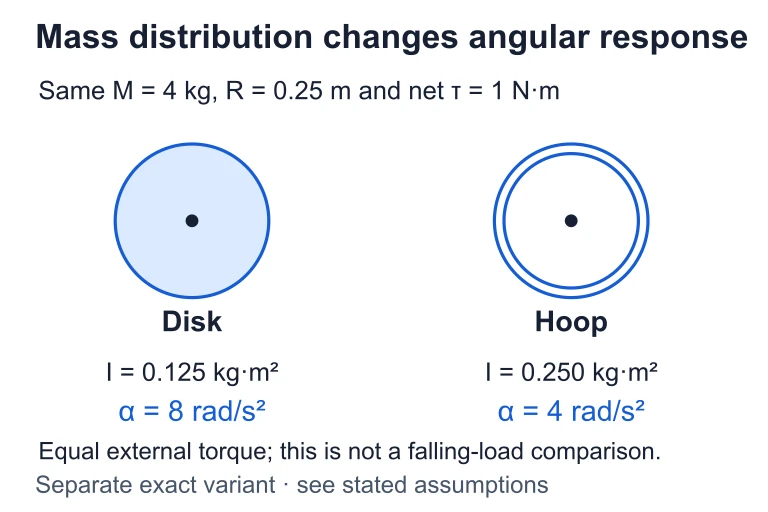
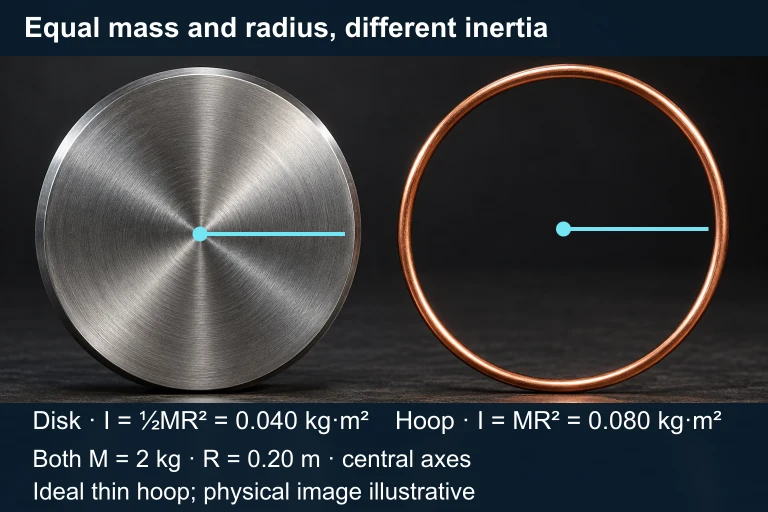
The disk and hoop picture is a separate geometry comparison with equal mass and radius. The pulley question below uses different values.
A massive-pulley example
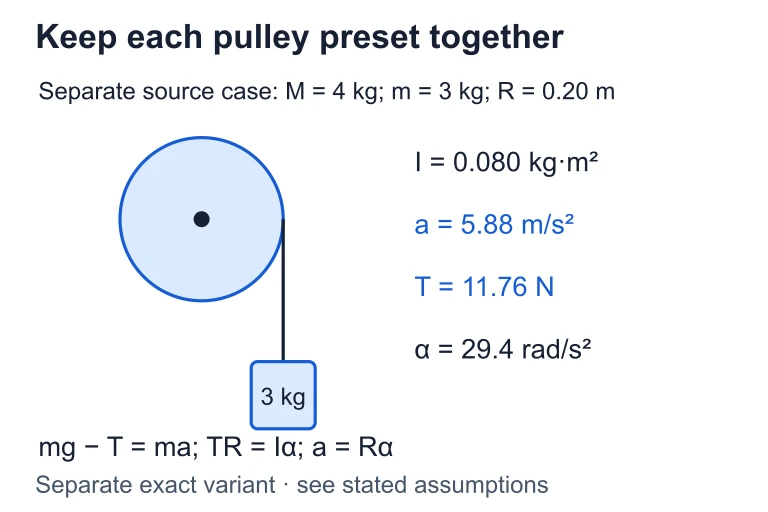
This separate source example applies rotational inertia to a pulley and hanging block.
A solid cylindrical pulley of mass M = 4.0 kg and radius R = 0.20 m is mounted on a frictionless axle. A block of mass m = 3.0 kg hangs from a light string wrapped around the pulley. The system is released from rest. Find: (a) the angular acceleration of the pulley, (b) the linear acceleration of the block, and (c) the tension in the string.
Show answer and explanation
Step 1 — Identify the Rotational Inertia of the Pulley: The pulley is a solid cylinder rotating about its central axis, so I = ½MR² = ½(4.0 kg)(0.20 m)² = 0.080 kg·m². I = 0.080 kg·m² Step 2 — Apply Newton's Second Law to the Block: Taking downward as positive for the block, the forces on it are its weight mg (downward) and the string tension T (upward). Newton's second law gives: mg − T = ma, where a is the linear acceleration of the block. mg − T = ma …(1) Step 3 — Apply Newton's Second Law for Rotation to the Pulley: The only torque on the pulley comes from the tension T acting at radius R. Since the string unwinds, the torque is τ = TR. Applying τₙₑₜ = Iα: TR = Iα. TR = Iα …(2) Step 4 — Relate Linear and Angular Quantities: Because the string does not slip on the pulley, the tangential acceleration of the rim equals the linear acceleration of the block: a = Rα, so α = a/R. α = a / R Step 5 — Solve for the Linear Acceleration: From equation (2): T = Iα/R = I(a/R)/R = Ia/R². Substituting into equation (1): mg − Ia/R² = ma. Solving for a: a = mg / (m + I/R²). Plugging in: a = (3.0)(9.8) / (3.0 + 0.080/0.04) = 29.4 / (3.0 + 2.0) = 29.4 / 5.0 = 5.88 m/s². a ≈ 5.9 m/s² Step 6 — Find the Angular Acceleration: α = a/R = 5.88 / 0.20 = 29.4 rad/s². α ≈ 29 rad/s² Step 7 — Find the Tension in the String: T = Ia/R² = (0.080)(5.88)/(0.04) = 11.76 N. Alternatively, T = m(g − a) = 3.0(9.8 − 5.88) = 3.0(3.92) = 11.76 N. Both methods agree, confirming our result. T ≈ 11.8 N
A pulley with its rotational inertia exposed
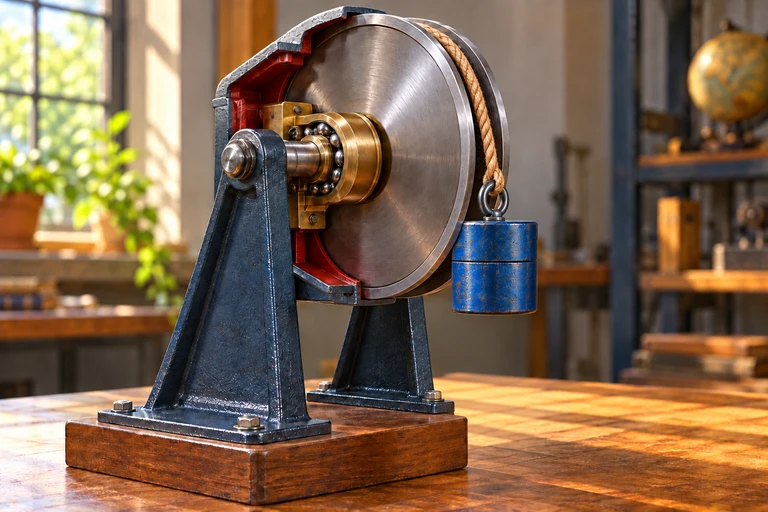
The falling load accelerates while cord tension supplies torque to the pulley. With no slip, the load acceleration and pulley angular acceleration satisfy a = Rα; tension is smaller than the load’s weight.Acceleration with a massive pulley
A 3 kg load drives a 4 kg solid pulley of radius 0.20 m. With I = 0.080 kg·m², the no-slip equations give a = 5.88 m/s², T = 11.76 N and α = 29.4 rad/s².Disk and hoop under equal torque
A 4 kg disk and hoop, each of radius 0.25 m, experience the same 1 N·m net torque. Their inertias are 0.125 and 0.250 kg·m², so their angular accelerations are 8 and 4 rad/s².Mass vs Rotational Inertia
| Mass \( m \) | Rotational Inertia \( I \) | |
|---|---|---|
| What it measures | Resistance to linear acceleration | Resistance to angular acceleration |
| Depends on | Amount of matter only | Amount of matter and its distribution |
| Units | \( \text{kg} \) | \( \text{kg} \cdot \text{m}^2 \) |
| Can change without adding mass? | No | Yes: move mass closer or farther from axis |
| Newton's 2nd Law form | \( F = ma \) | \( \tau = I\alpha \) |
The Axis Changes Everything
The Parallel Axis Theorem
If you know the rotational inertia \( I_\text{cm} \) about the center of mass, you can find \( I \) about any parallel axis at distance \( d \):
How to Solve Rotational Inertia Problems
Example 1: Two Point Masses
Two masses are attached to a light rod and rotate about its center. Mass A = 4 kg at 0.5 m from the axis. Mass B = 2 kg at 1.0 m from the axis. Find \( I \).
Example 2: Hoop vs Disk Rolling Race
A thin hoop and a solid disk have the same mass \( M \) and radius \( R \). Both start from rest and roll down an incline. Which arrives first?
Prefactor: 1
More inertia per mass
Prefactor: 0.5
Less inertia per mass
A tactile rolling race with visible mass distribution
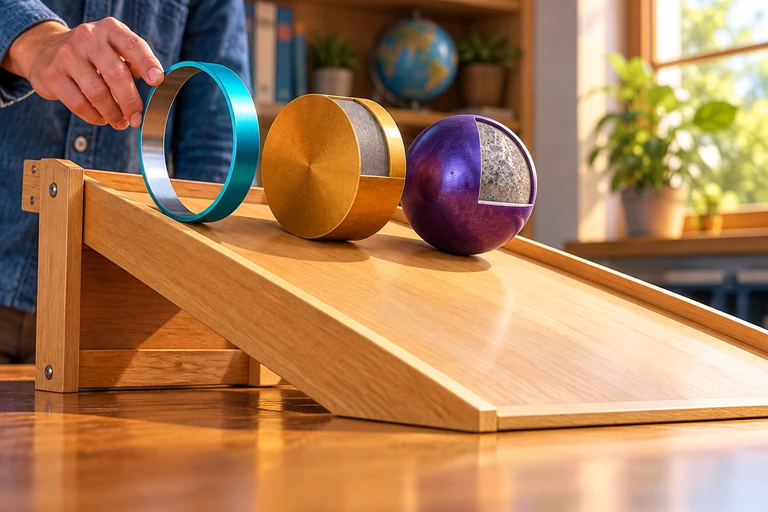
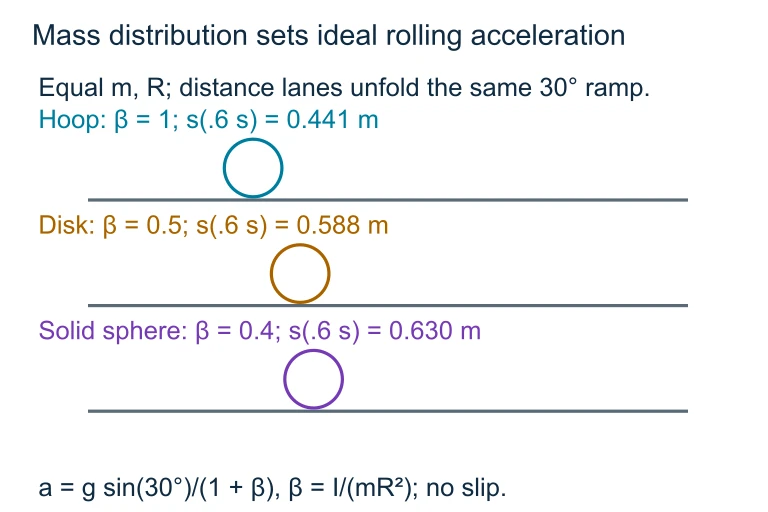
For bodies rolling without slipping from the same initial center-of-mass height, mass distribution determines acceleration and the partition of kinetic energy. Equal elapsed time and equal height loss are separate comparisons.Rolling race at equal elapsed time
Equal-mass, equal-radius bodies start together on a 30° ramp. At 0.6 s, the hoop travels 0.441 m, the disk 0.588 m and the solid sphere 0.630 m, with no slipping.Example 3: Composite System
A solid disk of mass 6 kg and radius 0.4 m has a 2 kg point mass bolted at its rim. Find the total \( I \) about the disk's center axis.
Common Mistakes to Avoid
Summary of Key Formulas
| Shape / Scenario | Rotational Inertia \( I \) | Axis |
|---|---|---|
| Point mass | \( mr^2 \) | Distance \( r \) from mass |
| Thin hoop (ring) | \( MR^2 \) | Through center, perpendicular |
| Solid disk / cylinder | \( \tfrac{1}{2}MR^2 \) | Through center, perpendicular |
| Solid sphere | \( \tfrac{2}{5}MR^2 \) | Through center |
| Thin rod (center) | \( \tfrac{1}{12}ML^2 \) | Through center, perpendicular |
| Thin rod (end) | \( \tfrac{1}{3}ML^2 \) | Through one end, perpendicular |
| Parallel axis theorem | \( I_\text{cm} + Md^2 \) | Any axis parallel to CM axis |
Question 1 of 5
A 3 kg point mass is located 2 m from an axis of rotation. What is its rotational inertia?
Question 2 of 5
Two identical solid disks have the same mass and radius. Disk A spins about its center axis. Disk B spins about an axis at its rim. Which has greater rotational inertia?
Question 3 of 5
A figure skater pulls her arms inward during a spin. Her rotational inertia decreases. If no external torque acts, what happens to her angular velocity?
Question 4 of 5
A thin hoop and a solid sphere of equal mass and radius roll down the same incline from rest. Which reaches the bottom first?
Question 5 of 5
A uniform thin rod of mass \( M = 4\;\text{kg} \) and length \( L = 3\;\text{m} \) rotates about one end. What is its rotational inertia?