Rolling
Without Slipping
Explore the physics of rolling motion, where translational and rotational kinematics unite through a single elegant constraint.
What Is Rolling Motion?
Rolling is a combination of translational motion (the center of mass moves forward) and rotational motion (the object spins about its own axis). A wheel on a road, a bowling ball down a lane, or a cylinder on a ramp: all exhibit rolling.
Two Motions in One
The Rolling Constraint
Why the Contact Point Is at Rest
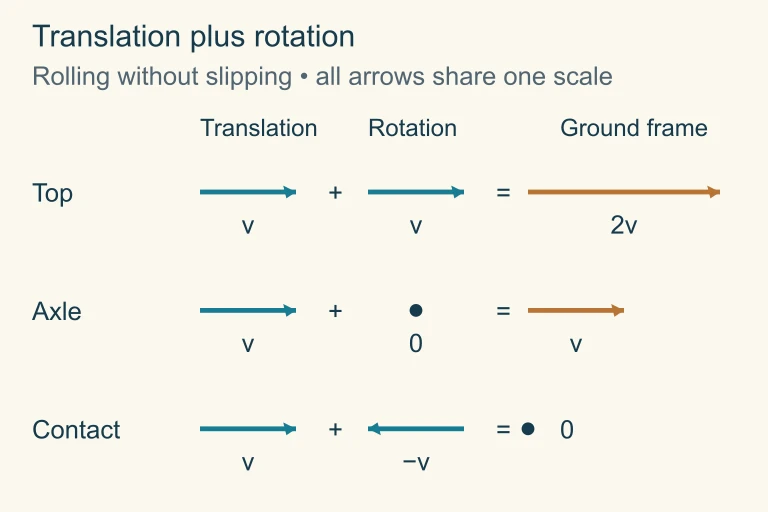
Consider any point on the rim. Its velocity is the sum of two contributions:
Velocity at three points
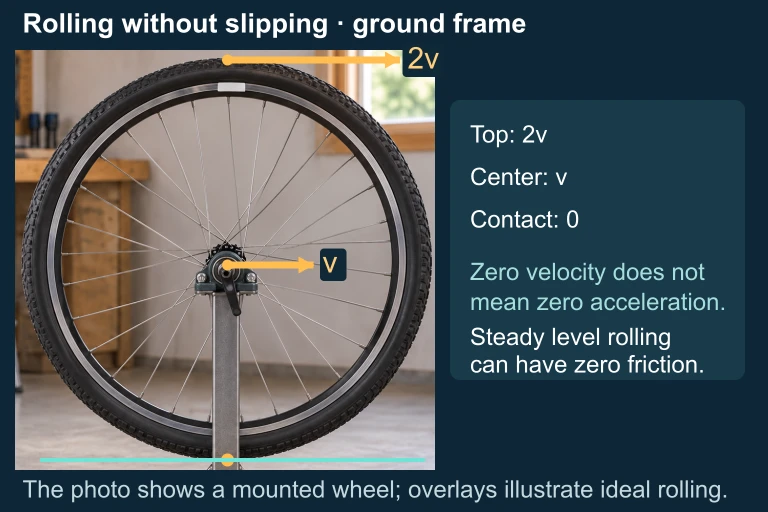
For ideal rolling in the ground frame, translation and rotation add at the top and cancel at the contact point. Both panels are needed for the vector construction; zero contact speed does not mean zero acceleration.
Kinetic Energy of a Rolling Object
The total kinetic energy is the sum of translational KE and rotational KE about the center of mass:
Using \( v_{\text{cm}} = R\omega \), substitute \( \omega = v_{\text{cm}} / R \):
Rolling vs Sliding
| Rolling Without Slipping | Sliding (No Rolling) | |
|---|---|---|
| Constraint | \( v_{\text{cm}} = R\omega \) | \( \omega = 0 \) or uncoupled |
| Contact point | At rest (zero velocity) | Moving (kinetic friction acts) |
| Friction type | Static (no slip) | Kinetic (sliding) |
| Energy lost to friction | None (static friction does no work) | Yes (heat generated) |
| KE expression | \( \frac{1}{2}Mv^2 + \frac{1}{2}I\omega^2 \) | \( \frac{1}{2}Mv^2 \) only |
Common Moments of Inertia
Rolling Down an Incline
The Role of Static Friction
On an incline, static friction provides the torque needed to spin the object. Without it, the object would simply slide.
How to Solve Rolling Problems
Example 1: Solid Sphere on a Ramp
A solid sphere of mass \( 2 \text{ kg} \) and radius \( 0.1 \text{ m} \) rolls without slipping from rest down a ramp of height \( 3 \text{ m} \). Find its speed at the bottom.
Example 2: Race Down an Incline
A solid cylinder, a solid sphere, and a hollow cylinder are released simultaneously from the same height. Which reaches the bottom first?
| Object | \( I_{\text{cm}} / MR^2 \) | \( a_{\text{cm}} \) | Finish Order |
|---|---|---|---|
| Solid Sphere | \( \frac{2}{5} \) | \( \frac{5}{7}g\sin\theta \) | 1st |
| Solid Cylinder | \( \frac{1}{2} \) | \( \frac{2}{3}g\sin\theta \) | 2nd |
| Hollow Cylinder | \( 1 \) | \( \frac{1}{2}g\sin\theta \) | 3rd |
A tactile rolling race with visible mass distribution
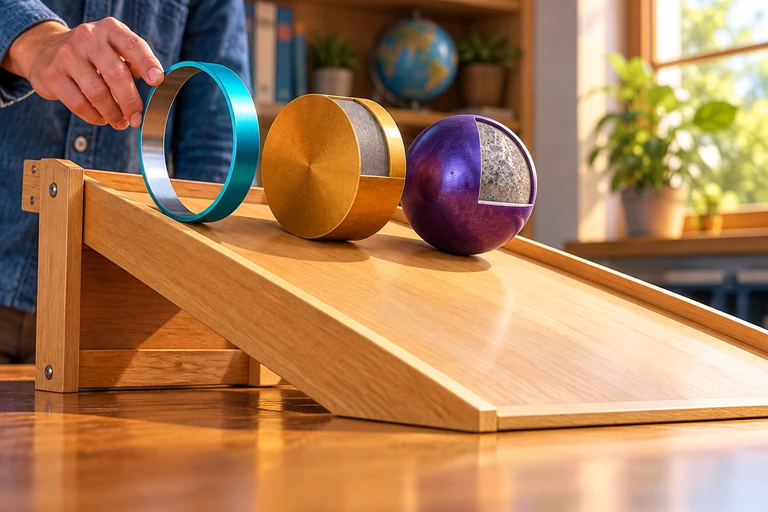 For bodies rolling without slipping from the same initial center-of-mass height, mass distribution determines acceleration and the partition of kinetic energy. Equal elapsed time and equal height loss are separate comparisons.
Rolling race at equal elapsed time
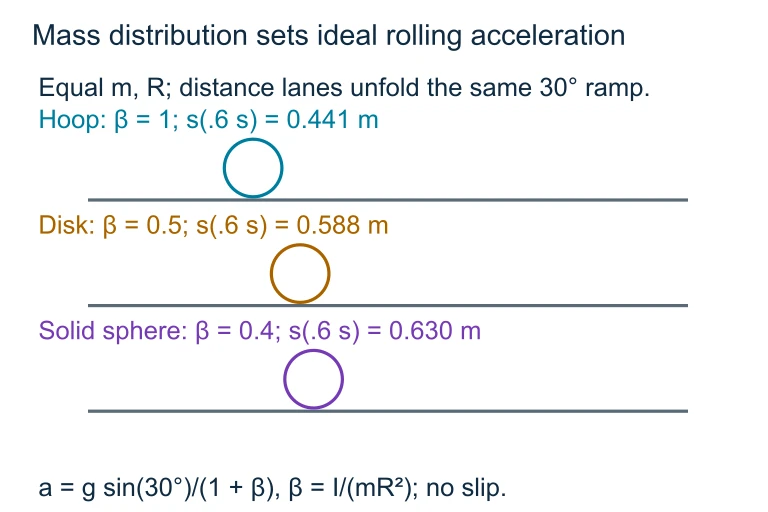 Equal-mass, equal-radius bodies start together on a 30° ramp. At 0.6 s, the hoop travels 0.441 m, the disk 0.588 m and the solid sphere 0.630 m, with no slipping.
Velocities around a rolling wheel
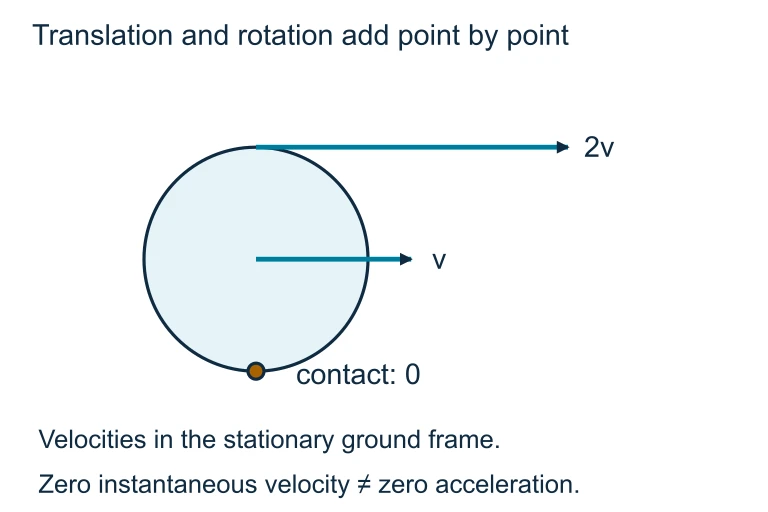 In the stationary ground frame, translation and rotation combine to give zero velocity at the contact point, v at the center and 2v at the top. Zero instantaneous velocity does not imply zero acceleration.
Example 3: Finding Friction Force
A solid cylinder (\( M = 4 \text{ kg} \), \( R = 0.2 \text{ m} \)) rolls without slipping down a \( 30^\circ \) incline. Find the friction force and the acceleration.
Common Mistakes in Rolling
Summary of Rolling Formulas
| Quantity | Formula | Notes |
|---|---|---|
| Rolling constraint | \( v_{\text{cm}} = R\omega \) | Links translation and rotation |
| Total KE | \( \frac{1}{2}Mv^2 + \frac{1}{2}I\omega^2 \) | Both terms always needed |
| Speed from height \( h \) | \( \sqrt{\frac{2gh}{1 + I/(MR^2)}} \) | Energy conservation shortcut |
| Acceleration on incline | \( \frac{g\sin\theta}{1 + I/(MR^2)} \) | Independent of \( M \) and \( R \) |
| Contact point velocity | \( 0 \) | Defines "without slipping" |
| Top point velocity | \( 2v_{\text{cm}} \) | Translation + rotation add |
Question 1 of 5
A wheel rolls without slipping with \( v_{\text{cm}} = 4 \text{ m/s} \). What is the velocity of the contact point with the ground?
Question 2 of 5
A solid sphere and a hollow sphere of equal mass and radius roll down the same incline from rest. Which reaches the bottom first?
Question 3 of 5
A solid cylinder rolls without slipping down a ramp of height \( h = 5 \text{ m} \). What is \( v_{\text{cm}} \) at the bottom? (Use \( g = 10 \text{ m/s}^2 \))
Question 4 of 5
During rolling without slipping on a level surface, what type of friction acts on the object and how much work does it do?
Question 5 of 5
A rolling wheel has \( v_{\text{cm}} = 3 \text{ m/s} \). What is the speed of the topmost point of the wheel relative to the ground?