Representing & Analyzing
Simple Harmonic Motion
Master the equations, graphs, and energy analysis of oscillatory systems: from mass-spring setups to pendulums.
What is Simple Harmonic Motion?
Simple Harmonic Motion (SHM) is a type of periodic oscillation where the restoring force is directly proportional to the displacement from equilibrium and acts in the opposite direction.
Key Quantities in SHM
Visualizing SHM: \( x(t) \) Graph
The Core Equations of SHM
Period of a Mass-Spring System
Period of a Simple Pendulum
Mass-Spring vs Pendulum
| Mass-Spring | Pendulum | |
|---|---|---|
| Period formula | \( T = 2\pi\sqrt{m/k} \) | \( T = 2\pi\sqrt{L/g} \) |
| Depends on mass? | Yes | No |
| Depends on amplitude? | No | No (small angles) |
| Restoring force | \( F = -kx \) | \( F \approx -\frac{mg}{L}x \) |
| Valid when | Ideal spring (Hooke's law) | Small angle (\( \theta < 15^\circ \)) |
Energy in Simple Harmonic Motion
Velocity at Any Position
From energy conservation, we can derive the velocity at any displacement \( x \):
How to Analyze SHM Problems
Example 1: Finding Period and Frequency
A 0.50 kg block is attached to a spring with \( k = 200 \) N/m. Find the period, frequency, and angular frequency.
Example 2: Speed at a Given Position
The same block (\( m = 0.50 \text{ kg} \), \( k = 200 \text{ N/m} \)) is pulled 0.10 m from equilibrium and released. What is its speed when \( x = 0.06 \text{ m} \)?
Example 3: Writing the Position Equation
A pendulum of length \( L = 1.0 \text{ m} \) swings with a small amplitude of 0.05 m. At \( t = 0 \), the bob is at \( x = 0 \) and moving in the positive direction. Write \( x(t) \).
Graphs of \( x \), \( v \), and \( a \)
A rotating peg whose shadow becomes an oscillator
 One coordinate of a peg in uniform circular motion varies sinusoidally. The spring cart provides a second oscillator model in which acceleration points toward equilibrium.
A rotating peg whose shadow becomes an oscillator
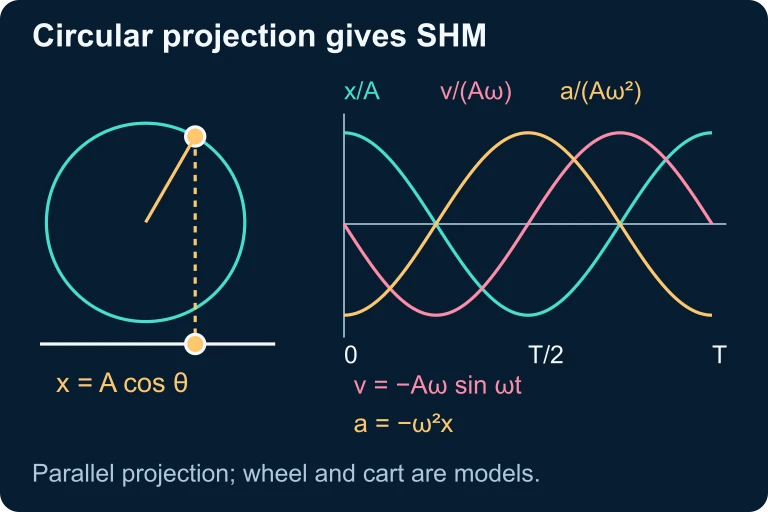 One coordinate of a peg in uniform circular motion varies sinusoidally. The spring cart provides a second oscillator model in which acceleration points toward equilibrium.
Common Mistakes in SHM
Summary of Key SHM Formulas
| Quantity | Formula | Units |
|---|---|---|
| Position | \( x = A\cos(\omega t + \phi) \) | m |
| Velocity | \( v = -A\omega\sin(\omega t + \phi) \) | m/s |
| Acceleration | \( a = -\omega^2 x \) | \( \text{m/s}^2 \) |
| Period (spring) | \( T = 2\pi\sqrt{m/k} \) | s |
| Period (pendulum) | \( T = 2\pi\sqrt{L/g} \) | s |
| Total energy | \( E = \frac{1}{2}kA^2 \) | J |
| Speed at position | \( v = \omega\sqrt{A^2 - x^2} \) | m/s |
Question 1 of 5
A mass on a spring oscillates with \( A = 0.20 \text{ m} \) and \( T = 0.50 \text{ s} \). What is the maximum speed of the mass?
Question 2 of 5
If you double the mass on a spring (keeping \( k \) constant), the period will:
Question 3 of 5
In SHM, at what displacement does the kinetic energy equal the potential energy?
Question 4 of 5
A simple pendulum has \( T = 2.0 \text{ s} \) on Earth. If taken to a planet where \( g = 4.9 \text{ m/s}^2 \), its new period is:
Question 5 of 5
A block on a spring has \( A = 0.12 \text{ m} \) and \( \omega = 10 \text{ rad/s} \). What is its maximum acceleration?