Reference Frames &
Relative Motion
Understand how different observers describe the same motion differently, and master the velocity addition equation for AP Physics 1.
What Is a Reference Frame?
A reference frame (or frame of reference) is a coordinate system attached to a particular observer. It defines where "at rest" is and how positions, velocities, and accelerations are measured.
Why Reference Frames Matter
Inertial vs Non-Inertial Frames
Not all reference frames behave the same way. The distinction matters because Newton's laws only work directly in inertial frames.
What Is Relative Motion?
Relative motion is the calculation of the motion of an object as observed from a particular reference frame. The velocity of an object depends on which frame you measure it from.
The Velocity Addition Equation
Read the subscripts as: the velocity of A relative to C equals the velocity of A relative to B plus the velocity of B relative to C.
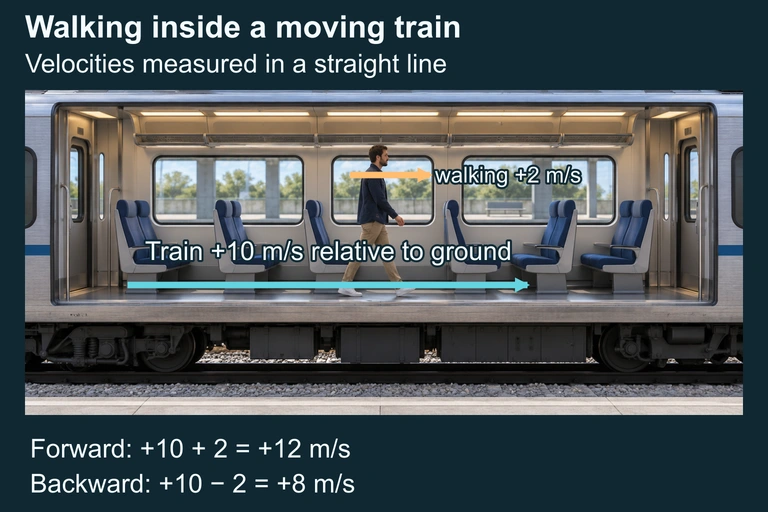
Walking on a train
This separate illustration applies the velocity chain to both walking directions. Use the sign of the walking velocity relative to the train before adding the train velocity relative to the ground.
The Subscript Chain Rule
1D vs 2D Relative Velocity
| 1D (Same/Opposite Line) | 2D (Perpendicular/Angled) | |
|---|---|---|
| Equation | \(v_{AC} = v_{AB} + v_{BC}\) | \(\vec{v}_{AC} = \vec{v}_{AB} + \vec{v}_{BC}\) |
| Operation | Scalar addition (with signs) | Vector addition (components or tip-to-tail) |
| Magnitude | Simple sum or difference | Use Pythagorean theorem if perpendicular |
| Example | Two cars on a highway | Boat crossing a river with current |
Flipping Subscripts
If you know the velocity of A relative to B, the velocity of B relative to A is the same magnitude but opposite direction. This lets you rearrange any problem to get the subscript chain you need.
How to Solve Relative Motion Problems
Example 1: Same Direction
A person walks at \(2\;\text{m/s}\) toward the front of a train that moves at \(30\;\text{m/s}\) east relative to the ground. What is the person's velocity relative to the ground?
Example 2: Opposite Direction
Car A travels east at \(25\;\text{m/s}\) and car B travels west at \(20\;\text{m/s}\), both relative to the ground. What is the velocity of A relative to B?
Example 3: River Crossing (2D)
A boat aims straight across a river at \(4\;\text{m/s}\) (relative to the water). The current flows downstream at \(3\;\text{m/s}\) relative to the ground. Find the boat's speed relative to the ground.
One boat, two velocity frames
 Boat velocity relative to water and current velocity relative to the ground add as vectors to give the boat’s ground velocity.
Shortest-time river crossing
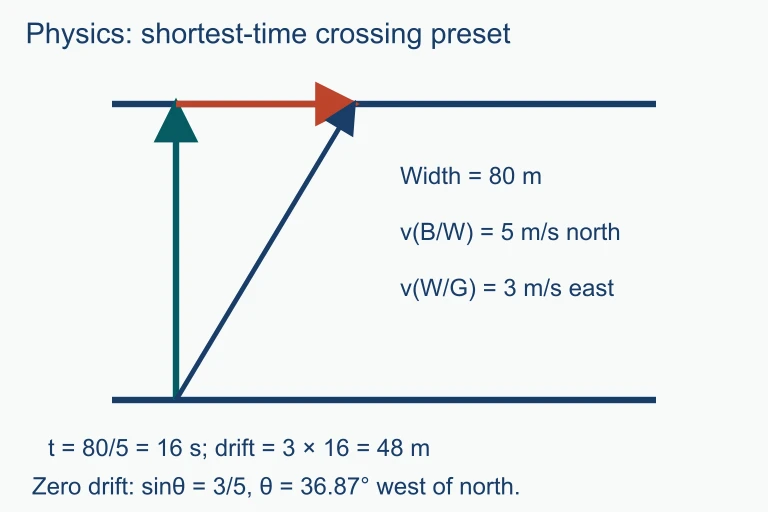 Across an 80 m river, a boat aimed north at 5 m/s relative to the water takes 16 s. A 3 m/s eastward current produces 48 m downstream drift; a zero-drift heading is 36.87° west of north.
Finding the Direction in 2D
From the river example, the boat's resultant velocity is \(5\;\text{m/s}\). To find the angle the boat drifts from its intended path, use trigonometry:
The boat actually travels at \(36.9^\circ\) downstream from perpendicular. The faster the current relative to the boat's speed, the larger the drift angle.
Common Mistakes
Summary of Key Ideas
| Concept | Key Formula / Rule | Remember |
|---|---|---|
| Velocity addition | \(\vec{v}_{AC} = \vec{v}_{AB} + \vec{v}_{BC}\) | Inner subscripts cancel |
| Flipping subscripts | \(\vec{v}_{AB} = -\vec{v}_{BA}\) | Same magnitude, opposite direction |
| 1D problems | Use + / − for directions | Define positive direction first |
| 2D problems | \(|\vec{v}| = \sqrt{v_x^2 + v_y^2}\) | Use components or tip-to-tail |
| Direction (2D) | \(\theta = \tan^{-1}(v_y / v_x)\) | Measure from reference axis |
Question 1 of 5
A passenger walks at \(1.5\;\text{m/s}\) toward the back of a train moving at \(20\;\text{m/s}\) east relative to the ground. What is the passenger's velocity relative to the ground?
Question 2 of 5
Car X moves at \(30\;\text{m/s}\) north and Car Y moves at \(20\;\text{m/s}\) south, both relative to the ground. What is the velocity of X relative to Y?
Question 3 of 5
A swimmer crosses a river at \(2\;\text{m/s}\) relative to the water, aiming straight across. The current is \(1.5\;\text{m/s}\). What is the swimmer's speed relative to the ground?
Question 4 of 5
If \(\vec{v}_{AB} = +12\;\text{m/s}\), what is \(\vec{v}_{BA}\)?
Question 5 of 5
An airplane flies at \(200\;\text{km/h}\) north relative to the air. A crosswind blows at \(50\;\text{km/h}\) east. What is the approximate direction of the airplane's velocity relative to the ground?