Understanding
Pressure
Explore how force distributed over area defines pressure, and master the equation \( P = \frac{F}{A} \) for AP Physics 1.
What Is Pressure?
Pressure is a scalar quantity that describes how a force is spread over a surface. When the same force acts on a smaller area, the pressure increases. When it acts on a larger area, the pressure decreases.
Pressure in Everyday Life
Why Does Pressure Matter?
Pressure connects mechanics to fluids, gases, and thermodynamics. In AP Physics 1, you will use it to analyze fluids at rest (hydrostatics), atmospheric phenomena, and force distributions on surfaces.
The Core Equation: \( P = \frac{F}{A} \)
Units of Pressure
The SI unit of pressure is the pascal (Pa). One pascal equals one newton per square metre: \( 1 \text{ Pa} = 1 \frac{\text{N}}{\text{m}^2} \).
| Unit | Symbol | Equivalent |
|---|---|---|
| Pascal | Pa | \( 1 \;\text{N/m}^2 \) |
| Kilopascal | kPa | \( 10^3 \) Pa |
| Atmosphere | atm | \( 1.013 \times 10^5 \) Pa |
| mmHg (Torr) | mmHg | \( 133.3 \) Pa |
| psi | \(\text{lbf/in}^2\) | \( 6895 \) Pa |
Pressure vs. Force: Key Distinction
| Property | Pressure | Force |
|---|---|---|
| Type | Scalar | Vector |
| SI Unit | Pa (\(\text{N/m}^2\)) | N (newton) |
| Depends on area? | Yes | No |
| Direction? | Acts equally in all directions (fluids) | Acts in a specific direction |
| Equation | \( P = F/A \) | \( F = ma \) |
How to Solve Pressure Problems
Example 1: Book on a Table
Example 2: Comparing Two Blocks
Example 3: Finding Required Area
A machine exerts a force of 800 N on the ground. The ground can withstand a maximum pressure of 4000 Pa. What is the minimum base area needed?
Atmospheric and Gauge Pressure
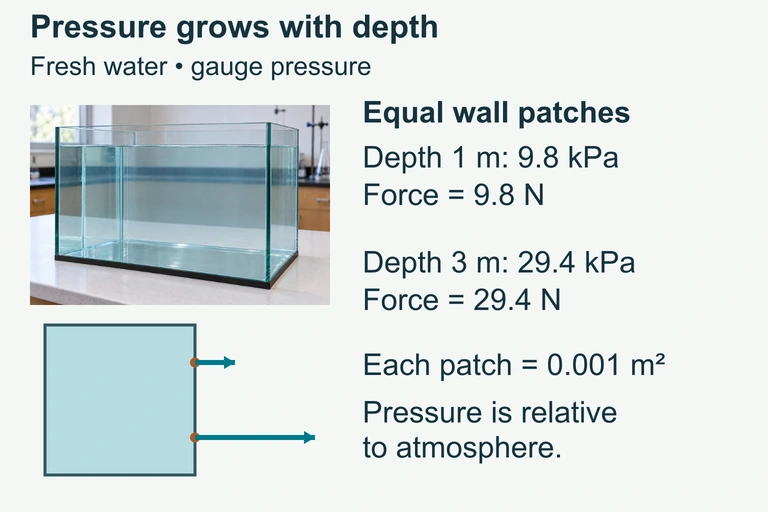
Pressure in Fluids: Depth Matters
Pressure at two depths
This separate fresh-water illustration compares gauge pressure and the normal forces on equal-area patches. Gauge pressure is measured relative to the outside atmosphere.
Pascal's Principle
A change in pressure applied to an enclosed, incompressible fluid is transmitted equally to every part of the fluid and to the walls of the container.
Hydraulic force advantage trades displacement for force
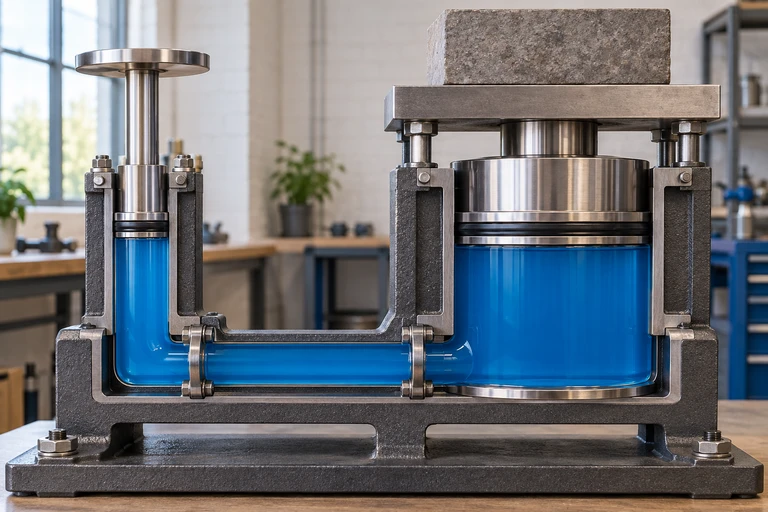 An ideal hydraulic system transmits the same pressure change to both pistons. A larger output area increases force while reducing displacement, preserving displaced volume and work.
An ideal hydraulic force advantage preserves volume and work rather than multiplying energy.
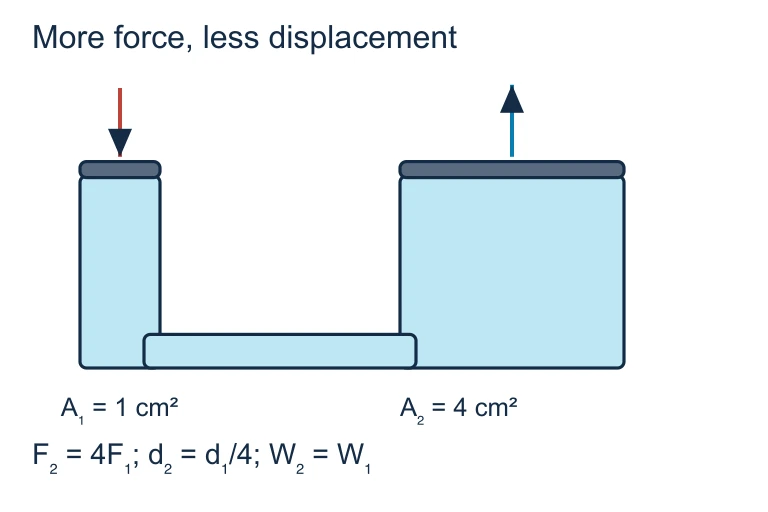 An ideal hydraulic system transmits the same pressure change to both pistons. A larger output area increases force while reducing displacement, preserving displaced volume and work.
Common Mistakes
Summary of Key Concepts
| Concept | Equation | Key Idea |
|---|---|---|
| Pressure | \( P = F/A \) | Force per unit area |
| Hydrostatic | \( P = P_0 + \rho g h \) | Pressure increases with depth |
| Pascal's Principle | \( F_1/A_1 = F_2/A_2 \) | Pressure transmitted equally |
| Gauge vs. Absolute | \( P_{\text{abs}} = P_{\text{gauge}} + P_{\text{atm}} \) | Gauge is relative to atmosphere |
| Unit | \( 1 \text{ Pa} = 1 \text{ N/m}^2 \) | Always use SI for AP |
Question 1 of 5
A 60 N force is applied uniformly over an area of 0.02 \(\text{m}^2\). What is the pressure?
Question 2 of 5
Two identical bricks are placed on a table. Brick X lies flat and Brick Y stands on its smallest face. Which exerts more pressure on the table?
Question 3 of 5
A swimming pool is 3 \(\text{m}\) deep. Taking \( \rho_{\text{water}} = 1000 \text{ kg/m}^3 \) and \( g = 9.8 \text{ m/s}^2 \), what is the gauge pressure at the bottom?
Question 4 of 5
In a hydraulic lift, the small piston has area \( A_1 = 0.01 \text{ m}^2 \) and the large piston has area \( A_2 = 0.05 \text{ m}^2 \). If a 200 N force is applied to the small piston, what force is exerted by the large piston?
Question 5 of 5
A box weighing 200 N rests on a ramp inclined at \( 30^\circ \) to the horizontal. The base of the box in contact with the ramp has area \( 0.10 \text{ m}^2 \). What pressure does the box exert on the ramp?