Power
The Rate of Doing Work
Understand how power quantifies the rate at which energy is transferred or work is done, and learn to apply \( P = \frac{W}{t} \) across real-world scenarios.
What is Power?
Power is the rate at which work is done or energy is transferred. Two machines can do the same total work, but the one that does it faster has greater power.
Why Power Matters
Work tells you how much energy is transferred. Power tells you how quickly. This distinction is critical in engineering, biology, and everyday life.
Power as Energy Transfer Rate
The Power Equation
Since work equals energy transferred, power also equals energy change per unit time: \( P = \frac{\Delta E}{t} \). This applies to any form of energy: kinetic, potential, thermal, or electrical.
Alternative Form: \( P = Fv \)
When force is parallel to velocity (\( \theta = 0^\circ \)), this simplifies to \( P = Fv \). This form is especially useful for objects moving at constant velocity.
Additional worked example
The following is a separate example from the long-form lesson. Its values may differ from the example already on this slide.
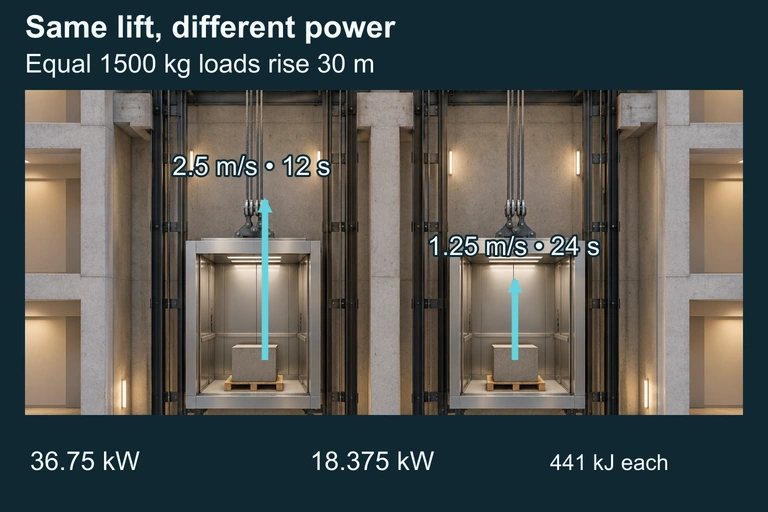
An elevator of mass 1200 kg carries passengers with a combined mass of 300 kg. The elevator motor lifts the system at a constant velocity of 2.5 m/s. Determine the power output of the motor. Then calculate the total energy the motor delivers over a 12-second ride.
Show answer and explanation
Step 1 — Identify Given Values: Total mass: m = 1200 kg + 300 kg = 1500 kg. Constant velocity: v = 2.5 m/s (upward). Acceleration due to gravity: g = 9.8 m/s². Time of ride: Δt = 12 s. Because the elevator moves at constant velocity, the net force is zero, so the motor's upward tension force equals the total weight. m = 1500 kg, v = 2.5 m/s, g = 9.8 m/s², Δt = 12 s Step 2 — Calculate the Required Force: At constant velocity, the applied force must balance gravity: F = mg = 1500 kg × 9.8 m/s² = 14,700 N. This is the tension in the cable (assuming no friction or cable mass). F = 14,700 N Step 3 — Apply P = Fv: Since the force and velocity are both directed upward (θ = 0°, cos 0° = 1): P = Fv = 14,700 N × 2.5 m/s = 36,750 W. P = 36,750 W ≈ 36.8 kW Step 4 — Calculate Total Energy Delivered: Rearranging P = W/Δt gives W = P × Δt = 36,750 W × 12 s = 441,000 J. This equals the gravitational potential energy gained: ΔPE = mgh = 1500 × 9.8 × (2.5 × 12) = 1500 × 9.8 × 30 = 441,000 J. ✓ The energy balance confirms our result. W = 441,000 J = 441 kJ Step 5 — Verify Units and Reasonableness: Unit check: [kg][m/s²][m/s] = kg·m²/s³ = W ✓. A 36.8 kW motor is roughly 49 hp, which is reasonable for a commercial elevator. The 441 kJ of energy delivered equals the gravitational potential energy gained over a 30-meter rise, consistent with a 12-story building.
Visualizing \( P = Fv \)
Power vs. Work vs. Energy
| Property | Power | Work | Energy |
|---|---|---|---|
| What it measures | Rate of energy transfer | Amount of energy transferred | Capacity to do work |
| Equation | \( P = W/t \) | \( W = Fd\cos\theta \) | \( KE = \tfrac{1}{2}mv^2 \) |
| SI Unit | Watt (W) | Joule (J) | Joule (J) |
| Scalar/Vector | Scalar | Scalar | Scalar |
Average vs. Instantaneous Power
How to Solve Power Problems
Example 1: Lifting a Box
Example 2: Car at Constant Speed
Example 3: Accelerating Object
A \( 1{,}200 \;\text{kg} \) car accelerates from rest to \( 30 \;\text{m/s} \) in \( 8 \;\text{s} \). Find the average power delivered by the engine (ignore friction).
Units of Power
| Unit | Symbol | Equivalent |
|---|---|---|
| Watt | W | \( 1 \;\text{J/s} \) |
| Kilowatt | kW | \( 1{,}000 \;\text{W} \) |
| Horsepower | hp | \( 746 \;\text{W} \) |
| Kilowatt-hour | kWh | \( 3.6 \times 10^6 \;\text{J} \) (energy, not power) |
Common Mistakes
Quick Reference Summary
| Formula | When to Use | Key Variables |
|---|---|---|
| \( P = \frac{W}{t} \) | Total work and time known | \( W \) in J, \( t \) in s |
| \( P = \frac{\Delta E}{t} \) | Energy change and time known | Any \( \Delta E \) (KE, PE, etc.) |
| \( P = Fv\cos\theta \) | Force and velocity known at an instant | \( F \) in N, \( v \) in m/s |
| \( P = Fv \) | Force parallel to velocity | Simplified case (\( \theta = 0 \)) |
Question 1 of 5
A motor does \( 6{,}000 \;\text{J} \) of work in \( 30 \;\text{s} \). What is the power output of the motor?
Question 2 of 5
A \( 60 \;\text{kg} \) student runs up a \( 5 \;\text{m} \) tall staircase in \( 4 \;\text{s} \). What is the student's average power output against gravity? (Use \( g = 10 \;\text{m/s}^2 \).)
Question 3 of 5
A truck engine exerts a force of \( 4{,}000 \;\text{N} \) on a trailer while moving at a constant \( 15 \;\text{m/s} \). What is the engine's power output?
Question 4 of 5
Two cranes lift identical \( 500 \;\text{kg} \) loads to the same height. Crane A takes \( 10 \;\text{s} \) and Crane B takes \( 20 \;\text{s} \). Which statement is correct?
Question 5 of 5
A \( 900 \;\text{kg} \) car accelerates from rest to \( 20 \;\text{m/s} \) in \( 10 \;\text{s} \). What is the average power delivered by the engine? (Ignore friction.)