01 / 21

Potential
Energy

Explore stored energy due to position and configuration: from gravitational heights to elastic springs, and learn to apply \( U_g = mgh \) and \( U_s = \frac{1}{2}kx^2 \) with confidence.

AP Physics 1

What Is Potential Energy?

Potential energy is stored energy associated with the position or configuration of an object within a force field. Unlike kinetic energy, it depends not on how fast something moves but on where it is or how it is arranged.

Two Main Types

Gravitational PE
Energy stored due to an object's height above a reference point in a gravitational field: \( U_g = mgh \)
Elastic PE
Energy stored in a deformed elastic object like a spring: \( U_s = \tfrac{1}{2}kx^2 \)

Why Potential Energy Matters

Potential energy is central to the conservation of energy principle. In any isolated system, the total mechanical energy \( E = K + U \) stays constant. This lets us solve problems without knowing the forces at every instant: we simply track energy at two points.

\(m\)
\(h\)
Large \(U\), small \(K\)
\(m\)
\(v\)
Small \(U\), large \(K\)
Energy converts

Gravitational PE: \( U_g = mgh \)

\( m \)
Mass of the object (kg)
\( g \)
Gravitational acceleration: \( 9.8\;\text{m/s}^2 \) near Earth's surface
\( h \)
Height above the chosen reference level (m)

Elastic PE: \( U_s = \tfrac{1}{2}kx^2 \)

\( k \)
Spring constant (N/m): measures stiffness
\( x \)
Displacement from equilibrium (m): compressed or stretched
\(m\)
equilibrium
\(x\)

Gravitational vs. Elastic PE

Gravitational PE Elastic PE
Formula \( mgh \) \( \tfrac{1}{2}kx^2 \)
Depends on Mass, height, \( g \) Spring constant, displacement
Sign Can be negative (below reference) Always \( \geq 0 \)
Relationship Linear in \( h \) Quadratic in \( x \)
Associated force Gravity Spring / elastic force

Conservation of Mechanical Energy

In the absence of non-conservative forces (like friction), the total mechanical energy is conserved:

When non-conservative forces are present, the work they do equals the change in total mechanical energy: \( W_{\text{nc}} = \Delta K + \Delta U \).

Additional worked example

The following is a separate example from the long-form lesson. Its values may differ from the example already on this slide.

A horizontal spring with spring constant k = 400 N/m is compressed by x = 0.15 m. A 0.50 kg block is placed against the compressed spring on a frictionless surface. When the spring is released, the block slides along the surface and then up a frictionless ramp. Find the maximum height the block reaches above the spring's release point.

Show answer and explanation

Step 1 — Define the System and Identify Energy Types: The system consists of the block, the spring, and Earth. At the initial instant, the spring is compressed and the block is at rest, so all energy is elastic potential energy. At the final instant the block is at maximum height (momentarily at rest) and the spring is at its natural length, so all energy is gravitational potential energy. Because there is no friction, W_(nc) = 0 and mechanical energy is conserved. Step 2 — Write the Conservation of Energy Equation: Starting from the general form: KE_(i) + U_(g,i) + U_(s,i) = KE_(f) + U_(g,f) + U_(s,f). Eliminating zero terms: 0 + 0 + ½kx² = 0 + mgh + 0, which simplifies to ½kx² = mgh. ½kx² = mgh Step 3 — Solve for h: Rearranging: h = kx² / (2mg). h = kx² / (2mg) Step 4 — Substitute Values: h = (400 N/m)(0.15 m)² / [2(0.50 kg)(9.8 m/s²)] = (400)(0.0225) / (9.8) = 9.0 / 9.8 ≈ 0.918 m. h ≈ 0.92 m Step 5 — Check Reasonableness: A stiff spring (k = 400 N/m) compressed 15 cm launches a light block (0.50 kg) about 0.92 m high—roughly the height of a table. This is physically plausible. Also verify units: [N/m × m²] / [kg × m/s²] = [N·m] / [N] = m. ✓
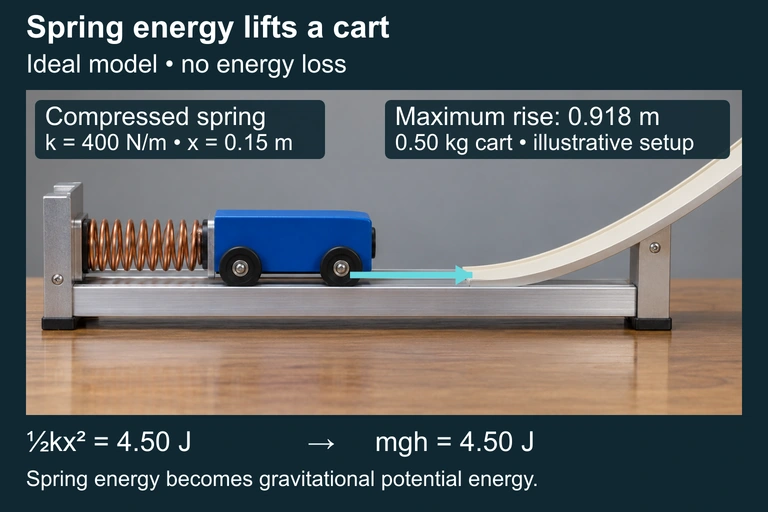
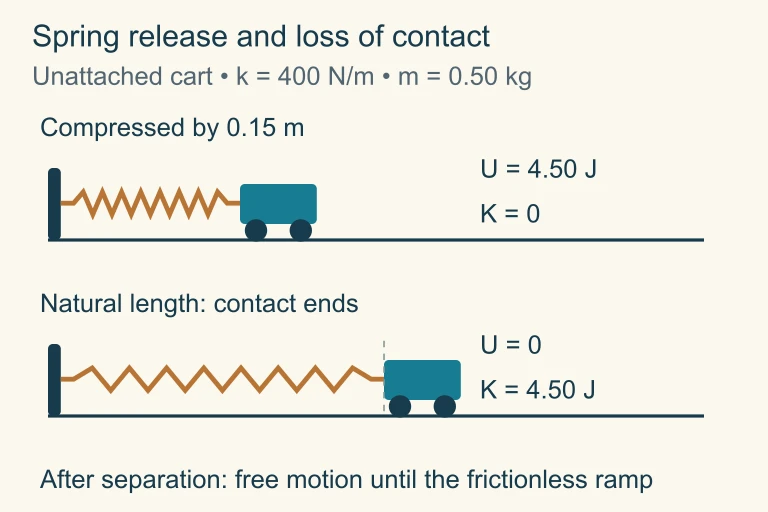
AP Physics 1: a 0.50 kg cart placed against a 400 N/m spring compressed by 0.15 m receives 4.50 J and rises 0.918 m on an ideal ramp. The cart is not attached; the required release panel shows contact ending at natural length.
The cart is placed against the spring, not attached. Contact ends when the spring reaches its natural length; the cart then travels freely to the ramp.

Visualizing with Energy Bar Charts

Top of Hill
\(K\)
\(U\)
\(E\)
Midway
\(K\)
\(U\)
Bottom
\(K\)
\(U\)
\(E\)
Kinetic Potential
Total \(E\) (constant)

How to Apply PE in Problems

1
Identify the system. What objects and forces are involved? Is the system isolated (no friction)?
2
Choose a reference level. Set \( h = 0 \) at a convenient point (ground, lowest position, etc.).
3
Write energy at both states. Use \( K_i + U_i = K_f + U_f \) (add \( W_{\text{nc}} \) if non-conservative forces act).
4
Substitute known values. Expand \( K = \tfrac{1}{2}mv^2 \), \( U_g = mgh \), or \( U_s = \tfrac{1}{2}kx^2 \).
5
Solve for the unknown. Algebra yields speed, height, spring compression, etc.

Example 1: Falling Ball

A 2 kg ball is released from rest at a height of 5 m. What is its speed just before hitting the ground? (Ignore air resistance.)

Ground (h = 0) 2 kg
\(v=0\)
5 m 2 kg
\(v=?\)

Example 2: Spring Launcher

A spring with \( k = 800 \;\text{N/m} \) is compressed by 0.15 m. It launches a 0.5 kg ball vertically. How high does the ball rise?

Example 3: Roller Coaster

A 500 kg cart starts from rest at height \( h_1 = 40\;\text{m} \) and reaches a second hill at \( h_2 = 15\;\text{m} \). Find the cart's speed at the top of the second hill. (No friction.)

40 m 15 m
\(v=0\)
\(v=?\)

Choosing the Reference Level

The reference level (\( h = 0 \)) is arbitrary. Physics only cares about changes in PE: \( \Delta U = mg\Delta h \). Choosing a smart reference simplifies your math.

1
Lowest point of motion: makes all heights positive. Great for free-fall and roller coasters.
2
Starting position: initial \( U_g = 0 \). Useful when you want to track energy gained or lost.
3
Spring equilibrium: for elastic PE, \( x = 0 \) is always the natural length. This is not arbitrary: it is fixed by the spring itself.

Common Mistakes

✕ Forgetting the Reference
Mixing heights from different reference levels in the same equation gives nonsense answers.
✕ Using \( mgh \) for Springs
Elastic PE uses \( \tfrac{1}{2}kx^2 \), not \( mgh \). The displacement is from equilibrium, not a height.
✕ Ignoring the Squared Term
Doubling spring compression quadruples PE. Students often assume a linear relationship.

Summary of Key Formulas

Quantity Formula Units
Gravitational PE \( U_g = mgh \) J (joules)
Elastic PE \( U_s = \tfrac{1}{2}kx^2 \) J (joules)
Kinetic Energy \( K = \tfrac{1}{2}mv^2 \) J (joules)
Conservation \( K_i + U_i = K_f + U_f \) J = J
With friction \( W_{\text{nc}} = \Delta K + \Delta U \) J (joules)

Question 1 of 5

A 3 kg book sits on a shelf 2 m above the floor. What is its gravitational potential energy relative to the floor?

Question 2 of 5

A spring with \( k = 400\;\text{N/m} \) is compressed 0.10 m. How much elastic potential energy is stored?

Question 3 of 5

A ball is dropped from 20 m. Using conservation of energy, what is its speed at 5 m above the ground? (No air resistance.)

Question 4 of 5

If the compression of a spring is tripled, by what factor does its elastic potential energy change?

Question 5 of 5

Two objects are at the same height: object A has mass 2 kg and object B has mass 6 kg. Which statement about their gravitational PE is correct?