Newton's Third Law
Action and Reaction
Every force in nature comes in pairs: when one object pushes or pulls another, the second object pushes or pulls back with a force that is equal in magnitude and opposite in direction.
What Is a Force Pair?
In physics, forces never exist alone. Whenever object A exerts a force on object B, object B simultaneously exerts a force back on object A. These two forces form what we call an interaction pair (also known as an action-reaction pair).
Forces Are Everywhere
When you walk, your foot pushes backward on the ground. The ground pushes forward on you. Without this reaction force, you could not accelerate forward.
Why Does This Matter?
The Formal Statement
$$ \vec{F}_{A \to B} = -\vec{F}_{B \to A} $$
Visualizing the Interaction
Third Law Pairs vs. Balanced Forces
| Third Law Pair | Balanced Forces | |
|---|---|---|
| Objects involved | Two different objects | Same object |
| Direction | Opposite | Opposite |
| Magnitude | Always equal | Equal only when \( a = 0 \) |
| Cancel out? | Never | Yes: net force = 0 |
| Example | Earth pulls you down / you pull Earth up | Weight down + normal force up on a book at rest |
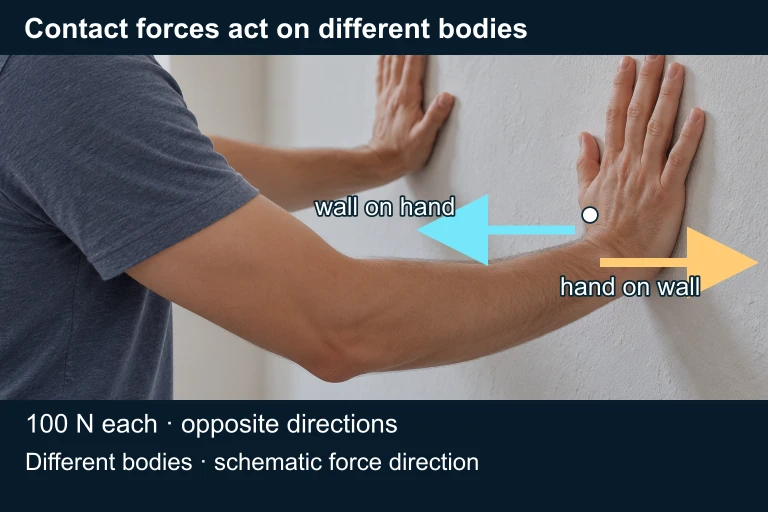
A hand and wall force pair
This separate illustration shows forces on different objects: the hand pushes the wall and the wall pushes the hand with equal magnitude and opposite direction.
How to Identify a Third Law Pair
Example 1: Book on a Table
Example 2: Falling Ball and the Earth
Example 3: Two Ice Skaters Push Off
Same Force, Different Acceleration
A common misconception is that a heavier object exerts a larger force. It does not. The forces are always equal. What differs is the acceleration each object experiences, because of Newton's Second Law:
$$ a = \frac{F_{\text{net}}}{m} $$
Third Law in Ropes and Tension
The Normal Force as a Third Law Pair
When you stand on the floor, two distinct third-law pairs are at play. Many students confuse them:
Common Mistakes
Summary of Newton's Third Law
| Property | Details |
|---|---|
| Statement | \(\vec{F}_{A \to B} = -\vec{F}_{B \to A}\) |
| Magnitude | Always equal |
| Direction | Always opposite |
| Objects | Always two different objects |
| Force type | Both forces are the same type |
| Timing | Simultaneous: one cannot exist without the other |
| Acceleration | Differs based on each object's mass (\(a = F/m\)) |
Question 1 of 5
A hammer strikes a nail with a force of 500 N. What force does the nail exert on the hammer?
Question 2 of 5
A book sits at rest on a table. Which pair of forces is a Newton's Third Law pair?
Question 3 of 5
A 1000 kg car collides with a 2000 kg truck. During the collision, which statement is correct about the forces?
Question 4 of 5
Two ice skaters push off each other. Skater A has mass 60 kg and skater B has mass 90 kg. If skater A accelerates at \( 3 \text{ m/s}^2 \), what is skater B's acceleration?
Question 5 of 5
A person stands still in an elevator moving upward at constant velocity. The normal force from the elevator floor on the person is \( F_N \), and the person's weight is \( W \). Which is true?