01 / 21

Newton's Second Law
in Rotational Form

Discover how net torque and rotational inertia govern angular acceleration: the rotational analog of \( F = ma \).

AP Physics 1

From Linear to Rotational Motion

In linear motion, a net force causes an object to accelerate in a straight line. But when an object spins, pivots, or orbits, we need a new framework: rotational dynamics.

Linear
Force \(\vec{F}\) causes linear acceleration \(a\) of mass \(m\).
Rotational
Torque \(\vec{\tau}\) causes angular acceleration \(\alpha\) of moment of inertia \(I\).

What Is Torque?

Pivot \(r\) (lever arm) \(F\) \(\theta\) \(\tau\)

Rotational Inertia: \(I\)

Moment of inertia \(I\) measures how much an object resists angular acceleration: the rotational analog of mass. It depends on both the mass and its distribution relative to the axis of rotation.

\(r\) Point mass \(I = mr^2\) \(R\) Solid disk \(I = \tfrac{1}{2}MR^2\) \(R\) Hoop \(I = MR^2\)

The Core Law: \(\sum\tau = I\alpha\)

\(\sum\tau\)
Net torque about the axis (N·m)
\(I\)
Moment of inertia about the axis (kg·m²)
\(\alpha\)
Angular acceleration (rad/s²)

Just as \(\sum F = ma\) links force to linear acceleration, \(\sum\tau = I\alpha\) links net torque to angular acceleration.

The falling rod that leaves a coin behind

A hinged falling rod with a separated coin accompanies an exact initial-state torque diagram and distinct tip/coin acceleration arrows.At release, the rod has zero angular speed. Gravity’s torque can give its tip a downward tangential acceleration greater than g, allowing the freely falling coin to separate from the tip.

The rod tip initially outruns free fall
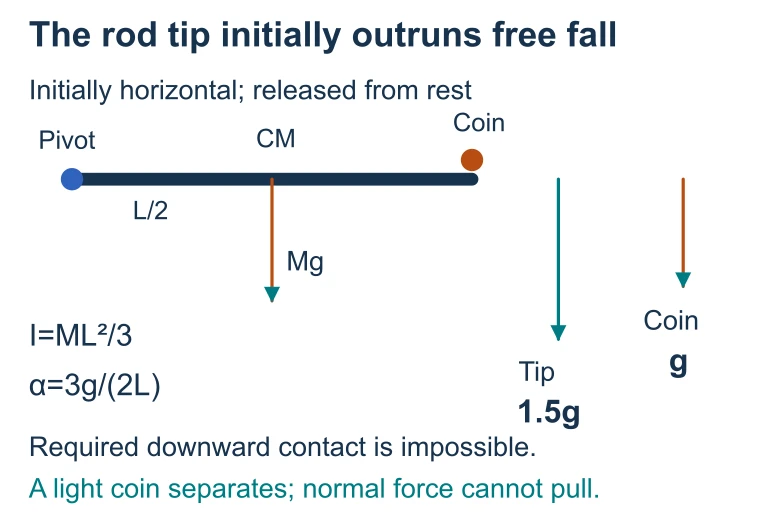
The rod tip initially outruns free fall. At release, the rod has zero angular speed. Gravity’s torque can give its tip a downward tangential acceleration greater than g, allowing the freely falling coin to separate from the tip.At release, the rod has zero angular speed. Gravity’s torque can give its tip a downward tangential acceleration greater than g, allowing the freely falling coin to separate from the tip.

Visualizing \(\sum\tau = I\alpha\)

Axis \(R\) \(F_1\) \(\tau_1 = -RF_1\) \(F_2\) \(\tau_2 = +RF_2\) \(\alpha\) \(\sum\tau = \tau_1 + \tau_2 = I\alpha\)

Linear vs Rotational Analogs

Concept Linear Rotational
Inertia Mass \(m\) Moment of inertia \(I\)
Cause of acceleration Force \(F\) Torque \(\tau\)
Acceleration \(a\) (m/s²) \(\alpha\) (rad/s²)
Newton's 2nd Law \(\sum F = ma\) \(\sum \tau = I\alpha\)
Displacement \(x\) (m) \(\theta\) (rad)
Velocity \(v\) (m/s) \(\omega\) (rad/s)

Sign Convention for Torque

+ (CCW) Positive \(\tau\) − (CW) Negative \(\tau\) Standard convention (AP Physics 1)

How to Apply \(\sum\tau = I\alpha\)

1
Identify the axis of rotation. Pick the pivot point or axis about which the object rotates.
2
Draw a free-body diagram. Show every force and its point of application on the object.
3
Calculate each torque. Use \(\tau = rF\sin\theta\) and assign + or − using your sign convention.
4
Find the moment of inertia \(I\) for the object about the chosen axis.
5
Solve for \(\alpha\). Use \(\alpha = \frac{\sum\tau}{I}\). Check that units work out to rad/s².

Example 1: Spinning Disk

A solid disk of mass \(m = 4\) kg and radius \(R = 0.5\) m is free to rotate about its center. A tangential force \(F = 10\) N is applied at the rim. Find the angular acceleration.

0.5 m 10 N \(\alpha\) = ?

Example 2: Two Opposing Forces

A uniform rod of length \(L = 1.2\) m and mass \(M = 3\) kg is pivoted at its center. A 6 N force acts upward at the right end, and a 2 N force acts downward at the left end. Find \(\alpha\). (\(I_{\text{rod, center}} = \tfrac{1}{12}ML^2\))

Pivot 0.6 m 0.6 m 6 N 2 N

Example 3: Pulley and Hanging Mass

A pulley (solid disk, mass \(M = 2\) kg, radius \(R = 0.3\) m) has a rope wrapped around it with a hanging block of mass \(m = 5\) kg. Find the angular acceleration of the pulley.

5 kg \(mg\) \(T\) \(M = 2\) kg, \(R = 0.3\) m \(R\)

Additional worked example

The following is a separate example from the long-form lesson. Its values may differ from the example already on this slide.

A solid disk pulley of mass M = 4.0 kg and radius R = 0.25 m is mounted on a frictionless axle. A light, inextensible string wrapped around the pulley supports a hanging block of mass m = 2.0 kg. The system is released from rest. Find the angular acceleration of the pulley and the linear acceleration of the hanging block.

Show answer and explanation

Step 1 — Identify Given Values and Unknowns: Given: M = 4.0 kg (pulley mass), R = 0.25 m (pulley radius), m = 2.0 kg (hanging block), released from rest (ω₀ = 0). The pulley is a solid disk, so I = ½MR². We need to find the angular acceleration α of the pulley and the linear acceleration a of the block. Step 2 — Draw Free-Body Diagrams: For the hanging block, two forces act: the weight mg downward and the tension T upward. Choosing downward as positive for the block, Newton's second law gives: mg − T = ma. For the pulley, the string exerts a tangential force T at the rim, creating a torque τ = TR about the axle. There is no friction torque. Step 3 — Apply Στ = Iα to the Pulley: The only torque on the pulley is from the tension: τₙₑₜ = TR. Substituting I = ½MR²: TR = (½MR²)α. Dividing both sides by R: T = ½MRα. Step 4 — Link Rotation and Translation via the Constraint a = Rα: Because the string is inextensible and does not slip on the pulley, the linear acceleration of the block equals the tangential acceleration at the rim: a = Rα, so α = a/R. Substituting into T = ½MRα gives T = ½Ma. Step 5 — Solve the System of Equations: From Step 2: mg − T = ma. Substituting T = ½Ma: mg − ½Ma = ma. Solving for a: a = mg / (m + ½M) = (2.0)(9.8) / (2.0 + 2.0) = 19.6 / 4.0. a = 4.9 m/s² Step 6 — Find Angular Acceleration: Using α = a/R = 4.9 / 0.25: α = 19.6 rad/s² Step 7 — Check for Reasonableness: The linear acceleration a = 4.9 m/s² is exactly half of g, which makes sense: the pulley's rotational inertia effectively doubles the resistance felt by the block (m + ½M = 2m). If the pulley were massless, a would equal g. The tension T = ½Ma = ½(4.0)(4.9) = 9.8 N, which is less than mg = 19.6 N, confirming the block accelerates downward.
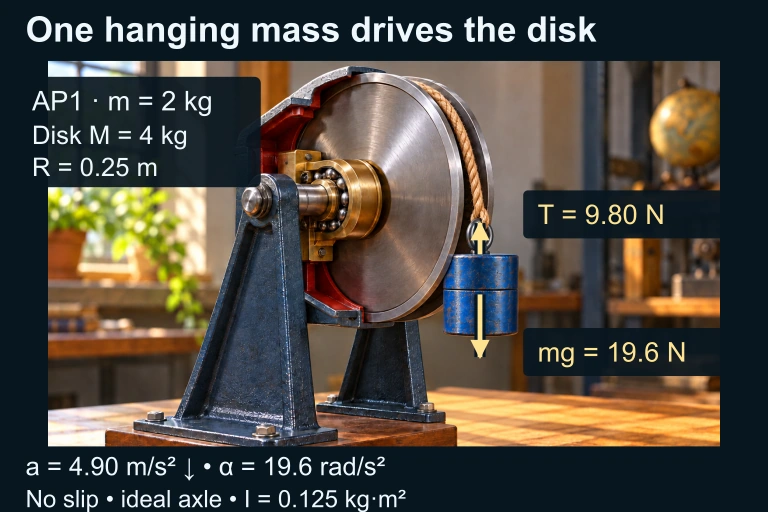
Separate AP1 single-mass preset, with tension and weight on the hanging mass

A pulley with its rotational inertia exposed
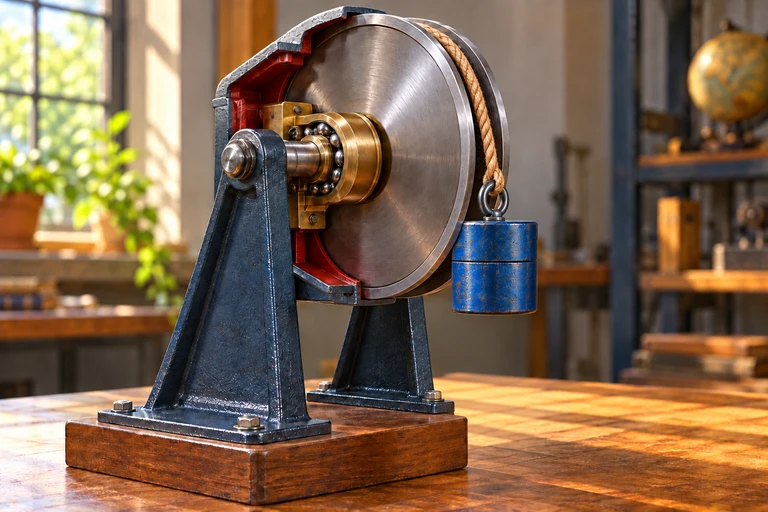
An exposed pulley rotor supports a taut cord and a blue load suspended clear of the base.The falling load accelerates while cord tension supplies torque to the pulley. With no slip, the load acceleration and pulley angular acceleration satisfy a = Rα; tension is smaller than the load’s weight.

Pulley and falling load
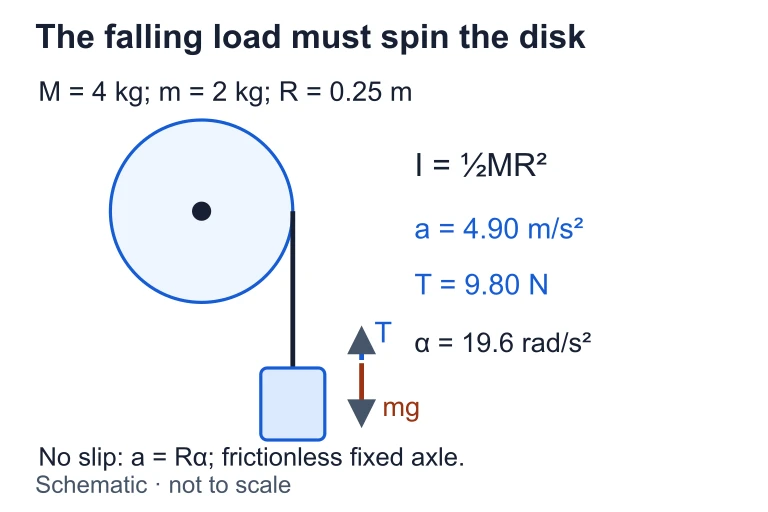
Pulley and falling load. For a 4 kg solid-disk pulley of radius 0.25 m and a 2 kg load, a = 4.90 m/s², T = 9.80 N and α = 19.6 rad/s². The cord does not slip and the fixed axle is frictionless.For a 4 kg solid-disk pulley of radius 0.25 m and a 2 kg load, a = 4.90 m/s², T = 9.80 N and α = 19.6 rad/s². The cord does not slip and the fixed axle is frictionless.

Special Case: \(\sum\tau = 0\)

When the net torque on an object is zero, the angular acceleration is zero: the object either remains at rest or rotates at constant angular velocity. This is rotational equilibrium.

Static Equilibrium
\(\sum\tau = 0\) and \(\omega = 0\). The object does not rotate at all.
Dynamic Equilibrium
\(\sum\tau = 0\) and \(\omega = \text{const}\). The object spins at a steady rate.

Connecting \(\alpha\) and \(a\)

When an object rolls without slipping or a rope unwinds without slipping, the tangential acceleration at the rim equals the linear acceleration of the connected object:

1
Rolling without slipping: The contact point has zero velocity, so \(v = R\omega\) and \(a = R\alpha\).
2
Rope on a pulley: The rope doesn't slip, so the linear acceleration of the rope equals \(R\alpha\) of the pulley.
3
This constraint lets you link \(\sum F = ma\) for the translating part with \(\sum\tau = I\alpha\) for the rotating part.

Common Mistakes

Wrong Axis for \(I\)
Using \(I = \tfrac{1}{2}MR^2\) (center) when the object pivots at the end. Always match \(I\) to the actual axis of rotation.
Forgetting \(\sin\theta\)
Using \(\tau = rF\) even when the force is not perpendicular. The full formula is \(\tau = rF\sin\theta\).
Sign Errors
Mixing up CW and CCW torques. Always define a positive direction first and apply it consistently.

Summary of Key Equations

Quantity Equation Units
Torque \(\tau = rF\sin\theta\) N·m
Newton's 2nd (Rotational) \(\sum\tau = I\alpha\) \(\text{N}\cdot\text{m} = \text{kg}\cdot\text{m}^2\cdot\text{rad/s}^2\)
Moment of inertia (point) \(I = mr^2\) kg·m²
Moment of inertia (disk) \(I = \tfrac{1}{2}MR^2\) kg·m²
Rolling constraint \(a = R\alpha\) \(\text{m/s}^2 = \text{m}\cdot\text{rad/s}^2\)
Rotational equilibrium \(\sum\tau = 0\) —

Question 1 of 5

A net torque of 12 N·m acts on an object with a moment of inertia of 4 kg·m². What is the angular acceleration?

Question 2 of 5

A force of 20 N is applied at a distance of 0.4 m from the axis, at an angle of 30° to the lever arm. What is the torque?

Question 3 of 5

Two solid disks have the same mass \(M\), but Disk A has radius \(R\) and Disk B has radius \(2R\). If the same net torque is applied to each, how do their angular accelerations compare?

Question 4 of 5

A pulley with \(I = 0.1\) kg·m² and \(R = 0.2\) m accelerates a hanging mass. If the tension in the rope is 25 N, what is the angular acceleration of the pulley?

Question 5 of 5

A uniform beam of length \(L\) is pivoted at its center and is in rotational equilibrium. A weight \(W\) hangs at the right end. What force must be applied upward at the left end to maintain equilibrium?