01 / 21

Newton's Second Law
\( \vec{F} = m\vec{a} \)

Discover the fundamental relationship between force, mass, and acceleration: the equation that governs how objects move.

AP Physics 1

What Is a Force?

A force is a push or pull that acts on an object. Forces are vectors: they have both a magnitude (measured in newtons, N) and a direction.

Contact Forces
Tension, friction, normal force, applied push/pull: require physical contact.
Field Forces
Gravity, electric, magnetic: act at a distance without direct contact.

The Net Force Idea

When multiple forces act on an object, they combine into a single net force (also called the resultant). It is the vector sum of every individual force:

\(m\) \(F_1\) \(F_2\) \(F_{\text{net}}\)

Only the net force determines how the object accelerates. If forces balance perfectly, \(\vec{F}_{\text{net}} = 0\) and the object's velocity does not change.

Why Does This Law Matter?

Newton's Second Law is the bridge between forces (causes) and motion (effects). It lets us predict how fast something speeds up, slows down, or changes direction when forces act on it.

Engineering
Designing rockets, brakes, and elevators all rely on \(\vec{F}=m\vec{a}\).
Medicine
Understanding crash impact forces helps design safer vehicles and helmets.
Sports
Athletes optimize force and body mass to maximize acceleration and performance.

The Core Equation

\(\vec{F}_{\text{net}}\)
Net (total) force on the object, in newtons (N).
\(m\)
Mass of the object, in kilograms (kg). A scalar quantity.
\(\vec{a}\)
Acceleration, in \(\text{m/s}^2\). Same direction as the net force.

This law tells us that acceleration is directly proportional to the net force and inversely proportional to mass. Equivalently: \(\displaystyle \vec{a} = \frac{\vec{F}_{\text{net}}}{m}\)

Visualizing \(\vec{F}=m\vec{a}\)

\(m\) \(F_{\text{app}}\) \(f\) \(N\) \(mg\) \(a\)

Two Key Proportionalities

Direct Proportion
Double the net force (same mass) → double the acceleration.
\(a \propto F_{\text{net}}\)
Inverse Proportion
Double the mass (same force) → half the acceleration.
\(a \propto \frac{1}{m}\)
\(a\) vs \(F\) (constant \(m\)) \(F\;(\text{N})\) \(a\;(\text{m/s}^2)\) \(a\) vs \(m\) (constant \(F\)) \(m\;(\text{kg})\) \(a\;(\text{m/s}^2)\)

Mass vs Weight

Mass (\(m\)) Weight (\(W\))
Definition Amount of matter Gravitational force on object
Type Scalar Vector (downward)
Unit kg N (newtons)
Changes with location? No Yes (\(W = mg\))
On the Moon Same About \(\frac{1}{6}\) of Earth

How to Apply the Law

1
Draw a free-body diagram (FBD). Sketch the object and draw every force acting on it as an arrow from its center.
2
Choose a coordinate system. Pick positive directions (usually right and up).
3
Resolve forces into components. Break angled forces into \(x\) and \(y\) components.
4
Write \(\Sigma F_x = ma_x\) and \(\Sigma F_y = ma_y\). Sum forces along each axis separately.
5
Solve for the unknown. Use algebra to find acceleration, force, or mass.

Example 1: One Force

A \(12\;\text{N}\) horizontal force is applied to a \(4\;\text{kg}\) box on a frictionless surface. Find the acceleration.

\(4\;\text{kg}\) \(12\;\text{N}\) \(a = ?\)

Example 2: With Friction

A \(5\;\text{kg}\) block is pushed with \(30\;\text{N}\) to the right. Kinetic friction is \(10\;\text{N}\). Find the acceleration.

\(5\;\text{kg}\) \(30\;\text{N}\) \(10\;\text{N}\) \(a = ?\)

Example 3: Angled Force

A \(10\;\text{kg}\) sled is pulled with \(50\;\text{N}\) at \(37^\circ\) above horizontal on a frictionless surface. Find the horizontal acceleration.

\(10\;\text{kg}\) \(50\;\text{N}\) \(37^\circ\) \(F\cos 37^\circ\) \(F\sin 37^\circ\) \(a_x = ?\)

Example 4: Connected Objects

Two blocks (\(m_1 = 3\;\text{kg}\), \(m_2 = 2\;\text{kg}\)) are connected by a light string on a frictionless surface. A \(25\;\text{N}\) force pulls the system. Find the system acceleration and the tension.

\(2\;\text{kg}\) \(T\) \(3\;\text{kg}\) \(25\;\text{N}\) \(a = ?\)

Additional worked example

The following is a separate example from the long-form lesson. Its values may differ from the example already on this slide.

An Atwood machine consists of two masses, m₁ = 6.0 kg and m₂ = 4.0 kg, connected by a massless, inextensible string over a frictionless, massless pulley. Find the acceleration of the system and the tension in the string.

Show answer and explanation

Step 1 — Draw Free-Body Diagrams: For m₁ (heavier): weight m₁g acts downward, tension T acts upward. For m₂ (lighter): weight m₂g acts downward, tension T acts upward. Because m₁ > m₂, m₁ accelerates downward and m₂ accelerates upward, both with magnitude a. Step 2 — Write ΣF = ma for Each Mass: Taking downward as positive for m₁ and upward as positive for m₂ (so both accelerations are positive): For m₁: m₁g − T = m₁a. For m₂: T − m₂g = m₂a. Step 3 — Solve for Acceleration: Add the two equations to eliminate T: m₁g − m₂g = (m₁ + m₂)a. Therefore a = (m₁ − m₂)g / (m₁ + m₂) = (6.0 − 4.0)(9.8) / (6.0 + 4.0) = (2.0)(9.8) / 10.0 a = 1.96 m/s² ≈ 2.0 m/s² Step 4 — Solve for Tension: Substitute a back into either equation. Using the m₂ equation: T = m₂g + m₂a = m₂(g + a) = 4.0(9.8 + 1.96) = 4.0 × 11.76 T = 47.0 N Step 5 — Sanity Check: The tension (47.0 N) should lie between the weights of the two masses: m₂g = 39.2 N < T = 47.0 N < m₁g = 58.8 N. ✓ This confirms the tension is large enough to accelerate m₂ upward but not as large as the full weight of m₁ (since m₁ is accelerating downward, not in equilibrium).
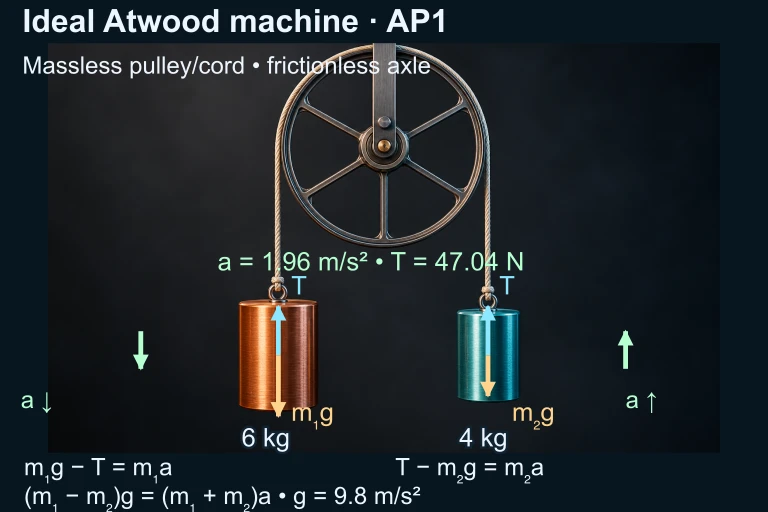
AP Physics 1 ideal Atwood machine: 6 kg descends and 4 kg rises with acceleration 1.96 m/s² and tension 47.04 N. The C companion uses 5 kg and 3 kg. Each model assumes a massless string and frictionless massless pulley.

Unit Analysis

Always verify your answer has the right units. Newton's Second Law defines the newton itself:

✓
Force in newtons (N), mass in kg, acceleration in \(\text{m/s}^2\).
✓
If mass is in grams, convert to kg first: \(500\;\text{g} = 0.5\;\text{kg}\).
✓
If given weight in newtons, find mass: \(m = W/g\).

Common Mistakes

✕ Using total force, not net force
You must subtract opposing forces. Only the net (resultant) force causes acceleration.
✕ Confusing mass and weight
Mass is in kg, weight is in N. Plugging weight into \(F=ma\) as mass gives a wrong answer.
✕ Forgetting to decompose angled forces
Only the component along the direction of motion contributes to acceleration in that direction.

Summary at a Glance

Concept Key Relationship Remember
Newton's 2nd Law \(\vec{F}_{\text{net}} = m\vec{a}\) Net force, not any single force
Acceleration direction Same as \(\vec{F}_{\text{net}}\) Acceleration is a vector
Weight \(W = mg\) Weight is a force (in N)
Unit of force \(1\;\text{N} = 1\;\text{kg}\cdot\text{m/s}^2\) Always use SI units
Systems \(a = F_{\text{net}} / m_{\text{total}}\) Treat connected objects as one

Question 1 of 5

A net force of \(24\;\text{N}\) acts on a \(6\;\text{kg}\) object. What is the acceleration?

Question 2 of 5

A \(2\;\text{kg}\) book rests on a table with a normal force of \(19.6\;\text{N}\) upward and gravity of \(19.6\;\text{N}\) downward. What is the net force?

Question 3 of 5

If you double the net force on an object while keeping its mass constant, the acceleration:

Question 4 of 5

A \(1000\;\text{kg}\) car accelerates at \(3\;\text{m/s}^2\). Friction exerts \(500\;\text{N}\) backward. What is the engine's driving force?

Question 5 of 5

A force of \(40\;\text{N}\) is applied at \(60^\circ\) above horizontal to a \(5\;\text{kg}\) block on a frictionless surface. The horizontal acceleration is approximately: