Motion of
Orbiting Satellites
Explore the physics of circular orbits, understand how gravity provides centripetal force, and derive the relationships between orbital speed, radius, and period.
What Is a Satellite Orbit?
A satellite orbit is the curved path an object follows as it moves around a much more massive body. The satellite is in constant free fall toward the central body, but its tangential velocity carries it forward fast enough that the surface curves away beneath it.
Essential Vocabulary
Gravity as Centripetal Force
Deriving Orbital Speed
For a satellite of mass \( m \) in a circular orbit of radius \( r \) around a body of mass \( M \), gravity provides the centripetal force:
Cancel \( m \) (satellite mass drops out!) and solve for \( v \):
The orbital speed depends only on the central body's mass \( M \) and the orbital radius \( r \): not on the satellite's mass.
The Orbital Period \( T \)
The circumference of the orbit is \( 2\pi r \). Since the satellite moves at constant speed \( v \):
Connection to Kepler's Third Law
Squaring the period equation reveals a powerful proportionality:
This is Kepler's Third Law for circular orbits. The ratio \( T^2 / r^3 \) is the same constant for every satellite orbiting the same central body.
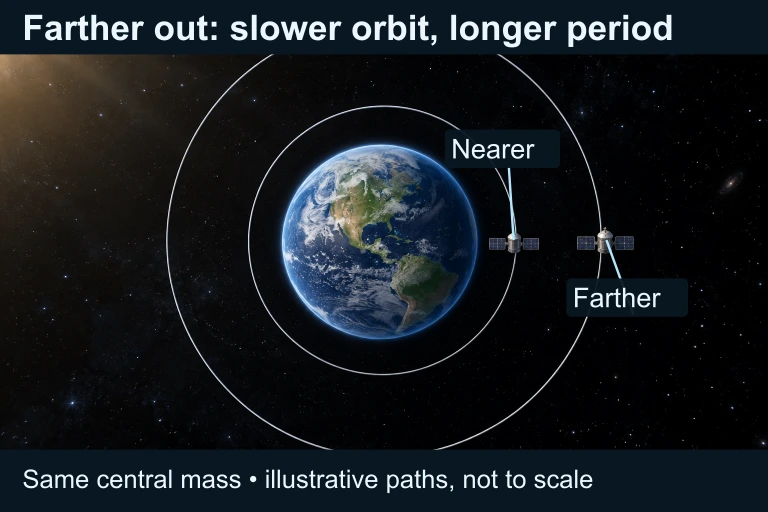
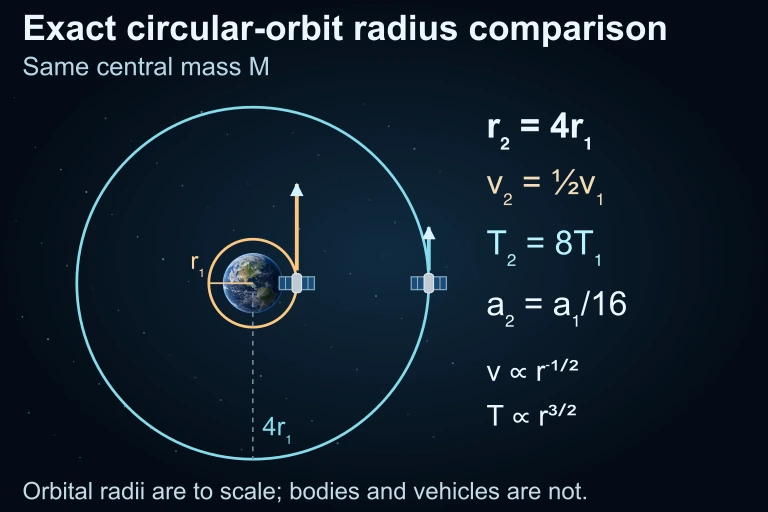
Comparing orbital radii
The photograph is illustrative; the companion gives the exact circular-orbit comparison for radii in a 1:4 ratio around the same central mass.
Orbital Radius vs Altitude
Energy of an Orbiting Satellite
A satellite in a circular orbit has both kinetic energy and gravitational potential energy:
Apparent Weightlessness
Astronauts on the ISS appear to "float" even though gravity is only about 10% weaker than at Earth's surface. Why?
A floating wrench inside an orbiting cabin
 The cabin and its loose objects fall together in orbit. Gravity remains present and points toward Earth while the orbital velocity is tangent to the path.
A floating wrench inside an orbiting cabin
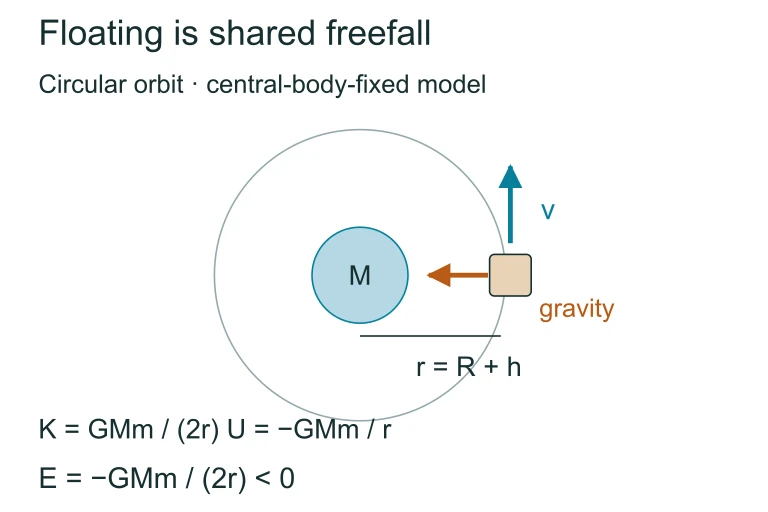 The cabin and its loose objects fall together in orbit. Gravity remains present and points toward Earth while the orbital velocity is tangent to the path.
Problem-Solving Strategy
Example 1: ISS Orbital Speed
The ISS orbits at an altitude of 408 km above Earth's surface. Earth's mass is \( M = 5.97 \times 10^{24}\;\text{kg} \) and radius is \( R = 6.37 \times 10^6\;\text{m} \). Find the orbital speed.
Example 2: Geostationary Orbit
A geostationary satellite has a period of \( T = 24 \;\text{hours} \). Find the required orbital radius around Earth.
Example 3: Comparing Two Orbits
Satellite A orbits at radius \( r \). Satellite B orbits at radius \( 4r \). How do their speeds and periods compare?
Common Mistakes to Avoid
Summary of Orbital Relationships
| Quantity | Formula | Depends on \( r \) |
|---|---|---|
| Orbital Speed \( v \) | \( \sqrt{GM/r} \) | \( v \propto r^{-1/2} \) |
| Period \( T \) | \( 2\pi\sqrt{r^3/(GM)} \) | \( T \propto r^{3/2} \) |
| Centripetal Accel. \( a_c \) | \( GM/r^2 \) | \( a_c \propto r^{-2} \) |
| Kinetic Energy \( K \) | \( GMm/(2r) \) | \( K \propto r^{-1} \) |
| Total Energy \( E \) | \( -GMm/(2r) \) | \( E \propto -r^{-1} \) |
Question 1 of 5
A satellite orbits Earth in a circular orbit. If the orbital radius is doubled, what happens to the orbital speed?
Question 2 of 5
The mass of a satellite is doubled while keeping the same orbital radius. What happens to its orbital period?
Question 3 of 5
A satellite orbits a planet at an altitude of 600 km. The planet has a radius of 3,400 km. What orbital radius should be used in calculations?
Question 4 of 5
Astronauts on the ISS experience apparent weightlessness because:
Question 5 of 5
Satellite X has orbital radius \( r \) and period \( T \). Satellite Y orbits the same planet at radius \( 2r \). What is the period of Satellite Y?