Momentum
\( \vec{p} = m\vec{v} \)
Explore linear momentum, the impulse-momentum theorem, and the conservation of momentum to analyze collisions and interactions in physics.
What Is Momentum?
Momentum is a measure of how difficult it is to stop a moving object. It depends on both the object's mass and its velocity. A heavy truck moving slowly can have the same momentum as a light car moving quickly.
Momentum Is a Vector
Units and Dimensions
There is no special name for the unit of momentum.
Mass times length per time.
Car at 60 mph: ~\( 40,000 \text{ kg} \cdot \text{m/s} \)
The Impulse-Momentum Theorem
Newton's Second Law can be rewritten in terms of momentum. The net force on an object equals the rate of change of its momentum:
Conservation of Momentum
When no net external force acts on a system of objects, the total momentum of the system remains constant. This is one of the most powerful principles in physics.
Visualizing a Collision
Additional worked example
The following is a separate example from the long-form lesson. Its values may differ from the example already on this slide.
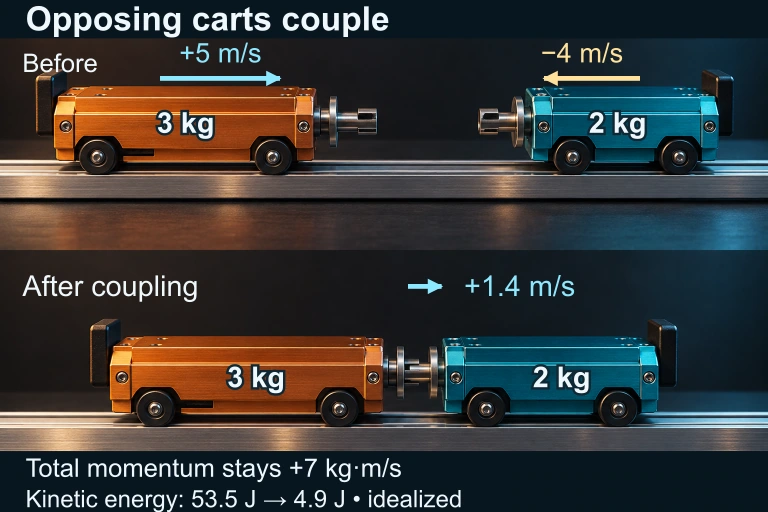
A 3.0 kg cart (Cart A) traveling east at 5.0 m/s collides head-on with a 2.0 kg cart (Cart B) traveling west at 4.0 m/s. The carts stick together after the collision. Find the velocity of the combined carts after the collision and determine how much kinetic energy is lost.
Show answer and explanation
Step 1 — Define the system and sign convention: The system consists of Cart A and Cart B. Choose east as positive. Therefore: v_(A,i) = +5.0 m/s and v_(B,i) = −4.0 m/s (west is negative). Because the carts stick together, this is a perfectly inelastic collision. Step 2 — Apply conservation of momentum: m_(A)v_(A,i) + m_(B)v_(B,i) = (m_(A) + m_(B))v_(f). Substituting: (3.0)(+5.0) + (2.0)(−4.0) = (3.0 + 2.0)v_(f). Step 3 — Solve for the final velocity: 15.0 + (−8.0) = 5.0 × v_(f) → 7.0 = 5.0 v_(f) → v_(f) = +1.4 m/s. The positive sign means the combined mass moves east. v_f = +1.4 m/s (east) Step 4 — Calculate kinetic energy before and after: KE_(i) = ½(3.0)(5.0)² + ½(2.0)(4.0)² = 37.5 + 16.0 = 53.5 J. KE_(f) = ½(5.0)(1.4)² = 4.9 J. Step 5 — Determine kinetic energy lost: ΔKE = KE_(f) − KE_(i) = 4.9 − 53.5 = −48.6 J. About 91% of the kinetic energy is converted to thermal energy, sound, and deformation during the collision. This large loss is characteristic of perfectly inelastic collisions. ΔKE = −48.6 J (lost to internal energy)
Elastic vs. Inelastic Collisions
| Elastic | Inelastic | Perfectly Inelastic | |
|---|---|---|---|
| Momentum | Conserved | Conserved | Conserved |
| Kinetic Energy | Conserved | NOT conserved | NOT conserved |
| Objects After | Bounce apart | May deform | Stick together |
| Example | Billiard balls | Car crash (bounce) | Clay balls merging |
How to Solve Momentum Problems
Example 1: Calculating Momentum
A \( 0.145 \text{ kg} \) baseball is pitched at \( 40 \text{ m/s} \). What is its momentum?
Example 2: Impulse on a Ball
A \( 0.5 \text{ kg} \) ball moving at \( 6 \text{ m/s} \) to the right hits a wall and bounces back at \( 4 \text{ m/s} \) to the left. Find the impulse.
Example 3: Perfectly Inelastic Collision
A \( 2 \text{ kg} \) cart moving at \( 3 \text{ m/s} \) collides with a \( 1 \text{ kg} \) stationary cart. They stick together. Find the final velocity.
Why Direction Matters
Systems and External Forces
Common Mistakes
Key Formulas Summary
| Concept | Formula | When to Use |
|---|---|---|
| Momentum | \( \vec{p} = m\vec{v} \) | Any moving object |
| Impulse | \( \vec{J} = \vec{F}\Delta t = \Delta \vec{p} \) | Force over time |
| Conservation | \( \Sigma \vec{p}_i = \Sigma \vec{p}_f \) | No net external force |
| Perfectly Inelastic | \( m_1v_{1i} + m_2v_{2i} = (m_1+m_2)v_f \) | Objects stick together |
| Elastic (extra eq.) | \( \frac{1}{2}m_1v_{1i}^2 + \frac{1}{2}m_2v_{2i}^2 = \frac{1}{2}m_1v_{1f}^2 + \frac{1}{2}m_2v_{2f}^2 \) | KE also conserved |
Question 1 of 5
A \( 4 \text{ kg} \) object moves at \( 5 \text{ m/s} \). What is its momentum?
Question 2 of 5
A \( 2 \text{ kg} \) ball moving at \( 3 \text{ m/s} \) to the right collides with a \( 2 \text{ kg} \) ball at rest. They stick together. What is the final velocity?
Question 3 of 5
Which quantity is always conserved during any collision (assuming no net external force)?
Question 4 of 5
A force of \( 100 \text{ N} \) acts on an object for \( 0.02 \text{ s} \). What impulse does the object receive?
Question 5 of 5
A \( 1500 \text{ kg} \) car and a \( 3000 \text{ kg} \) truck are moving toward each other. The car moves at \( +20 \text{ m/s} \) and the truck at \( -10 \text{ m/s} \). What is the total momentum of the system?