01 / 21

Kinetic & Static
Friction

Understand the contact forces that resist motion: when objects slide and when they stay put. Master \( f_s \) and \( f_k \) for AP Physics 1.

AP Physics 1

What Is Friction?

Friction is a contact force that acts along the surface between two objects. It opposes sliding, or the tendency to slide, relative to the contacting surface.

Origin
Microscopic surface roughness: tiny peaks interlock and resist sliding.
Direction
Always parallel to the contact surface and opposite to relative motion (or tendency).

Two Types: Static vs Kinetic

Static Friction \( f_s \)
Acts when surfaces are not sliding relative to each other. It adjusts its magnitude to match the applied force, up to a maximum.
Kinetic Friction \( f_k \)
Acts when surfaces are sliding relative to each other. It has a constant magnitude for a given pair of surfaces.

The conveyor belt that pushes forward by friction

A parcel contacts a conveyor belt with exposed rollers and a magnified contact region.A parcel moving slower than a right-moving conveyor slips left relative to the belt, so kinetic friction on the parcel points right. Once both move steadily together with no other horizontal force, the required friction can be zero.

Friction opposes relative slip
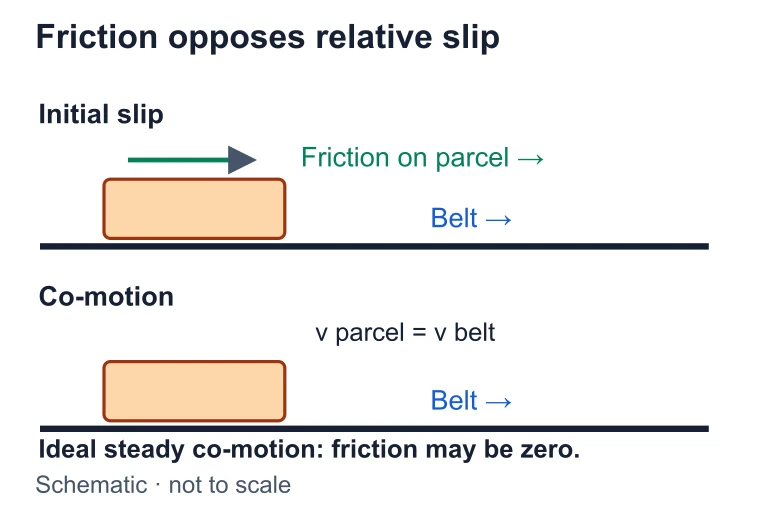
Friction opposes relative slip. A parcel moving slower than a right-moving conveyor slips left relative to the belt, so kinetic friction on the parcel points right. Once both move steadily together with no other horizontal force, the required friction can be zero.A parcel moving slower than a right-moving conveyor slips left relative to the belt, so kinetic friction on the parcel points right. Once both move steadily together with no other horizontal force, the required friction can be zero.

Why Does Friction Matter?

Walking
Static friction between your shoe and the ground pushes you forward.
Braking
Friction between tires and road decelerates a car: static (no skid) or kinetic (skidding).
Engineering
Designing brakes, conveyor belts, and clutches all depend on controlling friction.

Without friction, you could not walk, drive, or hold objects. Every AP Physics 1 problem involving surfaces requires understanding \( f_s \) and \( f_k \).

The Friction Equations

Static Friction
$$ f_s \leq \mu_s \, F_N $$
Maximum value is \( \mu_s F_N \). Below the maximum, \( f_s \) equals the applied force.
Kinetic Friction
$$ f_k = \mu_k \, F_N $$
Constant while sliding. Always less than the maximum static friction: \( \mu_k < \mu_s \).

Free-Body Diagram: Block on a Surface

\( m \) \( F \) \( f \) \( F_N \) \( mg \)

Friction vs Applied Force Graph

Applied Force Friction \( \mu_s F_N \) \( \mu_k F_N \) Static Region Kinetic Region drop

Additional worked example

The following is a separate example from the long-form lesson. Its values may differ from the example already on this slide.

A 12.0 kg block sits on a horizontal surface. The coefficients of friction between the block and surface are μₛ = 0.45 and μₖ = 0.30. A horizontal force of 60.0 N is applied to the block. Determine whether the block moves and, if so, find its acceleration.

Show answer and explanation

Step 1 — Identify the Normal Force: Since the surface is horizontal and the applied force is horizontal, the vertical forces are just the weight and the normal force. Applying Newton's second law in the vertical direction with a_(y) = 0: N − mg = 0, so N = mg = (12.0 kg)(9.8 m/s²). N = 117.6 N Step 2 — Calculate Maximum Static Friction: The maximum static friction is fₛ,max = μₛN = (0.45)(117.6 N). fₛ,max = 52.9 N Step 3 — Compare Applied Force to Maximum Static Friction: The applied force is 60.0 N, which exceeds fₛ,max = 52.9 N. Therefore, the block does begin to move, and kinetic friction applies. 60.0 N > 52.9 N → Block slides Step 4 — Calculate Kinetic Friction: Once sliding, fₖ = μₖN = (0.30)(117.6 N). fₖ = 35.3 N Step 5 — Apply Newton's Second Law for Acceleration: Taking the positive direction as the direction of the applied force: ΣF = Fₐₚₚ − fₖ = ma. Substituting: 60.0 N − 35.3 N = (12.0 kg) × a, which gives a = 24.7 N / 12.0 kg. a ≈ 2.06 m/s²
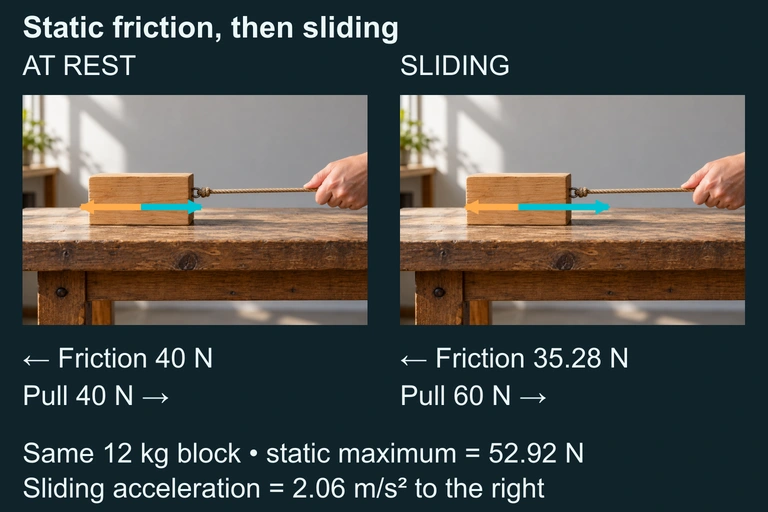
AP Physics 1: static friction balances a 40 N pull on a 12 kg block. A 60 N pull exceeds the 52.92 N static limit; kinetic friction is 35.28 N and acceleration is 2.06 m/s². The incline companions use the separate AP Physics C model.

Static vs Kinetic: Key Differences

Static \( f_s \) Kinetic \( f_k \)
When it acts No relative sliding Surfaces are sliding
Magnitude Variable: \( 0 \leq f_s \leq \mu_s F_N \) Constant: \( f_k = \mu_k F_N \)
Coefficient \( \mu_s \) (larger) \( \mu_k \) (smaller)
On the graph Rising line (slope = 1) Flat horizontal line
Example Pushing a heavy box that doesn't move Sliding a box across the floor

Understanding the Normal Force

The normal force \( F_N \) is perpendicular to the contact surface. It is NOT always equal to \( mg \). It changes when extra vertical forces act on the object.

1
Flat surface, no extra forces: \( F_N = mg \)
2
Pushing down at angle \( \theta \): \( F_N = mg + F\sin\theta \)
3
Pulling up at angle \( \theta \): \( F_N = mg - F\sin\theta \)
4
Inclined plane (angle \( \theta \)): \( F_N = mg\cos\theta \)

How to Solve Friction Problems

1
Draw a free-body diagram. Identify all forces: weight, normal, applied, and friction.
2
Choose coordinate axes. Align one axis along the surface (direction of motion) and one perpendicular.
3
Find \( F_N \). Sum forces in the perpendicular direction (\( \Sigma F_\perp = 0 \) if no vertical acceleration).
4
Determine friction type. Is the object sliding? Use \( f_k = \mu_k F_N \). Not sliding? Use \( f_s \leq \mu_s F_N \).
5
Apply Newton's second law along the surface: \( \Sigma F = ma \). Solve for the unknown.

Example 1: Will It Move?

A \( 25 \text{ kg} \) crate sits on a flat floor. The coefficients of friction are \( \mu_s = 0.40 \) and \( \mu_k = 0.30 \). You push horizontally with \( 80 \text{ N} \). Does the crate move? If so, what is its acceleration?

1
Find \( F_N \): Flat surface, no vertical extras: \( F_N = mg = 25 \text{ kg} \times 9.8 \text{ m/s}^2 = \) \( 245 \text{ N} \)
2
Max static friction: \( f_{s,\max} = \mu_s F_N = 0.40 \times 245 \text{ N} = \) \( 98 \text{ N} \)
3
Compare: Applied force \( 80 \text{ N} \) < \( 98 \text{ N} \). The crate does not move. Static friction equals \( 80 \text{ N} \) (matches applied force).

Example 2: Finding Acceleration

Same crate (\( 25 \text{ kg} \), \( \mu_s = 0.40 \), \( \mu_k = 0.30 \)), but now you push with \( 120 \text{ N} \) horizontally.

1
Check motion: \( f_{s,\max} = 98 \text{ N} \). Applied force \( 120 \text{ N} \) > \( 98 \text{ N} \), so the crate slides.
2
Kinetic friction: \( f_k = \mu_k F_N = 0.30 \times 245 \text{ N} = \) \( 73.5 \text{ N} \)
3
Net force: \( \Sigma F = 120 \text{ N} - 73.5 \text{ N} = 46.5 \text{ N} \)
4
Acceleration: \( a = \frac{\Sigma F}{m} = \frac{46.5 \text{ N}}{25 \text{ kg}} = \) \( 1.86 \text{ m/s}^2 \)

Example 3: Friction on an Incline

\( \theta \) \( mg \) \( F_N \) \( f \) Along incline: \( mg\sin\theta \) (down) \( f \) (up) Perpendicular: \( F_N = mg\cos\theta \)

Incline Calculation: Sliding Down?

A \( 10 \text{ kg} \) block sits on a \( 30^\circ \) incline with \( \mu_s = 0.60 \). Does it slide?

1
Normal force: \( F_N = mg\cos 30^\circ = 10 \text{ kg} \times 9.8 \text{ m/s}^2 \times 0.866 = \) \( 84.9 \text{ N} \)
2
Gravity along incline: \( mg\sin 30^\circ = 10 \text{ kg} \times 9.8 \text{ m/s}^2 \times 0.5 = \) \( 49.0 \text{ N} \)
3
Max static friction: \( f_{s,\max} = 0.60 \times 84.9 \text{ N} = \) \( 50.9 \text{ N} \)
4
Compare: \( 49.0 \text{ N} \) < \( 50.9 \text{ N} \), so the block stays put. Static friction = \( 49.0 \text{ N} \).

Common Mistakes

✕ Using \( \mu_s \) while sliding
Once the object moves, switch to \( \mu_k \). Using \( \mu_s \) overestimates friction during motion.
✕ Setting \( F_N = mg \) always
On inclines or with angled forces, \( F_N \neq mg \). Always solve for \( F_N \) from the perpendicular equilibrium.
✕ Forgetting \( f_s \) is variable
Static friction is not always at its maximum. It only equals \( \mu_s F_N \) at the threshold of motion.

Summary of Key Formulas

Scenario Formula Notes
Static (not moving) \( f_s \leq \mu_s F_N \) Adjusts to match applied force
Kinetic (sliding) \( f_k = \mu_k F_N \) Constant magnitude
Flat surface \( F_N = mg \) No vertical acceleration
Incline at \( \theta \) \( F_N = mg\cos\theta \) Gravity component: \( mg\sin\theta \)
Critical angle \( \tan\theta_c = \mu_s \) Angle where sliding just begins
Angled push (down) \( F_N = mg + F\sin\theta \) Increases \( F_N \) and friction

Question 1 of 5

A box sits on a flat floor with \( \mu_s = 0.50 \) and \( \mu_k = 0.35 \). The box weighs \( 200 \text{ N} \). What is the maximum horizontal force you can apply before the box starts to slide?

Question 2 of 5

A \( 5 \text{ kg} \) block slides across a table with \( \mu_k = 0.20 \). What is the kinetic friction force acting on the block? (Use \( g = 9.8 \text{ m/s}^2 \))

Question 3 of 5

A block is at rest on a rough incline. As the incline angle is slowly increased, the block eventually begins to slide. At the moment it begins to move, which statement is true?

Question 4 of 5

You push a \( 40 \text{ kg} \) crate with \( 200 \text{ N} \) horizontally on a flat floor. It accelerates at \( 2.0 \text{ m/s}^2 \). What is \( \mu_k \)? (Use \( g = 10 \text{ m/s}^2 \))

Question 5 of 5

A student pulls a \( 15 \text{ kg} \) sled with a rope angled \( 30^\circ \) above horizontal with a tension of \( 60 \text{ N} \). If \( \mu_k = 0.10 \) and \( g = 10 \text{ m/s}^2 \), what is the friction force?