01 / 21

Internal Structure
& Density

Explore how mass and volume determine density, and how internal structure shapes the physical properties of matter.

AP Physics 1

What Is Density?

Density describes how much mass is packed into a given volume. It is an intrinsic property: a small chip of copper has the same density as a massive copper block.

Because density is a ratio, doubling the mass of a uniform object while doubling its volume leaves \( \rho \) unchanged. This is why density is so useful for identifying materials.

Mass, Volume, and Density

Block A High Density Block B Low Density
Same mass, smaller \( V \)
Same mass, larger \( V \)

Why Does Density Matter?

Material ID
Density helps identify unknown substances: gold (\( 19{,}300\;\text{kg/m}^3 \)) vs. iron pyrite (\( 5{,}000\;\text{kg/m}^3 \)).
Buoyancy
Objects float when their density is less than the surrounding fluid: wood on water, helium balloons in air.
Engineering
Aerospace engineers choose low-density alloys (aluminum, titanium) to minimize weight while maintaining strength.

The Density Equation

\( \rho = \dfrac{m}{V} \)
density mass volume

Units must be consistent. Common conversions: \( 1\;\text{g/cm}^3 = 1{,}000\;\text{kg/m}^3 \). Water's density at \( 4^\circ\text{C} \) is exactly \( 1{,}000\;\text{kg/m}^3 \).

Internal Structure: Atomic View

Crystalline Solid High density Gas Low density

The spacing between atoms or molecules determines the macroscopic density. Solids have tightly packed, ordered particles: high density. Gases have widely separated, random particles: low density.

Mass vs. Weight: Key Distinction

Mass Weight
Definition Amount of matter Gravitational force on mass
Symbol \( m \) \( W = mg \)
SI Unit \( \text{kg} \) \( \text{N} \) (newtons)
Changes with location? No Yes (depends on \( g \))
Scalar / Vector Scalar Vector

Uniform vs. Non-Uniform Density

Uniform (Homogeneous)
Density is the same everywhere in the object. Any sample yields the same \( \rho \). Example: a solid aluminum sphere.
Non-Uniform (Heterogeneous)
Density varies by location. \( \rho = \rho(x, y, z) \). Example: Earth's interior (core denser than crust).

How to Solve Density Problems

1
Identify the unknowns. Which of \( \rho \), \( m \), or \( V \) do you need to find?
2
Check units. Convert everything to consistent SI units (kg and \( \text{m}^3 \)) or cgs (g and \( \text{cm}^3 \)).
3
Choose the right formula form. Use \( \rho = m/V \), \( m = \rho V \), or \( V = m/\rho \) depending on the unknown.
4
Substitute and solve. Plug in known values and compute. Always include units in your answer.
5
Sanity-check. Does the answer make physical sense? Compare with known densities (water \( \approx 1{,}000\;\text{kg/m}^3 \)).

Example 1: Finding Density

A metal cube has a mass of \( 540\;\text{g} \) and side length \( 3.0\;\text{cm} \). What is the density of the metal?

3.0 cm 540 g

Example 2: Finding Mass

A cylindrical steel rod has density \( 7{,}800\;\text{kg/m}^3 \), radius \( 0.02\;\text{m} \), and length \( 0.50\;\text{m} \). What is its mass?

L = 0.50 m r = 0.02 m
\( \rho = 7{,}800\;\text{kg/m}^3 \)

Example 3: Composite Object

A hollow sphere has outer radius \( R = 0.10\;\text{m} \), inner radius \( r = 0.06\;\text{m} \), and total mass \( m = 12.0\;\text{kg} \). Find the density of the shell material.

R r

Density Across Phases of Matter

Phase Typical \( \rho \) (\( \text{kg/m}^3 \)) Particle Spacing
Solid \( 1{,}000 \)–\( 22{,}000 \) Very close, fixed positions
Liquid \( 500 \)–\( 13{,}600 \) Close but mobile
Gas \( 0.1 \)–\( 10 \) Far apart, random motion

Density and Buoyancy

\( \rho_{\text{water}} = 1{,}000\;\text{kg/m}^3 \)
Wood
\( \rho = 600\;\text{kg/m}^3 \)
Floats Fish
\( \rho \approx 1{,}000\;\text{kg/m}^3 \)
Neutral Iron
\( \rho = 7{,}800\;\text{kg/m}^3 \)
Sinks

Additional worked example

The following is a separate example from the long-form lesson. Its values may differ from the example already on this slide.

Consider a hollow steel ball designed as a fishing bobber. The steel shell has a mass of 0.15 kg and encloses an air-filled cavity. The total outer volume of the ball is 2.5 × 10⁻⁴ m³. Determine whether this ball will float or sink in fresh water (ρ_(water) = 1,000 kg/m³), and find the fraction of its volume submerged if it floats.

Show answer and explanation

Step 1 — Identify Given Values: Mass of steel shell: mₛₜₑₑₗ = 0.15 kg. Total outer volume: Vₜₒₜₐₗ = 2.5 × 10⁻⁴ m³. The mass of the enclosed air is negligible (approximately 3 × 10⁻⁴ kg at STP), so mₜₒₜₐₗ ≈ 0.15 kg. Density of water: ρ_(water) = 1,000 kg/m³. m ≈ 0.15 kg, V = 2.5 × 10⁻⁴ m³ Step 2 — Calculate Average Density: Using ρ_(avg) = m / V: ρ_(avg) = 0.15 kg / (2.5 × 10⁻⁴ m³) = 600 kg/m³. ρ_avg = 600 kg/m³ Step 3 — Compare to Water Density: Since ρ_(avg) = 600 kg/m³ < ρ_(water) = 1,000 kg/m³, the ball's average density is less than that of water. Therefore, the ball will float. The ball floats. Step 4 — Find Fraction Submerged: For a floating object in equilibrium, the buoyant force equals the object's weight: ρ_(water) × V_(submerged) × g = ρ_(avg) × Vₜₒₜₐₗ × g. Canceling g and dividing: V_(submerged) / Vₜₒₜₐₗ = ρ_(avg) / ρ_(water) = 600 / 1,000 = 0.60. 60% of the ball's volume is submerged.
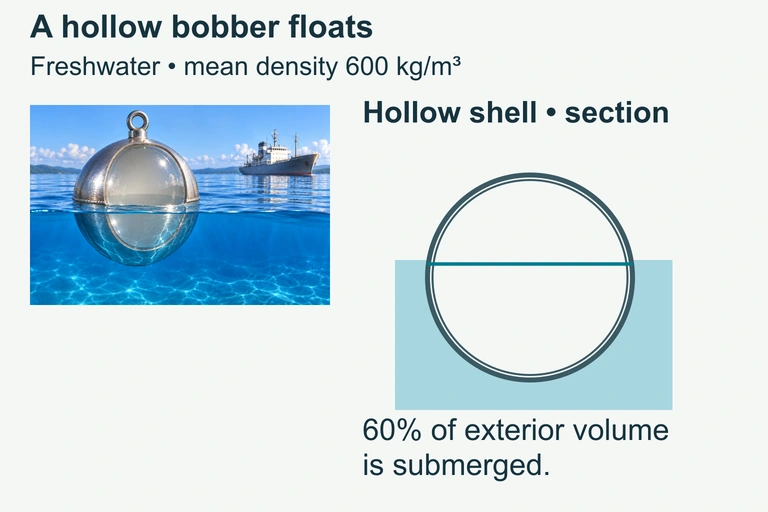
A hollow shell has mean density 600 kg/m³ and floats in water of density 1000 kg/m³ with 60% of its exterior volume submerged. This is a volume fraction, not a submerged-height fraction.

Hollow-body average density includes cavity volume

A sealed steel bobber with virtual transparent cavity window and distant ship accompanies an exact spherical immersion model.A sealed hollow object can float even when its shell material is denser than water. Average density uses the mass divided by the full outer volume, including the dry cavity.

A sealed hollow object can float despite a dense shell.
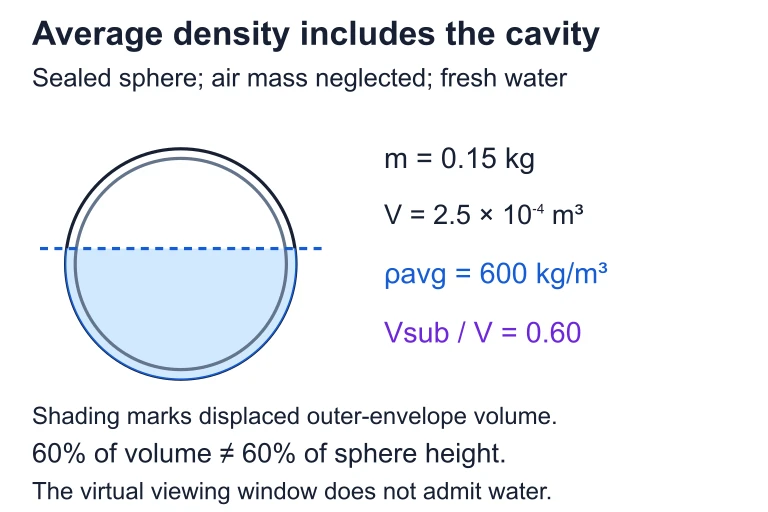
A sealed hollow object can float despite a dense shell.. A sealed hollow object can float even when its shell material is denser than water. Average density uses the mass divided by the full outer volume, including the dry cavity.A sealed hollow object can float even when its shell material is denser than water. Average density uses the mass divided by the full outer volume, including the dry cavity.

Common Mistakes

✕ Confusing Mass and Weight
Density uses mass (kg), never weight (N). Dividing weight by volume gives the wrong answer unless you divide by \( g \) first.
✕ Unit Mismatch
Mixing grams with cubic meters or kg with \( \text{cm}^3 \) produces values off by factors of \( 10^3 \) or \( 10^6 \). Always convert before calculating.
✕ Using Total Volume for Hollow Objects
For a hollow sphere, the material volume is \( V_{\text{outer}} - V_{\text{inner}} \), not \( V_{\text{outer}} \) alone. Using total volume underestimates \( \rho \).

Summary: Key Formulas and Facts

Concept Formula / Fact Key Note
Density \( \rho = m / V \) Intrinsic property
Mass from density \( m = \rho V \) Useful for composite objects
Volume from density \( V = m / \rho \) Useful for irregular shapes
Unit conversion \( 1\;\text{g/cm}^3 = 10^3\;\text{kg/m}^3 \) Most common conversion
Buoyancy rule \( \rho_{\text{obj}} \) vs. \( \rho_{\text{fluid}} \) Determines float or sink
Hollow objects \( V = V_{\text{outer}} - V_{\text{inner}} \) Use shell volume only

Question 1 of 5

A block of aluminum has a mass of 2.7 kg and a volume of \( 1.0 \times 10^{-3}\;\text{m}^3 \). What is its density?

Question 2 of 5

Two cubes are made of the same material. Cube A has side length \( 2\;\text{cm} \) and Cube B has side length \( 4\;\text{cm} \). How does the density of Cube B compare to Cube A?

Question 3 of 5

An object has a density of \( 850\;\text{kg/m}^3 \). It is placed in water (\( \rho_{\text{water}} = 1{,}000\;\text{kg/m}^3 \)). What happens?

Question 4 of 5

A hollow metal sphere has an outer radius of \( 0.10\;\text{m} \) and an inner radius of \( 0.08\;\text{m} \). The mass of the sphere is \( 7.5\;\text{kg} \). What is the density of the shell material?

Question 5 of 5

Which change would increase the average density of a solid sphere?