Gravitational
Force
Explore Newton's Law of Universal Gravitation, understand how mass and distance govern the attractive force between objects, and apply \( F = G\frac{m_1 m_2}{r^2} \) to real-world scenarios.
What Is Gravity?
Gravity is one of the four fundamental forces of nature. It is the attractive force that exists between any two objects that have mass. Unlike electromagnetic forces, gravity is always attractive and cannot be shielded or canceled.
Key Terms and Quantities
Why Does Gravity Matter?
Newton's Law of Universal Gravitation
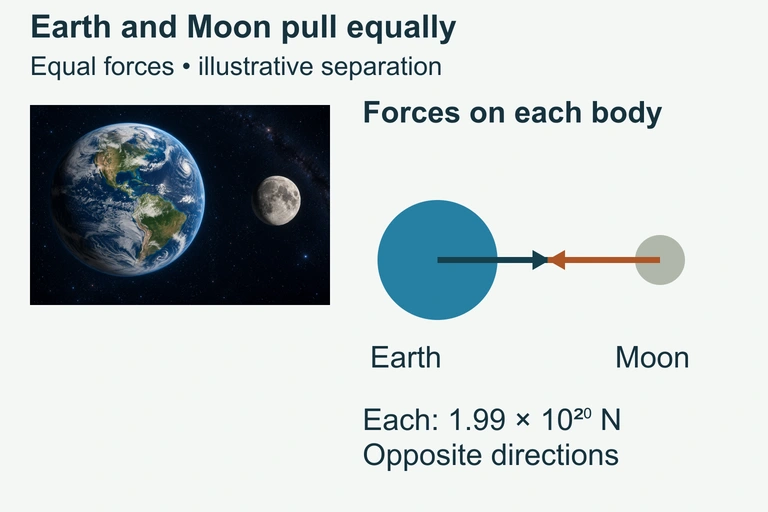
The force is always attractive, directed along the line connecting the centers of the two masses. Both objects experience the same magnitude of force.
Mutual gravitational forces
The Earth–Moon example illustrates the same law for two bodies: each pulls the other with equal magnitude in the opposite direction. The separation is measured center to center.
The Inverse-Square Relationship
Because \( F \propto \frac{1}{r^2} \), doubling the distance between two objects reduces the gravitational force to one-quarter of its original value. Tripling the distance reduces it to one-ninth.
Torsion balance tests the inverse-square law
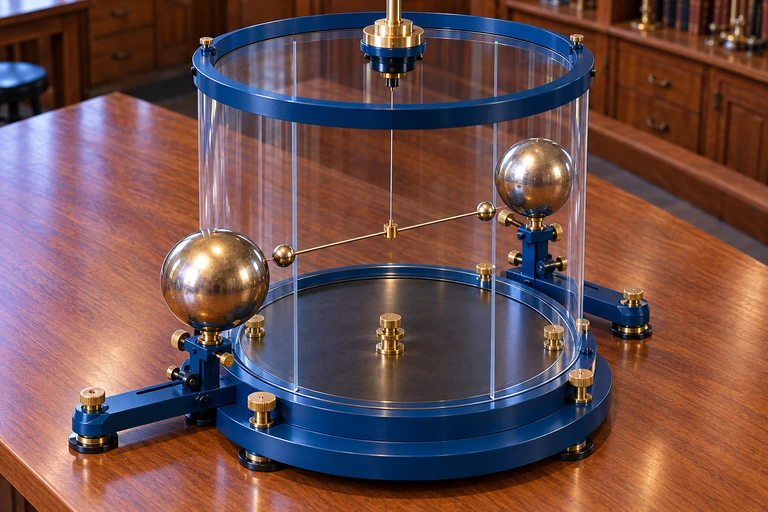 A torsion balance measures a tiny gravitational torque through a calibrated fiber’s angular deflection. Use center-to-center mass distances and include both source masses.
A tiny gravitational torque needs calibration
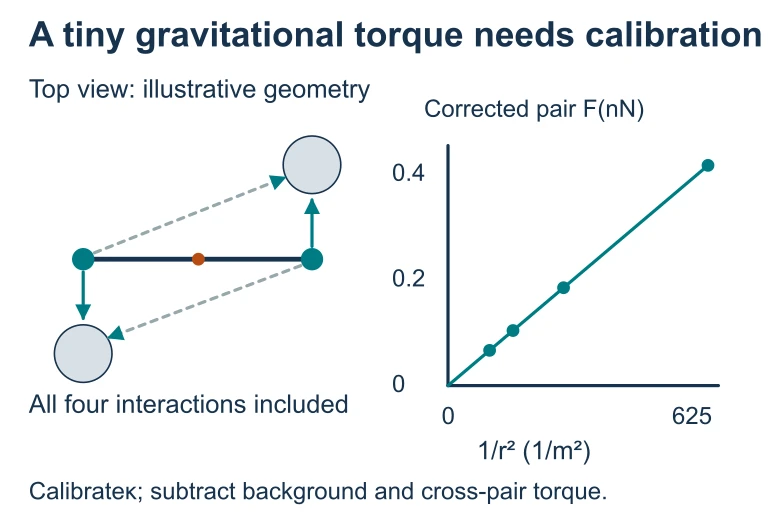 A torsion balance measures a tiny gravitational torque through a calibrated fiber’s angular deflection. Use center-to-center mass distances and include both source masses.
Gravitational Field Strength \( g \)
Near any massive body, we define the gravitational field strength as the force per unit mass experienced by a small test mass:
At Earth's surface, \( g \approx 9.8 \; \text{m/s}^2 \). This value decreases as you move farther from Earth's center.
Gravity vs. Electrostatic Force
| Gravitational | Electrostatic (Coulomb's) | |
|---|---|---|
| Law | \( F = G\frac{m_1 m_2}{r^2} \) | \( F = k\frac{q_1 q_2}{r^2} \) |
| Direction | Always attractive | Attractive or repulsive |
| Depends on | Mass | Charge |
| Relative strength | Very weak | Very strong |
| Range | Infinite | Infinite |
How to Apply the Law
Example 1: Two Masses on a Table
Two bowling balls, each with mass \( m = 7.0 \; \text{kg} \), are placed with their centers \( r = 0.50 \; \text{m} \) apart. Find the gravitational force between them.
Example 2: Your Weight from Earth
Calculate the gravitational force on a \( 65 \; \text{kg} \) person standing on Earth's surface. Use \( M_E = 5.97 \times 10^{24} \; \text{kg} \) and \( R_E = 6.37 \times 10^6 \; \text{m} \).
Example 3: Doubling the Distance
A satellite orbits Earth at altitude \( h = R_E \) above the surface (so \( r = 2R_E \) from Earth's center). How does the gravitational force on the satellite compare to its weight on the surface?
Superposition of Gravitational Forces
When more than two masses are present, the net gravitational force on any one mass is the vector sum of the individual forces from all other masses:
Calculate each force separately, then add them as vectors (break into components).
Gravity and Circular Orbits
For a satellite in a circular orbit, gravity provides the centripetal force:
Common Mistakes
Summary of Key Relationships
| Quantity | Formula | Key Insight |
|---|---|---|
| Gravitational force | \( F = G\frac{m_1 m_2}{r^2} \) | Inversely proportional to \( r^2 \) |
| Field strength | \( g = \frac{GM}{r^2} \) | Independent of test mass |
| Weight | \( W = mg \) | Varies with location |
| Orbital speed | \( v = \sqrt{\frac{GM}{r}} \) | Independent of satellite mass |
Question 1 of 5
If the distance between two objects is tripled, by what factor does the gravitational force between them change?
Question 2 of 5
Two objects of mass \( m \) are separated by distance \( d \). If both masses are doubled and the distance is halved, the new force is:
Question 3 of 5
A planet has twice the mass of Earth and twice the radius. What is the gravitational field strength \( g \) on its surface compared to Earth's?
Question 4 of 5
An astronaut in the International Space Station (ISS) feels "weightless." Which statement best explains why?
Question 5 of 5
What is the orbital speed of a satellite orbiting Earth at a distance of \( 2R_E \) from Earth's center? Use \( g = 9.8 \; \text{m/s}^2 \) and \( R_E = 6.37 \times 10^6 \; \text{m} \).