Frequency & Period
of Simple Harmonic Motion
Master the timing of oscillations: how \( T \) and \( f \) describe every spring and pendulum in the universe.
What is Simple Harmonic Motion?
Simple Harmonic Motion (SHM) is a type of periodic, oscillatory motion where the restoring force is directly proportional to displacement from equilibrium: \( F = -kx \). The object moves back and forth through a central point, repeating the same path over and over.
Visualizing an Oscillation Cycle
Defining the Period \( T \)
The period \( T \) is the time it takes for one complete oscillation cycle. It is measured in seconds (s). A longer period means the object oscillates more slowly.
Defining the Frequency \( f \)
The frequency \( f \) is the number of complete oscillations per unit time. It is measured in hertz (Hz), where \( 1\,\text{Hz} = 1\,\text{cycle/s} \). A higher frequency means faster oscillation.
The Core Relationship: \( T = \frac{1}{f} \)
Period and frequency are reciprocals of each other. Knowing one immediately gives you the other:
Introducing Angular Frequency \( \omega \)
Angular frequency \( \omega \) measures how fast the oscillation sweeps through its cycle in radians per second. One full cycle = \( 2\pi \) radians, so:
Period of a Mass-Spring System
Key point: the period does not depend on amplitude. A larger stretch produces faster peak speeds but takes the same time per cycle.
Period of a Simple Pendulum
For small angles (\( < 15^\circ \)), the pendulum's period depends only on the string length and local gravity: not mass, not amplitude.
Period vs. Frequency
| Period \( T \) | Frequency \( f \) | |
|---|---|---|
| What it measures | Time per one cycle | Cycles per unit time |
| Unit | seconds (s) | hertz (Hz = \( \text{s}^{-1} \)) |
| If motion speeds up | Decreases | Increases |
| Formula link | \( T = 1/f \) | \( f = 1/T \) |
| Intuition | "How long to complete one?" | "How many in one second?" |
What Affects \( T \) and \( f \)?
| Mass-Spring | Pendulum | |
|---|---|---|
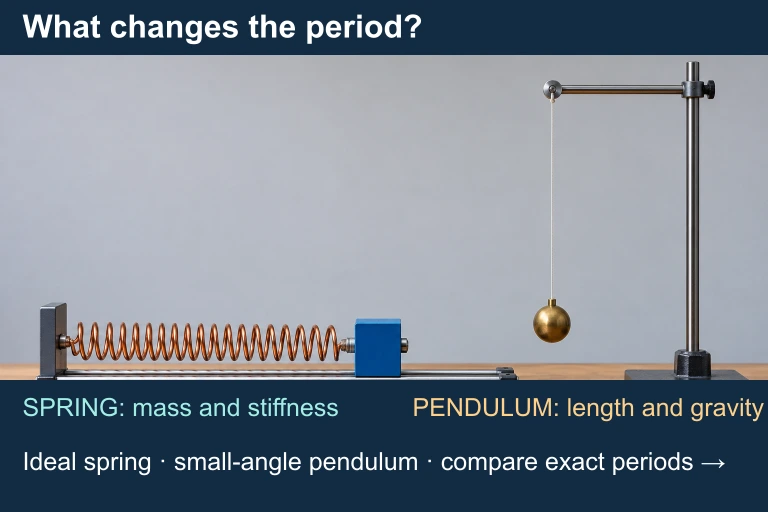
| Increases \( T \) | Larger m, smaller k | Longer L, weaker g |
| Amplitude? | No effect | No effect (small angles) |
| Mass? | Yes: \( T \propto \sqrt{m} \) | No effect |
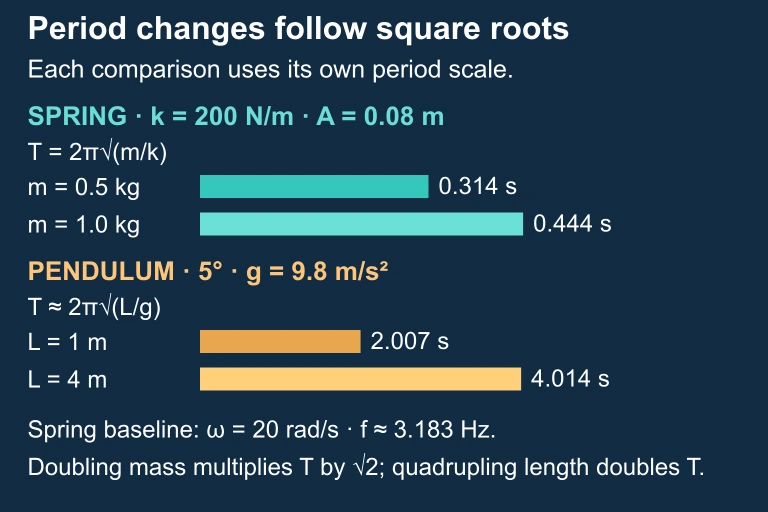
| Formula | \( T = 2\pi\sqrt{m/k} \) | \( T = 2\pi\sqrt{L/g} \) |
Comparing oscillator periods
These two coordinated panels compare the parameters in the spring and small-angle pendulum formulas. The timing comparison uses the separately declared scales shown in the companion.
How to Solve SHM Problems
Example 1: Mass-Spring Period
A 0.50 kg block is attached to a spring with constant \( k = 200\,\text{N/m} \). Find the period and frequency of oscillation.
Example 2: Pendulum on the Moon
A pendulum has length \( L = 1.0\,\text{m} \). Compare its period on Earth (\( g = 9.8\,\text{m/s}^2 \)) and on the Moon (\( g = 1.6\,\text{m/s}^2 \)).
\( T_E = 2\pi(0.3194) \)
\( T_E \approx 2.01\,\text{s} \)
\( T_M = 2\pi(0.7906) \)
\( T_M \approx 4.97\,\text{s} \)
Example 3: Finding \( k \) from \( T \)
A 2.0 kg mass oscillates on a spring with period \( T = 0.80\,\text{s} \). Find the spring constant \( k \).
Common Mistakes to Avoid
Question 1 of 5
A mass-spring system has a period of \( T = 0.5\,\text{s} \). What is its frequency?
Question 2 of 5
If the mass on a spring is quadrupled, what happens to the period?
Question 3 of 5
A simple pendulum has \( T = 2.0\,\text{s} \) on Earth. If taken to a planet where \( g \) is 4 times Earth's gravity, what is the new period?
Question 4 of 5
Which of the following does NOT affect the period of a simple pendulum (small angle)?
Question 5 of 5
A spring with \( k = 50\,\text{N/m} \) supports a \( 2.0\,\text{kg} \) mass. What is the angular frequency \( \omega \)?