01 / 22

Fluids and
Newton's Laws

Discover how pressure, buoyancy, and fluid dynamics emerge directly from the same force and motion principles you already know.

AP Physics 1

What Is a Fluid?

A fluid is any substance that flows and conforms to the shape of its container. Both liquids and gases qualify as fluids because their molecules can move freely past one another.

Liquids
Nearly incompressible. Definite volume, no definite shape. Molecules close together.
Gases
Highly compressible. No definite volume or shape. Molecules far apart and fast-moving.

Defining Pressure

Pressure is the normal force per unit area that a fluid exerts on a surface. It acts in all directions at any point within the fluid.

\( F_{\perp} \) Area A \( P = \frac{F_{\perp}}{A} \)

Pressure Increases with Depth

Consider a thin horizontal slab of fluid at depth \( h \). Newton's second law in the vertical direction (with \( a = 0 \) for a static fluid) gives the hydrostatic pressure equation.

Surface h \( mg \) \( PA \) (from below) \( P_0 A \) (from above) \( \sum F = 0 \) \( PA - P_0 A - mg = 0 \)

Pascal's Principle

A change in pressure applied to an enclosed, incompressible fluid is transmitted undiminished to every portion of the fluid and the walls of the container.

\( F_1 \) \( A_1 \) (small) \( F_2 \) \( A_2 \) (large)

Buoyancy and Archimedes' Principle

The buoyant force on an object submerged in a fluid equals the weight of the fluid displaced by the object. This arises from the pressure difference between the bottom and top of the object.

Water surface Object \( mg \) \( F_B \) Higher P (bottom) Lower P (top) Net upward \( = F_B \)

Additional worked example

The following is a separate example from the long-form lesson. Its values may differ from the example already on this slide.

A solid aluminum cube with side length 0.10 m is suspended by a string and fully submerged in water. Determine (a) the buoyant force on the cube, (b) the tension in the string, and (c) the apparent weight of the cube. Use ρ_(Al) = 2700 kg/m³, ρ_(water) = 1000 kg/m³, and g = 9.8 m/s².

Show answer and explanation

Step 1 — Identify the Given Values: Side length s = 0.10 m, so V = s³ = (0.10)³ = 1.0 × 10⁻³ m³. The cube is fully submerged, so V_(displaced) = V = 1.0 × 10⁻³ m³. We also know ρ_(Al) = 2700 kg/m³ and ρ_(water) = 1000 kg/m³. Step 2 — Calculate the Buoyant Force: Apply Archimedes' principle: F_(b) = ρ_(water) × g × V_(displaced) = (1000)(9.8)(1.0 × 10⁻³). F_b = 9.8 N Step 3 — Calculate the Weight of the Cube: W = m × g = ρ_(Al) × V × g = (2700)(1.0 × 10⁻³)(9.8). W = 26.46 N Step 4 — Apply Newton's Second Law (Equilibrium): The cube is stationary (a = 0), so ΣF_(y) = 0. Three forces act on the cube: tension T (up), buoyant force F_(b) (up), and weight W (down). Therefore T + F_(b) − W = 0, giving T = W − F_(b) = 26.46 − 9.8. T = 16.66 N ≈ 16.7 N Step 5 — Determine Apparent Weight: The apparent weight is the reading a scale or string tension would show—effectively the true weight minus the buoyant force. Since the string tension supports the cube against both gravity and the buoyant force, the apparent weight equals the tension. Apparent weight = T = 16.7 N (compared to true weight of 26.5 N)
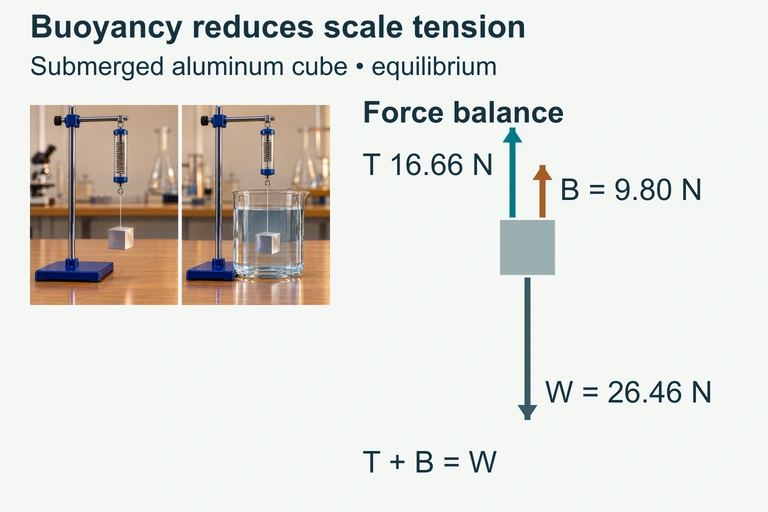
A fully submerged 0.10 m aluminum cube is supported without touching the vessel: weight 26.46 N downward, buoyancy 9.80 N upward and tension 16.66 N upward. T + B = W at equilibrium; arrow lengths are schematic.

Apparent weight measures tension rather than changed gravity
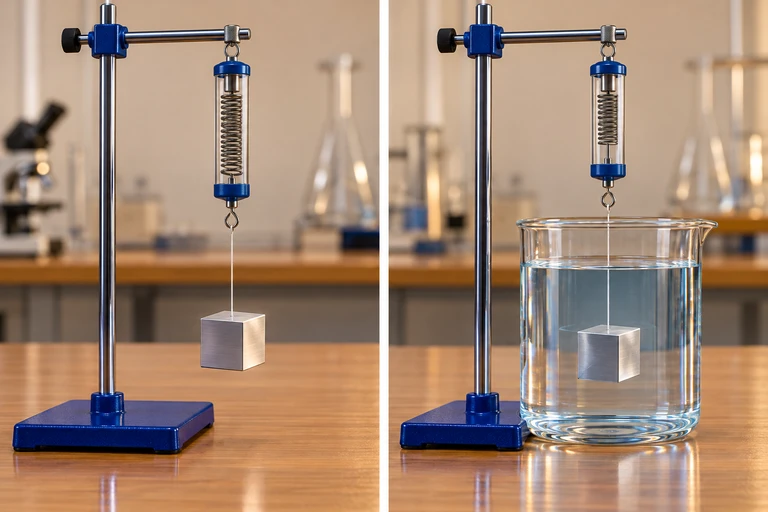
Matched spring scales suspend an aluminum cube in air and fully underwater, with a taut thread and clear gaps around the submerged cube.Submersion changes a supporting scale’s tension without changing the object’s gravitational force. At rest, upward tension plus buoyancy balances the weight.

Apparent weight is the supporting tension
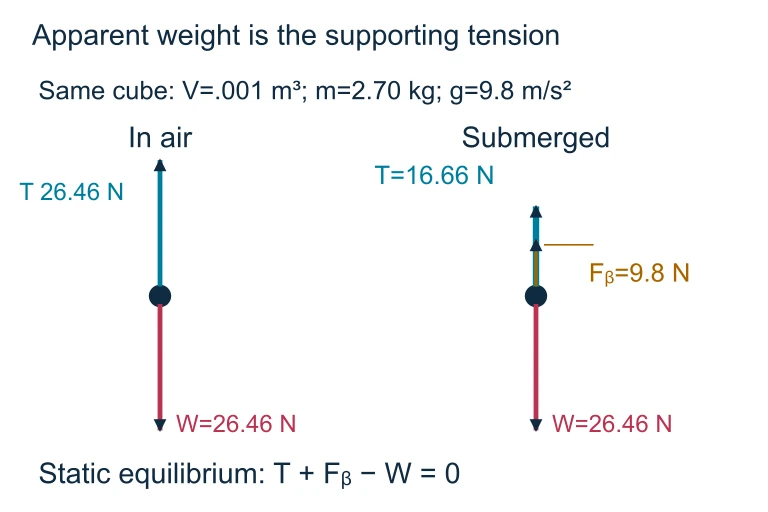
Apparent weight is the supporting tension. Submersion changes a supporting scale’s tension without changing the object’s gravitational force. At rest, upward tension plus buoyancy balances the weight.Submersion changes a supporting scale’s tension without changing the object’s gravitational force. At rest, upward tension plus buoyancy balances the weight.

Buoyancy reduces the scale reading, not gravity
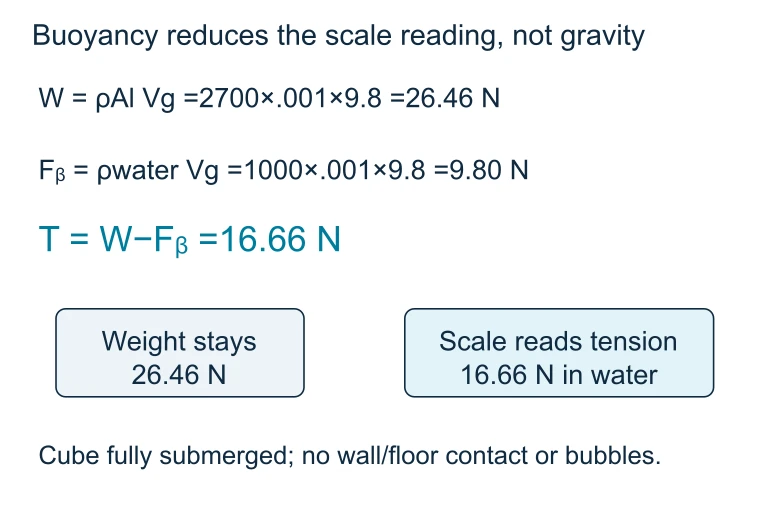
Buoyancy reduces the scale reading, not gravity. Submersion changes a supporting scale’s tension without changing the object’s gravitational force. At rest, upward tension plus buoyancy balances the weight.Submersion changes a supporting scale’s tension without changing the object’s gravitational force. At rest, upward tension plus buoyancy balances the weight.

Newton's Second Law for a Fluid Element

Take a tiny cube of fluid with sides \( \Delta x \). The net pressure force in one direction plus gravity gives the acceleration of that parcel:

Static Fluid
\( a = 0 \): pressure forces balance gravity. Result: \( P = P_0 + \rho g h \).
Accelerating Fluid
\( a \neq 0 \): net force causes flow. Pressure differences drive the fluid to accelerate.

The Continuity Equation

For an incompressible fluid flowing through a pipe, mass conservation requires the volume flow rate to be the same everywhere:

\( v_1 \) \( A_1 \) \( v_2 > v_1 \) \( A_2 \)

Bernoulli's Equation

Applying Newton's second law (or the work-energy theorem) to a streamline of ideal fluid gives Bernoulli's equation: energy per unit volume is constant along a streamline.

Gauge vs Absolute Pressure

Gauge Pressure Absolute Pressure
Definition Pressure above atmospheric Total pressure including atmosphere
Formula \( P_g = \rho g h \) \( P_{abs} = P_{atm} + \rho g h \)
Can be negative? Yes (vacuum) No (minimum is 0)
Read by Tire gauge, blood pressure cuff Barometer
Use in Bernoulli Only if both points share same \( P_{atm} \) Always valid

Sink or Float?

Whether an object floats or sinks depends on the balance between its weight and the buoyant force: Newton's second law in disguise.

Floats
\( \rho_{\text{object}} < \rho_{\text{fluid}} \): buoyant force can match weight before full submersion.
Neutrally Buoyant
\( \rho_{\text{object}} = \rho_{\text{fluid}} \): object remains at whatever depth it is placed.
Sinks
\( \rho_{\text{object}} > \rho_{\text{fluid}} \): weight exceeds maximum buoyant force (fully submerged).

How to Solve Fluid Problems

1
Draw a free-body diagram. Identify all forces on the object or fluid element: weight, pressure forces, buoyant force, normal forces.
2
Choose the right equation. Static fluid: \( P = P_0 + \rho g h \). Flowing fluid: \( A_1 v_1 = A_2 v_2 \) and Bernoulli's equation. Buoyancy: \( F_B = \rho_f V_d g \).
3
Set a reference level. Define \( y = 0 \) for Bernoulli or the surface for depth \( h \). Be consistent.
4
Apply Newton's second law (\( \sum F = ma \)) if the system accelerates; set \( a = 0 \) for equilibrium.
5
Solve algebraically and check units. Pressure in Pa, force in N, density in \( \text{kg}/\text{m}^3 \).

Example 1: Hydrostatic Pressure

A diver is 25 m below the surface of a freshwater lake (\( \rho = 1000\;\text{kg}/\text{m}^3 \)). What is the absolute pressure on the diver? (\( P_{atm} = 1.01 \times 10^5 \;\text{Pa} \))

Example 2: Buoyancy Force

A wooden block (\( \rho = 600\;\text{kg}/\text{m}^3 \), volume \( 0.02\;\text{m}^3 \)) is placed in water. What fraction is submerged? What is the buoyant force?

Example 3: Bernoulli's Equation

Water flows through a horizontal pipe. At point 1 the diameter is 10 cm and speed is 2 m/s. At point 2 the diameter is 5 cm. Find the speed at point 2 and the pressure difference.

Common Mistakes

✕ Forgetting Atmosphere
Using \( P = \rho g h \) when the question asks for absolute pressure. Always check: gauge or absolute?
✕ Wrong Volume in \( F_B \)
Using the object's total volume instead of the displaced volume. For partially submerged objects, only the underwater part counts.
✕ Bernoulli with Viscosity
Applying Bernoulli's equation to a viscous or turbulent flow. It only holds for ideal, steady, incompressible flow along a streamline.

Summary of Key Equations

Concept Equation Newton's Law Connection
Pressure \( P = \frac{F}{A} \) Force per unit area (3rd law at surface)
Hydrostatic \( P = P_0 + \rho g h \) 2nd law, \( a = 0 \) (static equilibrium)
Buoyancy \( F_B = \rho_f V_d g \) Net pressure force = weight of displaced fluid
Continuity \( A_1 v_1 = A_2 v_2 \) Mass conservation (no accumulation)
Bernoulli \( P + \tfrac{1}{2}\rho v^2 + \rho g y = \text{constant} \) Work-energy theorem along streamline
Pascal \( \frac{F_1}{A_1} = \frac{F_2}{A_2} \) Pressure transmitted undiminished

Question 1 of 5

A submarine is at a depth of 200 m in seawater (\( \rho = 1025\;\text{kg}/\text{m}^3 \)). What is the gauge pressure on its hull? (\( g = 9.8\;\text{m}/\text{s}^2 \))

Question 2 of 5

An ice cube (\( \rho_{ice} = 917\;\text{kg}/\text{m}^3 \)) floats in freshwater (\( \rho_w = 1000\;\text{kg}/\text{m}^3 \)). What fraction of the ice cube is above the waterline?

Question 3 of 5

Water flows through a horizontal pipe. The cross-sectional area at point A is four times the area at point B. If the speed at A is \( v \), what is the speed at B?

Question 4 of 5

In a hydraulic lift, a force of 50 N is applied to a piston of area \( 0.01\;\text{m}^2 \). What force can the larger piston (area \( 0.1\;\text{m}^2 \)) exert?

Question 5 of 5

Water exits a small hole near the bottom of a large open tank. If the water surface is 5 m above the hole and both the surface and hole are open to the atmosphere, what is the exit speed? (\( g = 9.8\;\text{m}/\text{s}^2 \))