Fluids and
Conservation Laws
Master pressure, Bernoulli's equation, and the continuity equation to understand how fluids behave in pipes, tanks, and everyday systems.
What Is a Fluid?
A fluid is any substance that flows and takes the shape of its container. Both liquids and gases qualify. Unlike solids, fluids cannot resist shear stress: they deform continuously under an applied force.
Pressure in Fluids at Rest
In a static fluid, pressure increases with depth. At any depth \(h\) below the surface, the absolute pressure is the atmospheric pressure plus the weight of the fluid column above.
Pascal's Principle
A change in pressure applied to an enclosed, incompressible fluid is transmitted equally to every point in the fluid and to the walls of the container. This is the basis for hydraulic systems.
The Continuity Equation
For an incompressible fluid flowing through a pipe, mass is conserved. What flows in must flow out. If the pipe narrows, the fluid speeds up.
Bernoulli's Equation
Bernoulli's equation applies conservation of energy to a flowing fluid. Along a streamline, the total of pressure energy, kinetic energy per volume, and gravitational potential energy per volume is constant.
Visualizing Bernoulli's Principle
Continuity vs Bernoulli
| Continuity Equation | Bernoulli's Equation | |
|---|---|---|
| Conservation of | Mass | Energy |
| Equation | \(A_1 v_1 = A_2 v_2\) | \(P + \frac{1}{2}\rho v^2 + \rho g y = \text{const}\) |
| Tells you | How speed changes with pipe area | How pressure, speed, and height trade off |
| Conditions | Incompressible, steady flow | Incompressible, steady, non-viscous, along a streamline |
| Number of terms | 2 | 3 (per side) |
How to Solve Fluid Problems
Example 1: Speed in a Pipe
Water flows through a horizontal pipe that narrows from a cross-sectional area of \(0.04\,\text{m}^2\) to \(0.01\,\text{m}^2\). The speed in the wide section is \(2\,\text{m/s}\). Find the speed in the narrow section.
Example 2: Pressure Drop
Using the same pipe from Example 1, the pressure in the wide section is \(200{,}000\,\text{Pa}\). Find the pressure in the narrow section. (Water density: \(\rho = 1000\,\text{kg/m}^3\), same height.)
Water through a Venturi
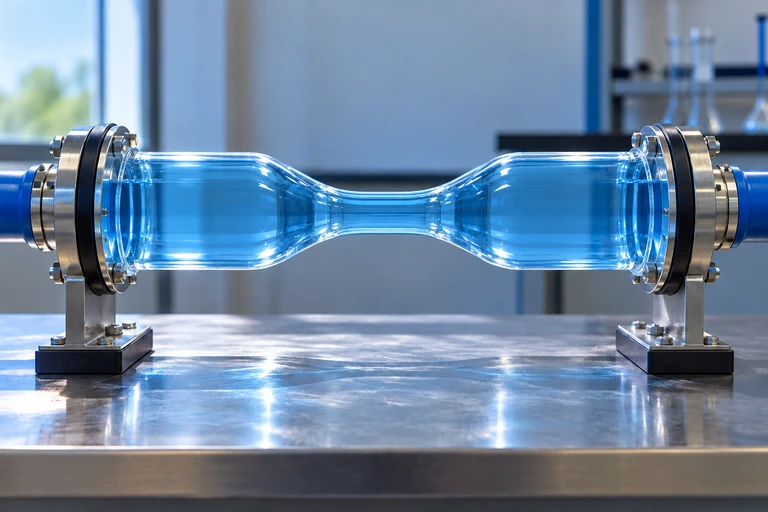 For steady horizontal water flow with negligible losses, narrowing the diameter from 8.0 cm to 4.0 cm raises speed from 1.5 to 6.0 m/s. With P₁ = 250 kPa, P₂ = 233.125 kPa.
A second pipe example: 8 cm to 4 cm
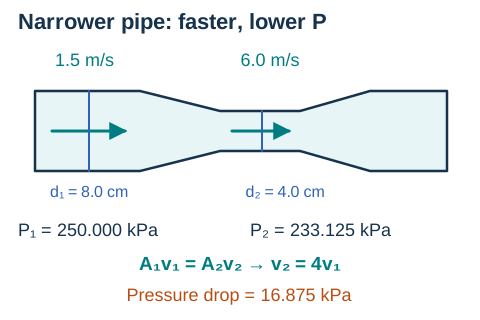 For steady horizontal water flow with negligible losses, narrowing the diameter from 8.0 cm to 4.0 cm raises speed from 1.5 to 6.0 m/s. With P₁ = 250 kPa, P₂ = 233.125 kPa.Open full diagram
Example 3: Elevated Tank
A large open tank is filled with water to a height of \(h = 5\,\text{m}\) above a small spout at the bottom. How fast does water exit the spout? (Assume the tank surface barely moves.)
Ideal outlet flow
This separate outlet example uses a 1 m depth. Both the free surface and outlet are at atmospheric pressure, and losses are neglected; these assumptions give the indicated speed.
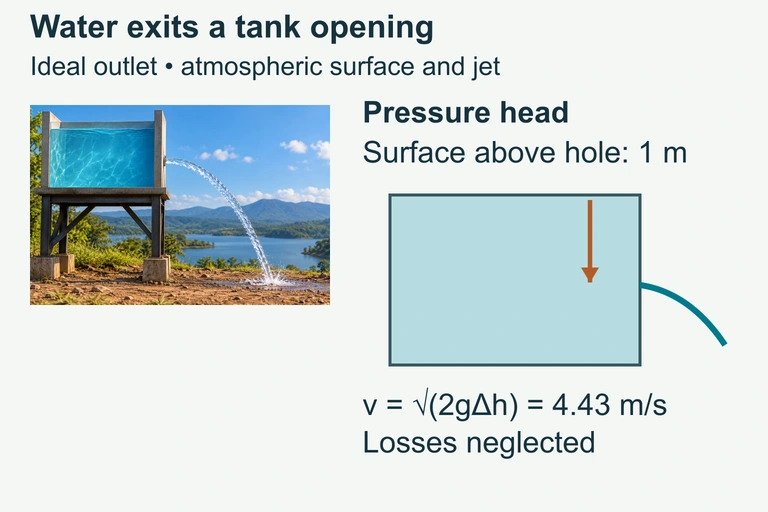
Tank-drain geometry and free-jet trajectory
 The head driving the outlet speed is the vertical difference between the water surface and the opening. The opening’s height above the ground separately determines the jet’s flight time.
Outlet speed and jet range
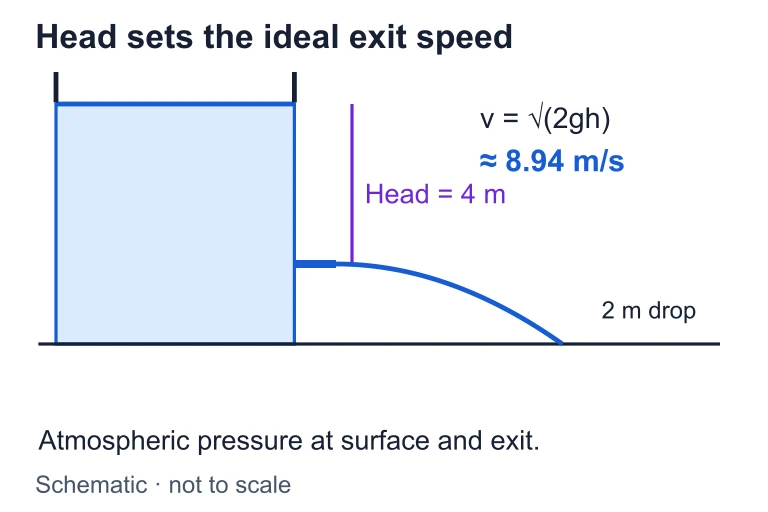 With a 4 m water head and g = 10 m/s², exit speed is about 8.94 m/s. A separate 2 m drop from outlet to ground gives flight time about 0.632 s and range about 5.66 m.
Buoyancy and Archimedes' Principle
Any object submerged (fully or partially) in a fluid experiences an upward buoyant force equal to the weight of the fluid it displaces.
The Energy Perspective
Bernoulli's equation is really just conservation of energy per unit volume. Each term represents a form of energy density:
Common Mistakes
Summary of Fluid Laws
| Law | Equation | Conserves | Key Insight |
|---|---|---|---|
| Hydrostatic | \(P = P_0 + \rho g h\) | Equilibrium | Deeper = more pressure |
| Pascal's | \(\frac{F_1}{A_1} = \frac{F_2}{A_2}\) | Pressure | Force multiplied by area ratio |
| Continuity | \(A_1 v_1 = A_2 v_2\) | Mass | Narrower = faster |
| Bernoulli | \(P + \frac{1}{2}\rho v^2 + \rho g y = \text{const}\) | Energy | Faster = lower pressure |
| Archimedes | \(F_b = \rho_f V_d g\) | Force balance | Buoyancy = displaced weight |
Question 1 of 5
Water flows through a horizontal pipe. The pipe narrows so that \(A_2 = \frac{1}{3}A_1\). If the speed in the wide section is \(v_1 = 3\,\text{m/s}\), what is \(v_2\)?
Question 2 of 5
According to Bernoulli's Principle, when an ideal fluid flows through a region where its speed increases, the pressure in that region:
Question 3 of 5
A large water tank has an open top. A small hole is at a depth of \(h = 3.2\,\text{m}\) below the water surface. Using Torricelli's theorem, the exit speed of the water is approximately:
Question 4 of 5
A hydraulic press has pistons with areas \(A_1 = 0.005\,\text{m}^2\) and \(A_2 = 0.5\,\text{m}^2\). A force of 100 N is applied to the small piston. What force is exerted by the large piston?
Question 5 of 5
A solid cube of density \(600\,\text{kg/m}^3\) is placed in water (\(\rho_w = 1000\,\text{kg/m}^3\)). What fraction of the cube's volume is submerged when it floats?