Energy of
Simple Harmonic Oscillators
Discover how kinetic energy and potential energy transform back and forth in oscillating systems, and why the total mechanical energy stays constant.
What is Simple Harmonic Motion?
Simple harmonic motion (SHM) occurs when a restoring force is directly proportional to displacement from equilibrium and directed toward it. The hallmark equation is:
Examples include a mass on a spring and a simple pendulum (for small angles). In SHM, energy continuously converts between kinetic and potential forms.
The Three Energies in SHM
Why Energy Matters in SHM
Energy methods let you solve SHM problems without tracking forces or accelerations at every instant. Since total energy is conserved (no friction), you can relate speed at one position to speed at another.
Core Energy Equations
Energy vs. Position Diagram
Energy vs. Time
A rotating peg whose shadow becomes an oscillator
 In the undamped spring model, kinetic and elastic potential energies exchange while their sum remains constant. Both energies oscillate at twice the displacement frequency.
Energy versus displacement
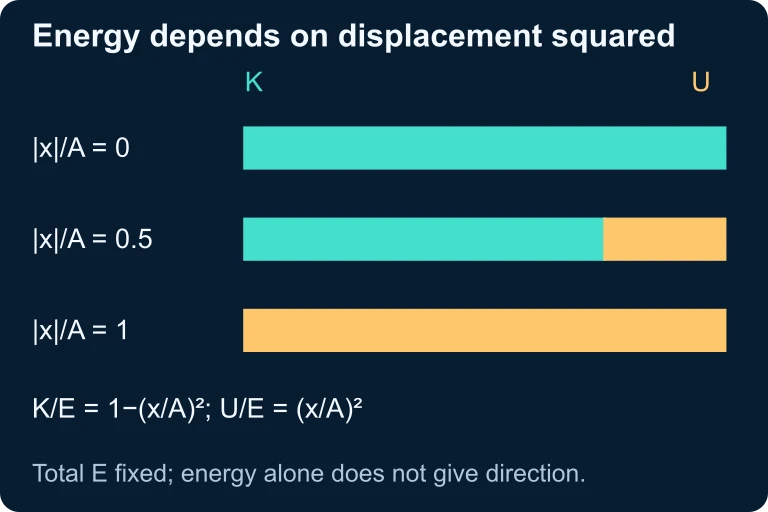 For an undamped spring oscillator, U/E = (x/A)² and K/E = 1 − (x/A)². The same energy fractions occur at positive and negative displacement of equal magnitude.
Spring vs. Pendulum Energy
| Mass-Spring | Simple Pendulum | |
|---|---|---|
| Potential Energy | \( \tfrac{1}{2}kx^2 \) (elastic) | \( mgh \) (gravitational) |
| At equilibrium | \( x = 0 \), spring relaxed | Lowest point, \( h = 0 \) |
| At max displacement | \( x = \pm A \), \( v = 0 \) | \( \theta = \theta_{\max} \), \( v = 0 \) |
| Total Energy | \( \tfrac{1}{2}kA^2 \) | \( mgL(1 - \cos\theta_{\max}) \) |
| Period depends on | \( m \) and \( k \) | \( L \) and \( g \) |
Speed at Any Position
From energy conservation, solve for the speed \( v \) at displacement \( x \):
How to Solve Energy Problems
Example 1: Finding Speed
A \(0.5\;\text{kg}\) mass on a spring (\( k = 200\;\text{N/m} \)) oscillates with amplitude \( A = 0.10\;\text{m} \). Find the speed when \( x = 0.06\;\text{m} \).
Example 2: Finding Amplitude
A mass of \(2.0\;\text{kg}\) on a spring (\( k = 50\;\text{N/m} \)) passes through equilibrium at \( v = 3.0\;\text{m/s} \). What is the amplitude?
Example 3: Energy Ratios
At what fraction of the amplitude is the kinetic energy equal to the potential energy?
What Happens When You Double \( A \)?
Common Mistakes to Avoid
Summary of Key Relationships
| Position | K | U | Speed |
|---|---|---|---|
| \( x = 0 \) | \( \tfrac{1}{2}kA^2 \) (max) | 0 | \( v_{\max} = A\omega \) |
| \( x = \pm\tfrac{A}{\sqrt{2}} \) | \( \tfrac{1}{4}kA^2 \) | \( \tfrac{1}{4}kA^2 \) | \( \tfrac{v_{\max}}{\sqrt{2}} \) |
| \( x = \pm A \) | 0 | \( \tfrac{1}{2}kA^2 \) (max) | 0 |
Question 1 of 5
A block on a spring oscillates with amplitude \( A \). If the amplitude is tripled, by what factor does the total mechanical energy change?
Question 2 of 5
In SHM, at which position is the kinetic energy at its maximum?
Question 3 of 5
A \(0.4\;\text{kg}\) block on a spring (\( k = 100\;\text{N/m} \)) has amplitude \( 0.20\;\text{m} \). What is the maximum speed of the block?
Question 4 of 5
At what displacement (as a fraction of \( A \)) is the potential energy equal to three times the kinetic energy?
Question 5 of 5
A simple pendulum swings with small amplitude. If the mass is doubled but the length and amplitude remain the same, what happens to the total energy?