Elastic & Inelastic
Collisions
Master the physics of collisions: when kinetic energy is conserved, when it isn't, and how momentum ties it all together.
What Is a Collision?
A collision occurs when two or more objects exert forces on each other over a brief time interval. During this interaction, external forces (like gravity or friction) are typically negligible compared to the enormous internal forces between the objects.
Momentum Conservation
Linear momentum is defined as \( \vec{p} = m\vec{v} \). In any collision between two objects where external forces are negligible:
This equation holds for every type of collision: elastic, inelastic, and perfectly inelastic. It comes directly from Newton's Third Law: the forces objects exert on each other are equal and opposite, so the total impulse on the system is zero.
Kinetic Energy in Collisions
While momentum is always conserved, kinetic energy may or may not be. The kinetic energy of an object is:
During a collision, kinetic energy can be converted into heat, sound, deformation, or other forms of energy. Whether this conversion happens determines the type of collision.
Elastic Collisions: Two Conservation Laws
In an elastic collision, both momentum and kinetic energy are conserved. This gives us two simultaneous equations:
Perfectly Inelastic Collisions
In a perfectly inelastic collision, the two objects stick together and move as one mass after the collision. Only momentum is conserved:
This type loses the maximum amount of kinetic energy possible while still conserving momentum. Examples: a football tackle, a ball of clay hitting a wall.
Elastic vs. Inelastic: Key Distinction
| Property | Elastic | Inelastic | Perfectly Inelastic |
|---|---|---|---|
| Momentum conserved? | ✓ Yes | ✓ Yes | ✓ Yes |
| KE conserved? | ✓ Yes | ✕ No | ✕ No |
| Objects after? | Bounce apart | Bounce (some KE lost) | Stick together |
| KE lost to | Nothing | Sound, heat, deformation | Maximum loss |
| Real example | Billiard balls (approx.) | Car crash (cars separate) | Catching a ball |
A cart collision
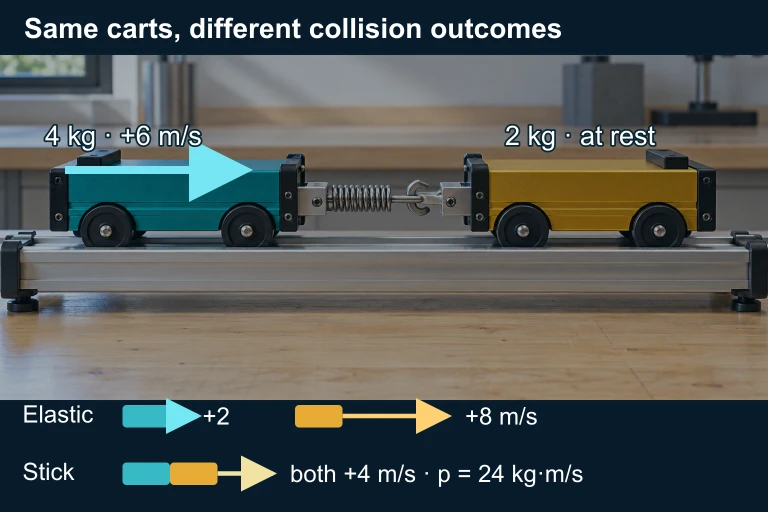
This source example asks about sticking. The graphic also shows the elastic outcome for the same incoming cart masses and speed.
A 4.0 kg cart moving at 6.0 m/s to the right collides with a 2.0 kg cart initially at rest on a frictionless track. The two carts lock together after the collision. Find (a) the final velocity and (b) the fraction of kinetic energy lost.
Show answer and explanation
Step 2 — Classify the Collision: The carts lock together, so this is a perfectly inelastic collision. We use: m₁v₁ᵢ + m₂v₂ᵢ = (m₁ + m₂)vf. Step 3 — Apply Conservation of Momentum: Substituting: (4.0 kg)(6.0 m/s) + (2.0 kg)(0 m/s) = (4.0 + 2.0 kg) × vf → 24 kg·m/s = 6.0 kg × vf. vf = 4.0 m/s to the right Step 4 — Calculate Initial Kinetic Energy: KEᵢ = ½m₁v₁ᵢ² + ½m₂v₂ᵢ² = ½(4.0)(6.0)² + 0 = 72 J. KEᵢ = 72 J Step 5 — Calculate Final Kinetic Energy: KEf = ½(m₁ + m₂)vf² = ½(6.0)(4.0)² = 48 J. KEf = 48 J Step 6 — Determine Fraction of KE Lost: ΔKE = 72 − 48 = 24 J. Fraction lost = ΔKE / KEᵢ = 24 / 72 = 1/3 ≈ 0.33. One-third of the kinetic energy was converted into internal energy (heat, sound, deformation). Notice that in any perfectly inelastic collision where one object is initially at rest, the fraction of KE lost equals m₂ / (m₁ + m₂), which here is 2/6 = 1/3. Fraction lost = 1/3 (about 33%)
Why Momentum Is Always Conserved
How to Solve Collision Problems
Example 1: Elastic Collision
A \( 2\,\text{kg} \) ball moving at \( 5\,\text{m/s} \) collides elastically with a \( 3\,\text{kg} \) ball at rest. Find the final velocities of both balls.
Example 2: Perfectly Inelastic
A \( 4\,\text{kg} \) cart moving at \( 6\,\text{m/s} \) collides with and sticks to a \( 2\,\text{kg} \) cart moving at \( -3\,\text{m/s} \) (opposite direction). Find the final velocity and the kinetic energy lost.
Example 3: Ballistic Pendulum
A \( 0.01\,\text{kg} \) bullet embeds in a \( 2\,\text{kg} \) block hanging from a string. The block+bullet rises \( 0.45\,\text{m} \). Find the bullet's speed.
The impact that becomes a pendulum swing
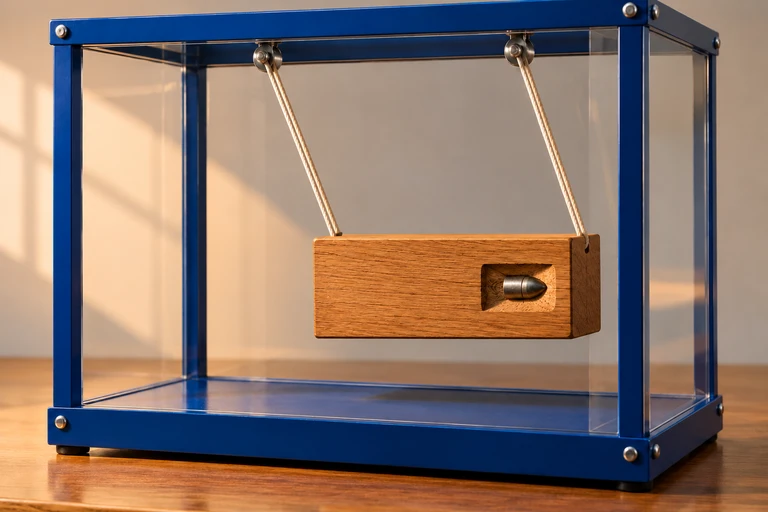
Treat capture and swing as separate stages. Horizontal momentum is conserved during the short impact; mechanical energy is conserved during the subsequent ideal swing.The impact that becomes a pendulum swing
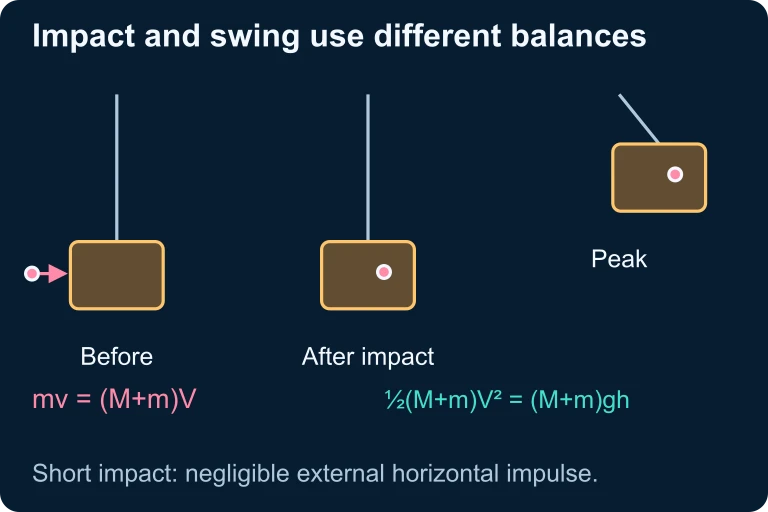
Treat capture and swing as separate stages. Horizontal momentum is conserved during the short impact; mechanical energy is conserved during the subsequent ideal swing.Special Elastic Cases
Quantifying Energy Loss
For a perfectly inelastic collision where object 2 is initially at rest, the fraction of kinetic energy lost has a clean formula:
Common Mistakes
Summary of Collision Equations
| Equation | Elastic | Inelastic | Perf. Inelastic |
|---|---|---|---|
| \( \Sigma p_i = \Sigma p_f \) | ✓ | ✓ | ✓ |
| \( \Sigma KE_i = \Sigma KE_f \) | ✓ | ✕ | ✕ |
| Relative velocity condition | ✓ | ✕ | ✕ |
| Objects stick? | ✕ | ✕ | ✓ |
| # of unknowns solvable | 2 (two equations) | 1 (one equation) | 1 (one equation) |
Question 1 of 5
In all collisions (elastic, inelastic, and perfectly inelastic), which quantity is always conserved?
Question 2 of 5
A \( 3\,\text{kg} \) object moving at \( 4\,\text{m/s} \) collides with and sticks to a \( 1\,\text{kg} \) object at rest. What is the final velocity of the combined object?
Question 3 of 5
Two objects of equal mass undergo a head-on elastic collision. Object A is moving at \( 6\,\text{m/s} \) and object B is at rest. What happens after the collision?
Question 4 of 5
A \( 5\,\text{kg} \) ball moving at \( 8\,\text{m/s} \) collides with a \( 5\,\text{kg} \) ball at rest. After the collision, the first ball moves at \( 2\,\text{m/s} \) in the original direction. How much kinetic energy was lost?
Question 5 of 5
Which of the following collisions loses the greatest fraction of the system's initial kinetic energy?