Simple Harmonic
Motion
Explore the physics of oscillations, understand the restoring force, and master the equations that describe periodic motion from springs to pendulums.
What Is Oscillation?
An oscillation is any repetitive back-and-forth motion around a central point called the equilibrium position. When you pull a mass on a spring and release it, the mass moves back and forth: that is oscillation.
Defining Simple Harmonic Motion
Simple Harmonic Motion (SHM) is a special type of oscillation where the restoring force is directly proportional to the displacement from equilibrium and always directed toward it.
This linear relationship between force and displacement is what makes the motion "simple." If the restoring force has any other dependence on \( x \), the motion is oscillatory but not simple harmonic.
Visualizing SHM: Mass-Spring System
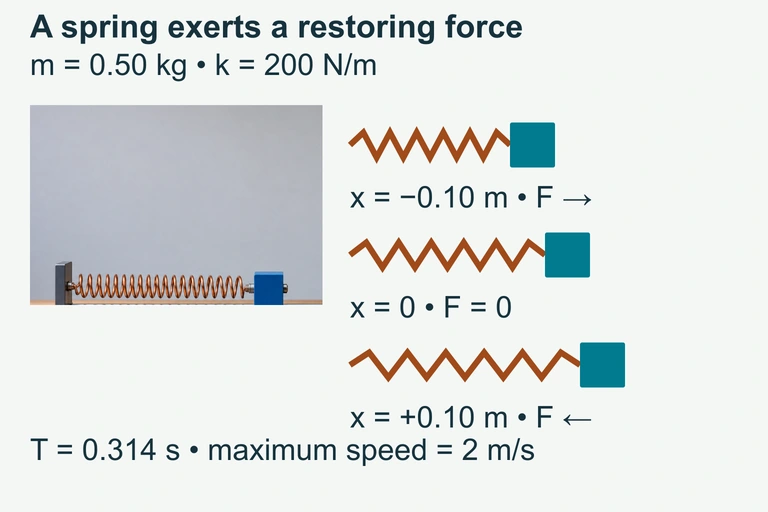
A numerical illustration of the restoring force
This separate spring example illustrates the same force directions with m = 0.50 kg, k = 200 N/m, and amplitude 0.10 m. Its period and maximum speed apply to these values.
The Equation of Motion
Applying Newton's second law \( F = ma \) to the restoring force \( F = -kx \) gives us the fundamental differential equation of SHM:
The acceleration is always proportional to and opposite in direction to the displacement. This is the hallmark of SHM: \( a \propto -x \).
Position, Velocity, and Acceleration
The solution to \( a = -\omega^2 x \) gives position as a sinusoidal function of time. Velocity and acceleration follow by differentiation:
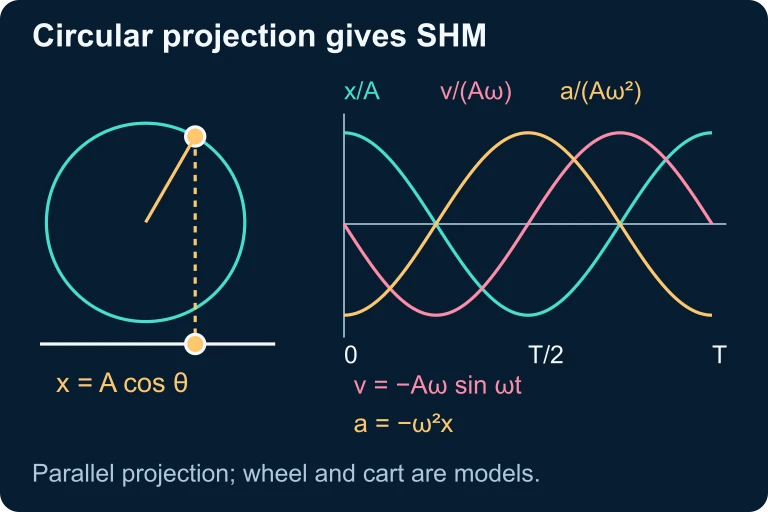
A rotating peg whose shadow becomes an oscillator
 One coordinate of a peg in uniform circular motion varies sinusoidally. The spring cart provides a second oscillator model in which acceleration points toward equilibrium.
A rotating peg whose shadow becomes an oscillator
 One coordinate of a peg in uniform circular motion varies sinusoidally. The spring cart provides a second oscillator model in which acceleration points toward equilibrium.
Graphing SHM Over Time
Key SHM Parameters
SHM vs. General Oscillation
| Property | Simple Harmonic | General Oscillation |
|---|---|---|
| Restoring Force | \( F = -kx \) (linear) | Any function of \( x \) |
| Motion Shape | Perfectly sinusoidal | May be non-sinusoidal |
| Period | Independent of amplitude | May depend on amplitude |
| Examples | Ideal spring, small-angle pendulum | Large-angle pendulum, bouncing ball |
Energy in SHM
In SHM, energy continuously converts between kinetic and potential forms while the total mechanical energy remains constant (no friction).
Maximum at equilibrium, zero at endpoints
Maximum at endpoints, zero at equilibrium
Energy Diagram in SHM
Period of a Mass-Spring System
Period of a Simple Pendulum
How to Identify SHM
Example 1: Spring Period
A \(0.50 \text{ kg}\) block is attached to a spring with spring constant \( k = 200 \text{ N/m}\). Find the period and frequency of oscillation.
Example 2: Maximum Speed
The same block (\( m = 0.50 \text{ kg} \), \( k = 200 \text{ N/m} \)) is pulled \(0.08 \text{ m}\) from equilibrium and released. Find the maximum speed.
Common Mistakes
SHM Summary
| Quantity | Formula | Units |
|---|---|---|
| Position | \( x(t) = A\cos(\omega t + \phi) \) | \(\text{m}\) |
| Velocity | \( v(t) = -A\omega\sin(\omega t + \phi) \) | \(\text{m/s}\) |
| Acceleration | \( a(t) = -\omega^2 x \) | \(\text{m/s}^2\) |
| Period (spring) | \( T = 2\pi\sqrt{m/k} \) | \(\text{s}\) |
| Period (pendulum) | \( T = 2\pi\sqrt{L/g} \) | \(\text{s}\) |
| Max Speed | \( v_{\max} = A\omega \) | \(\text{m/s}\) |
| Total Energy | \( E = \frac{1}{2}kA^2 \) | \(\text{J}\) |
Question 1 of 5
Which condition must be true for a system to undergo simple harmonic motion?
Question 2 of 5
A mass on a spring has period \( T \). If the mass is quadrupled, what is the new period?
Question 3 of 5
In SHM, at what position does the object have maximum speed?
Question 4 of 5
A simple pendulum has length \( L \) and period \( T \) on Earth. If taken to a planet where \( g \) is four times Earth's gravity, what is the new period?
Question 5 of 5
If the amplitude of a mass-spring SHM system is doubled, what happens to the total mechanical energy?