01 / 21

Conservation of
Linear Momentum

Discover why total momentum stays constant in isolated systems, and master the principle behind collisions and explosions.

AP Physics 1

What Is Momentum?

Momentum is a vector quantity that describes the "quantity of motion" an object possesses. It depends on both mass and velocity:

Vector
Momentum has both magnitude and direction, matching the direction of velocity.
SI Unit
Measured in kg·m/s. There is no special named unit for momentum.

Impulse and Newton's Second Law

Newton's Second Law can be rewritten in terms of momentum. The net force on an object equals the rate of change of its momentum:

Impulse (\( \vec{J} \)) is the product of force and the time interval over which it acts. It equals the change in momentum of the object.

Internal vs External Forces

To apply conservation of momentum, you must define a system of objects and classify every force:

Internal Forces
Forces between objects within the system. By Newton's Third Law, they always cancel in pairs and cannot change total momentum.
External Forces
Forces from outside the system (gravity, friction with ground, applied pushes). These can change total momentum.

The Conservation Law

BEFORE \( m_1 \) \( v_{1i} \) \( m_2 \) \( v_{2i} = 0 \) → AFTER \( m_1 \) \( v_{1f} \) \( m_2 \) \( v_{2f} \) \( m_1 v_{1i} + m_2 v_{2i} = m_1 v_{1f} + m_2 v_{2f} \)

The Two-Object Equation

For a system of two objects with no net external force, conservation of momentum gives us:

1
Assign a positive direction. Choose one direction (e.g., right) as positive. Objects moving in the opposite direction get a negative velocity.
2
Plug in known values. Substitute masses and initial/final velocities. Use signs consistently.
3
Solve for the unknown. Typically one final velocity is unknown. The sign of your answer tells you the direction.

Elastic vs Inelastic Collisions

Momentum is conserved in all collisions (assuming an isolated system). The distinction lies in whether kinetic energy is also conserved:

Elastic Inelastic Perfectly Inelastic
Momentum Conserved? Yes Yes Yes
KE Conserved? Yes No No (max loss)
Objects After Bounce apart May deform Stick together
Example Billiard balls Car crash (bounce) Catching a ball

Perfectly Inelastic Collisions

When objects stick together after colliding, they share a common final velocity \( v_f \). This simplifies the conservation equation:

BEFORE \( m_1 \) \( v_{1i} \) \( m_2 \) → AFTER \( m_1+m_2 \) \( v_f \) Objects stick together → single final velocity

Additional worked example

The following is a separate example from the long-form lesson. Its values may differ from the example already on this slide.

A 1200 kg car traveling east at 15 m/s collides with a 900 kg car traveling west at 10 m/s. The cars lock bumpers and slide together after the collision. Determine the velocity of the combined wreckage immediately after impact, and calculate the fraction of kinetic energy lost.

Show answer and explanation

Step 1 — Define the System & Coordinate Axis: The system consists of both cars. Define east as the positive direction. Car 1: m₁ = 1200 kg, v₁ᵢ = +15 m/s. Car 2: m₂ = 900 kg, v₂ᵢ = −10 m/s (west is negative). Since the collision happens quickly and friction during the collision is negligible compared to the enormous internal forces, the system is approximately isolated during the impact. Step 2 — Write Conservation of Momentum: Because the cars stick together (perfectly inelastic), they share a common final velocity vf. The conservation equation is: m₁v₁ᵢ + m₂v₂ᵢ = (m₁ + m₂)vf. Step 3 — Substitute and Solve for vf: (1200)(+15) + (900)(−10) = (1200 + 900)vf → 18000 − 9000 = 2100 × vf → 9000 = 2100 × vf → vf = 9000 / 2100 ≈ 4.29 m/s. vf ≈ +4.3 m/s (east) Step 4 — Calculate Initial and Final Kinetic Energies: KE_initial = ½m₁v₁ᵢ² + ½m₂v₂ᵢ² = ½(1200)(15²) + ½(900)(10²) = 135000 + 45000 = 180000 J. KE_final = ½(2100)(4.29²) ≈ ½(2100)(18.38) ≈ 19300 J. Step 5 — Determine the Fraction of KE Lost: Fraction lost = (KE_initial − KE_final) / KE_initial = (180000 − 19300) / 180000 ≈ 0.893. Approximately 89% of the original kinetic energy is converted into thermal energy, sound, and permanent deformation of the vehicles. This dramatic energy loss is characteristic of perfectly inelastic collisions, yet momentum is perfectly conserved. ≈ 89% of KE is lost
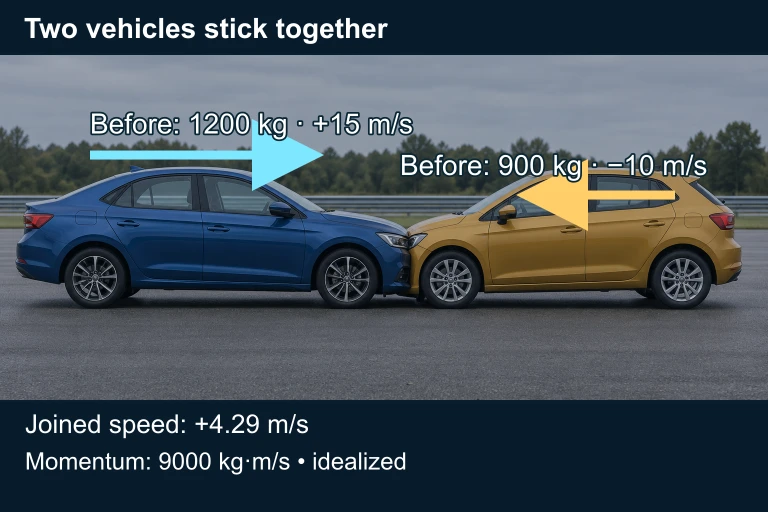
Cars of 1200 kg at +15 m/s and 900 kg at −10 m/s stick together with velocity +30/7 ≈ +4.29 m/s. Momentum remains +9000 kg·m/s; kinetic energy decreases.

Explosions and Recoil

An explosion is the reverse of a perfectly inelastic collision: one object splits into two or more pieces. If the system starts at rest, total momentum before is zero:

The pieces fly off in opposite directions with momenta that are equal in magnitude. A cannon recoiling after firing a shell is a classic example: the heavy cannon moves slowly backward while the lighter shell moves quickly forward.

How to Solve Momentum Problems

1
Define your system. Identify which objects to include so that external forces are zero (or negligible).
2
Choose a coordinate axis and assign a positive direction. Velocities opposite to that direction are negative.
3
Write conservation of momentum: \( \sum p_i = \sum p_f \). Expand for each object.
4
Substitute known values (masses and velocities). Keep signs consistent.
5
Solve algebraically. Interpret the sign of the answer as the direction of motion.

Example 1: Simple Collision

A 4 kg cart moving at 6 m/s to the right collides with a 2 kg cart at rest. After the collision, the 4 kg cart moves at 2 m/s to the right. Find the final velocity of the 2 kg cart.

BEFORE 4 kg 6 m/s 2 kg at rest AFTER 4 kg 2 m/s 2 kg \( v_{2f} \) = ?

Example 2: Perfectly Inelastic

A 5 kg ball moving at 3 m/s right collides with a 3 kg ball moving at 2 m/s left. They stick together. Find \( v_f \).

Example 3: Cannon Recoil

A 500 kg cannon fires a 5 kg shell at 200 m/s forward. Both start at rest. Find the recoil velocity of the cannon.

Momentum in Two Dimensions

Momentum is a vector, so conservation applies independently to each component:

x y \( m_1 \) \( p_{1i} \) \( m_2 \) \( p_{1f} \) \( p_{2f} \) \( \theta_1 \) \( \theta_2 \)

Common Mistakes to Avoid

✕ Ignoring Direction
Momentum is a vector. Forgetting to assign negative signs for objects moving opposite to your positive axis will give wrong answers.
✕ Using KE Conservation for All Collisions
Kinetic energy is only conserved in elastic collisions. Momentum is conserved in all collisions with no net external force.
✕ Forgetting External Forces
If significant friction or gravity acts on the system during the collision, momentum is not conserved. Verify your system is isolated.

Summary of Key Equations

Scenario Equation Key Condition
General (2 objects) \( m_1v_{1i} + m_2v_{2i} = m_1v_{1f} + m_2v_{2f} \) \( F_{\text{ext}} = 0 \)
Perfectly Inelastic \( m_1v_{1i} + m_2v_{2i} = (m_1+m_2)v_f \) Objects stick together
Explosion / Recoil \( 0 = m_1v_{1f} + m_2v_{2f} \) Starts from rest
Elastic (extra eq.) \( \tfrac{1}{2}m_1v_{1i}^2 + \tfrac{1}{2}m_2v_{2i}^2 = \tfrac{1}{2}m_1v_{1f}^2 + \tfrac{1}{2}m_2v_{2f}^2 \) KE also conserved

Question 1 of 5

A 3 kg object moving at 4 m/s collides with a 1 kg object at rest. They stick together. What is their final velocity?

Question 2 of 5

Which quantity is always conserved in any collision within an isolated system?

Question 3 of 5

A 60 kg astronaut floating at rest in space throws a 5 kg tool at 6 m/s. What is the astronaut's recoil speed?

Question 4 of 5

Two identical 2 kg balls collide head-on. Ball A moves right at 5 m/s and Ball B moves left at 3 m/s. After collision, Ball A moves right at 1 m/s. What is Ball B's final velocity?

Question 5 of 5

A 10 kg cart moving at 4 m/s collides with a 10 kg stationary cart. They stick together. How much kinetic energy is lost?