Conservation of
Angular Momentum
Discover why spinning objects speed up when they pull inward, and master the law that governs every rotating system in the universe.
What Is Angular Momentum?
Angular momentum is the rotational analog of linear momentum. Just as a moving object resists changes to its straight-line motion, a spinning object resists changes to its rotation.
Angular momentum is a vector quantity: it has both magnitude and direction (determined by the right-hand rule).
The Key Quantities
Why Does It Matter?
An ice skater pulling in their arms decreases \( I \), so \( \omega \) must increase to keep \( L \) constant. This is conservation of angular momentum in action.
A separate arms-in comparison
For this illustration the moment of inertia decreases from 4 to 2 kg·m² while angular velocity increases from 2 to 4 rad/s. Angular momentum remains 8 kg·m²/s; internal work increases rotational kinetic energy.
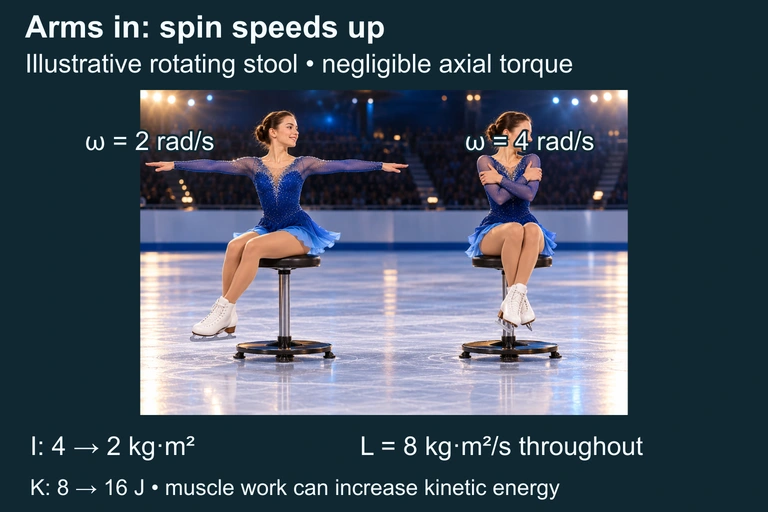
Mass redistribution at constant angular momentum
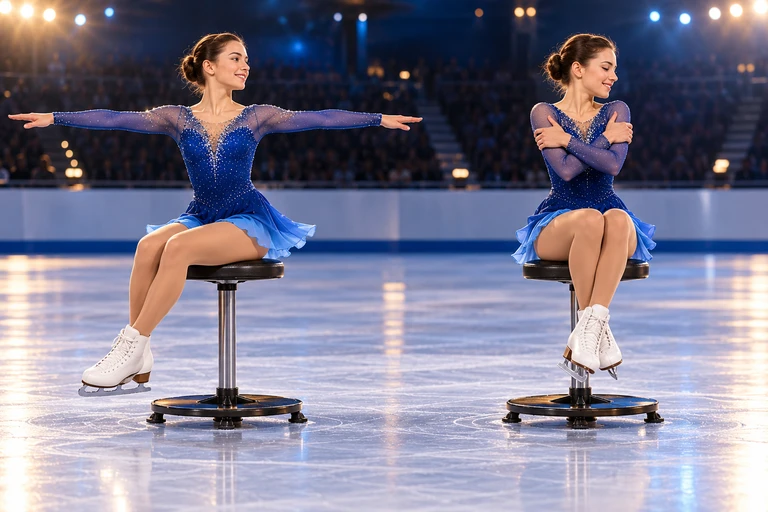 With negligible external torque about the rotation axis, pulling mass inward reduces rotational inertia and increases angular speed. Internal work can increase kinetic energy while angular momentum stays constant.
Mass redistribution at constant angular momentum
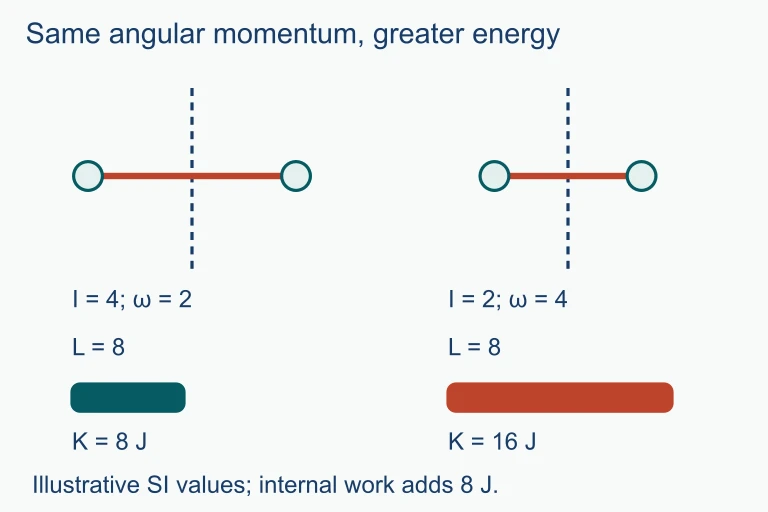 With negligible external torque about the rotation axis, pulling mass inward reduces rotational inertia and increases angular speed. Internal work can increase kinetic energy while angular momentum stays constant.
The Conservation Law
This law holds for any isolated system: no matter how the parts rearrange themselves, the total angular momentum of the system cannot change unless an external torque acts on it.
Torque and \( L \): The Connection
Linear vs Angular Momentum
| Linear | Angular | |
|---|---|---|
| Quantity | \( p = mv \) | \( L = I\omega \) |
| Inertia | Mass \( m \) | Moment of inertia \( I \) |
| Velocity | Linear \( v \) | Angular \( \omega \) |
| Cause of change | Force \( F \) | Torque \( \tau \) |
| Conservation condition | \( \sum F_{\text{ext}} = 0 \) | \( \sum \tau_{\text{ext}} = 0 \) |
How to Apply the Law
Example 1: Ice Skater
A figure skater spins with arms outstretched at \( \omega_i = 2 \;\text{rad/s} \) with moment of inertia \( I_i = 4.0 \;\text{kg}\cdot\text{m}^2 \). She pulls her arms in, reducing her moment of inertia to \( I_f = 1.0 \;\text{kg}\cdot\text{m}^2 \). Find her new angular velocity.
Example 2: Merry-Go-Round
A solid disk merry-go-round (\( I_{\text{disk}} = 250 \;\text{kg}\cdot\text{m}^2 \)) spins at \( \omega_i = 3.0 \;\text{rad/s} \). A child (\( m = 30 \;\text{kg} \)) jumps on at the edge, \( r = 2.0 \;\text{m} \) from the center. Find the new angular velocity.
Adding mass increased the total moment of inertia, so the system slowed down to conserve angular momentum.
Example 3: Collapsing Star
A star with \( I_i = 5.0 \times 10^{45} \;\text{kg}\cdot\text{m}^2 \) rotates once every 25 days. It collapses to a neutron star with \( I_f = 1.0 \times 10^{38} \;\text{kg}\cdot\text{m}^2 \). Find its new rotation period.
The star goes from one rotation every 25 days to ~23 rotations per second: this is how pulsars are born.
When Is \( L \) Not Conserved?
Point Mass Angular Momentum
Equivalently, \( L = mvr_\perp \), where \( r_\perp = r\sin\theta \) is the perpendicular distance from the axis to the velocity line.
Multi-Object Systems
When a system has multiple rotating parts, the total angular momentum is the sum of each part's contribution:
Common Mistakes
Summary Cheat Sheet
| Scenario | \( I \) Changes? | \( \omega \) Changes? | Result |
|---|---|---|---|
| Pull mass inward | Decreases | Increases | Spins faster |
| Extend mass outward | Increases | Decreases | Spins slower |
| Mass lands on disk | Increases | Decreases | System slows |
| Mass flies off tangent | Decreases | Increases | Remainder speeds up |
| No external torque, no \( I \) change | Constant | Constant | No change |
Question 1 of 5
A spinning figure skater pulls her arms in, reducing her moment of inertia by half. What happens to her angular velocity?
Question 2 of 5
What condition must be met for angular momentum to be conserved?
Question 3 of 5
A disk with \( I = 4.0 \;\text{kg}\cdot\text{m}^2 \) spins at \( 6.0 \;\text{rad/s} \). A second disk with \( I = 2.0 \;\text{kg}\cdot\text{m}^2 \) (initially at rest) is dropped on top. What is the final angular velocity?
Question 4 of 5
When a spinning skater pulls her arms in, her rotational kinetic energy:
Question 5 of 5
A point mass \( m \) moves in a straight line with velocity \( v \) past a fixed point at perpendicular distance \( d \). Its angular momentum about that point is: