Connecting Linear and
Rotational Motion
Discover how translational quantities like velocity and acceleration map onto their rotational counterparts through the radius of circular motion.
What Is Rotational Motion?
When an object moves along a straight line, we describe it with displacement, velocity, and acceleration. But when an object spins or moves in a circle, we need a parallel set of rotational (angular) quantities to describe the same physics from a new perspective.
The Bridge Variable: Radius \(r\)
The radius \(r\) is the key that converts between linear and angular worlds. A point on a spinning wheel has a tangential speed that depends on how far it sits from the center.
Key Angular Quantities
The Core Conversion Equations
Visualizing the Connection
Multiply by \(r\) to go from angular to linear. Divide by \(r\) to go back. The centripetal acceleration \(a_c = \omega^2 r\) is the extra piece that points toward the center.
Don't Forget Centripetal Acceleration
An object in circular motion has two components of acceleration:
Linear vs. Rotational Kinematics
| Linear | Rotational | |
|---|---|---|
| Displacement | \(x\) | \(\theta\) |
| Velocity | \(v = v_0 + at\) | \(\omega = \omega_0 + \alpha t\) |
| Displacement Eq. | \(x = v_0 t + \tfrac{1}{2}at^2\) | \(\theta = \omega_0 t + \tfrac{1}{2}\alpha t^2\) |
| Velocity-Displacement | \(v^2 = v_0^2 + 2ax\) | \(\omega^2 = \omega_0^2 + 2\alpha\theta\) |
| Inertia | \(m\) | \(I\) (moment of inertia) |
| Newton's 2nd Law | \(F = ma\) | \(\tau = I\alpha\) |
Rolling Without Slipping
A tactile rolling race with visible mass distribution
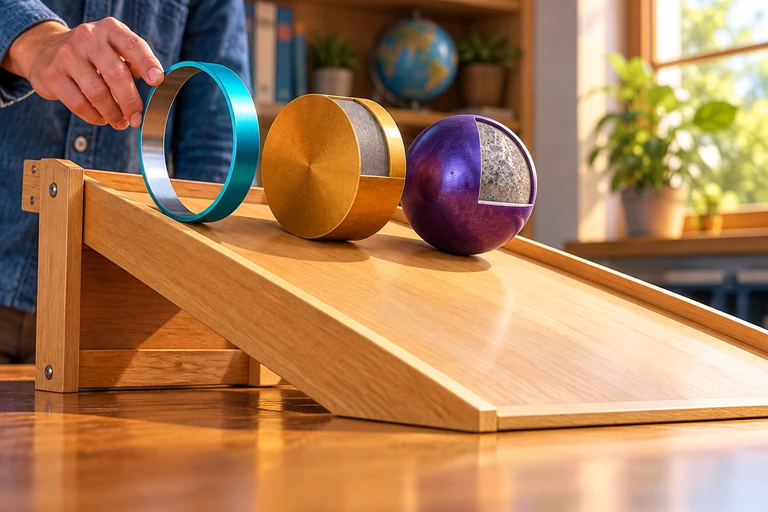 For bodies rolling without slipping from the same initial center-of-mass height, mass distribution determines acceleration and the partition of kinetic energy. Equal elapsed time and equal height loss are separate comparisons.
Velocities around a rolling wheel
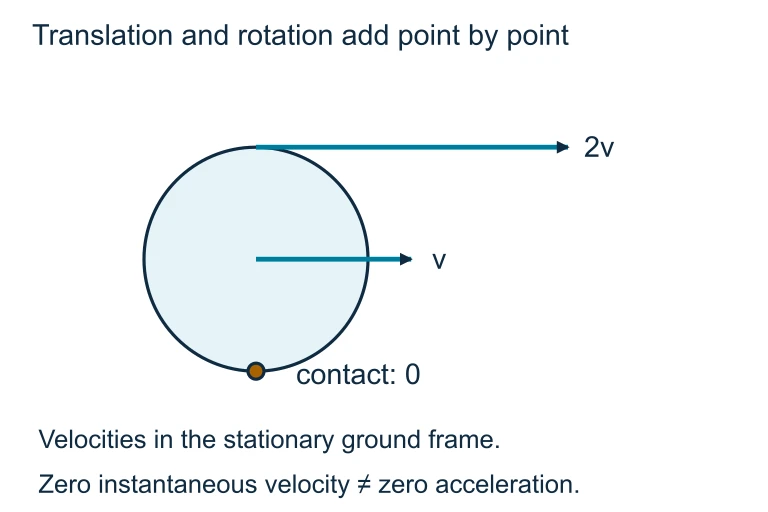 In the stationary ground frame, translation and rotation combine to give zero velocity at the contact point, v at the center and 2v at the top. Zero instantaneous velocity does not imply zero acceleration.
How to Apply the Conversions
Example 1: Spinning Wheel
A bicycle wheel of radius \(r = 0.35\) m rotates at \(\omega = 12\) rad/s. Find the tangential speed and centripetal acceleration of a point on the rim.
Example 2: Accelerating Disk
A disk of radius \(r = 0.20\) m starts from rest and reaches \(\omega = 30\) rad/s in \(t = 5\) s. Find the angular acceleration, the tangential acceleration of a rim point, and the total distance traveled by a point on the rim.
Example 3: Rolling Ball
A bowling ball of radius \(R = 0.11\) m rolls without slipping down a lane at \(v_{\text{cm}} = 6.0\) m/s. What is its angular velocity?
Points at Different Radii
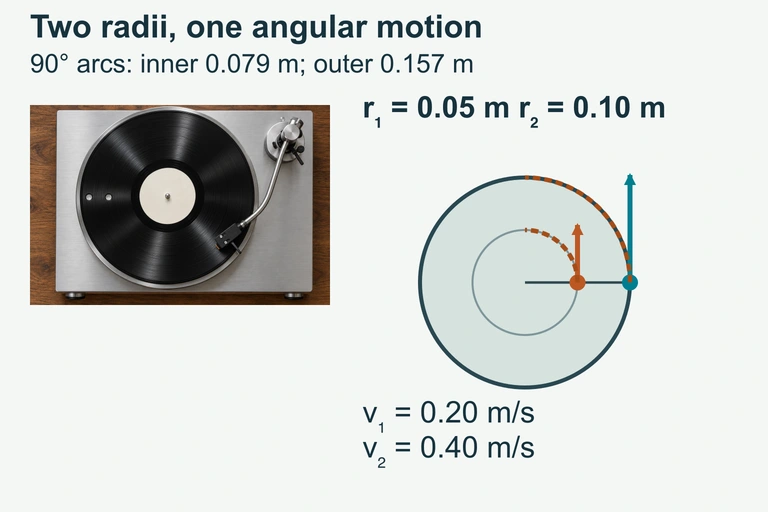
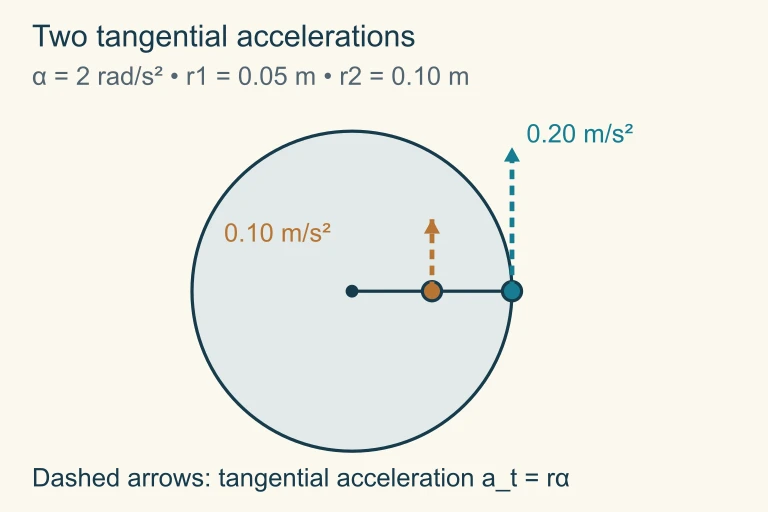
Comparing two radii
In this separate illustration, both points share angular velocity and angular acceleration. Their tangential speeds and accelerations depend on radius; the companion diagram shows both acceleration values.
Common Mistakes
Summary of Connections
| Quantity | Angular | Relation | Linear |
|---|---|---|---|
| Displacement | \(\theta\) | \(s = r\theta\) | \(s\) |
| Velocity | \(\omega\) | \(v = r\omega\) | \(v\) |
| Tangential Accel. | \(\alpha\) | \(a_t = r\alpha\) | \(a_t\) |
| Centripetal Accel. | \(\omega^2\) | \(a_c = \omega^2 r\) | \(v^2/r\) |
| Rolling Constraint | \(\omega\) | \(v_{\text{cm}} = R\omega\) | \(v_{\text{cm}}\) |
Question 1 of 5
A fan blade of radius 0.50 m spins at \(\omega = 20\) rad/s. What is the tangential speed of the tip?
Question 2 of 5
A wheel accelerates uniformly from rest to \(\omega = 40\) rad/s in 8 seconds. If the wheel has radius 0.25 m, what is the tangential acceleration of a point on the rim?
Question 3 of 5
Two points, A and B, are on the same rotating disk. Point A is at radius \(r\) and Point B is at radius \(2r\). How do their tangential speeds compare?
Question 4 of 5
A car tire of radius 0.30 m rolls without slipping. If the car moves at 15 m/s, what is the angular velocity of the tire?
Question 5 of 5
A point on the edge of a disk moves with tangential speed \(v = 3\) m/s at radius \(r = 0.5\) m. What is the centripetal acceleration?