Circular-motion laboratory geometry and force measurement
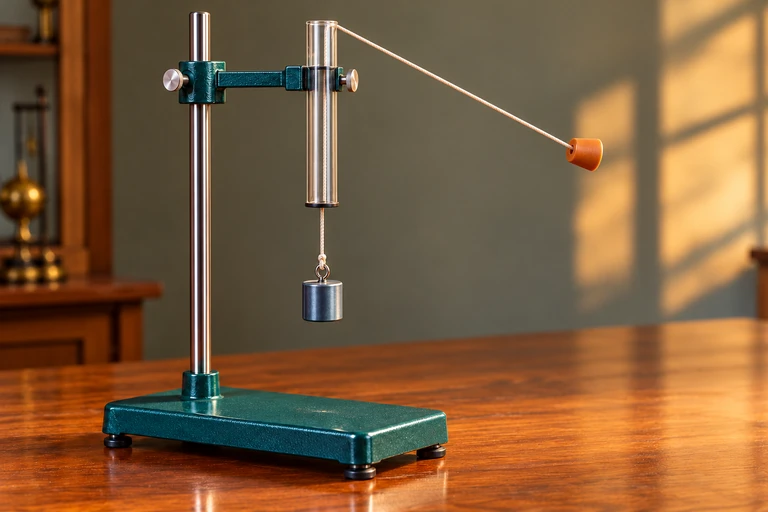 In a steady conical orbit, tension has an upward component that balances weight and an inward component that produces centripetal acceleration. The horizontal radius is r = ℓ sin θ.
Tension must also support the stopper
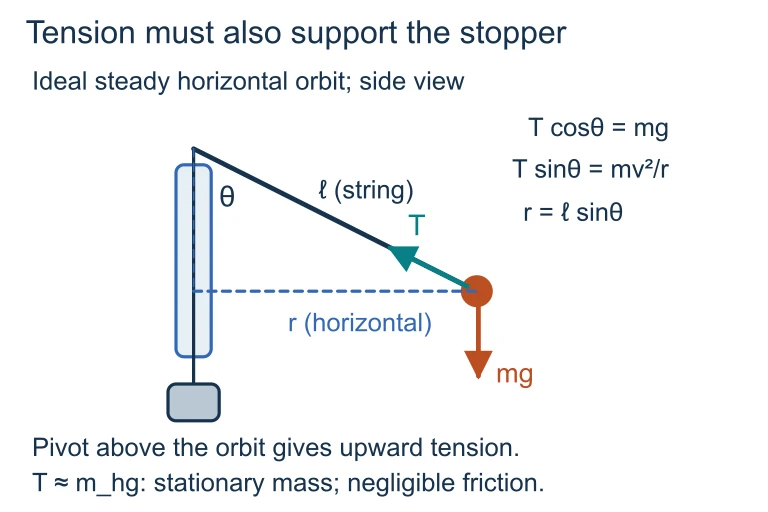 In a steady conical orbit, tension has an upward component that balances weight and an inward component that produces centripetal acceleration. The horizontal radius is r = ℓ sin θ.
Time the orbit to find acceleration
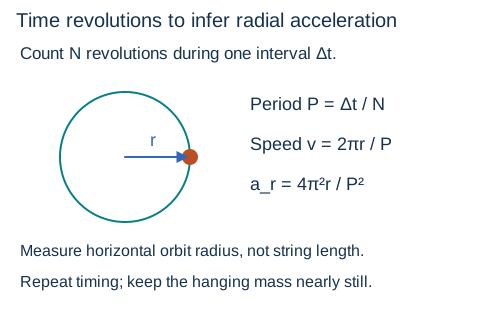 Time N complete revolutions over Δt to find period P = Δt/N. For steady circular motion, use the horizontal orbit radius r to calculate v = 2πr/P and inward acceleration 4π²r/P².Open full diagram
Additional worked example
The following is a separate example from the long-form lesson. Its values may differ from the example already on this slide.
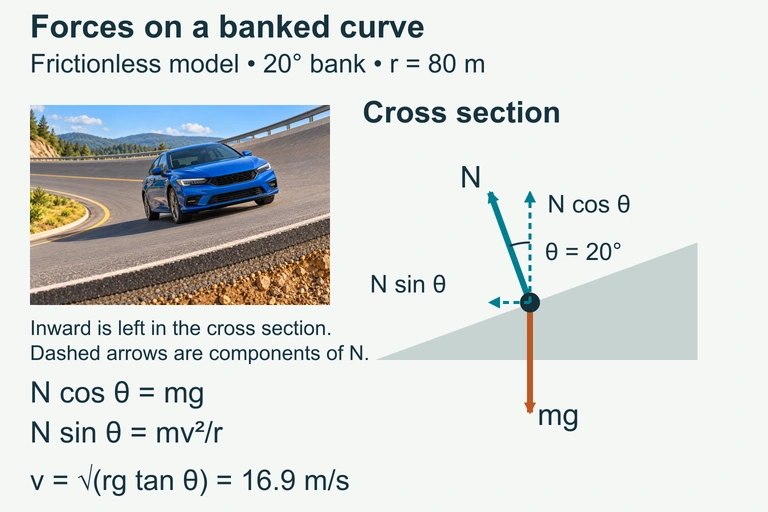
A car of mass 1200 kg travels around a banked circular curve with radius 80 m. The banking angle is 20° and the road surface is frictionless. Determine the speed at which the car can negotiate the curve without sliding up or down the bank.
Show answer and explanation
Step 1 — Draw Free-Body Diagram & Identify Forces: Only two forces act on the car: the gravitational force mg directed downward and the normal force N directed perpendicular to the banked surface. Because there is no friction, the only force with a horizontal component is the normal force. Step 2 — Choose Coordinate System & Decompose: Use a radial-vertical coordinate system. The radial direction (horizontal, toward center) is positive inward. Decompose N into components: N sin θ (radial, inward) and N cos θ (vertical, upward). Gravity has no radial component. Step 3 — Apply Newton's Second Law (vertical): In the vertical direction, the car is in equilibrium (no vertical acceleration): N cos θ − mg = 0, so N = mg / cos θ. N = mg / cos θ Step 4 — Apply Newton's Second Law (radial): The net inward force equals the centripetal force: N sin θ = mv²/r. Substitute N from Step 3: (mg / cos θ) × sin θ = mv²/r, which simplifies to mg tan θ = mv²/r. mg tan θ = mv²/r Step 5 — Solve for Speed: Cancel m from both sides: g tan θ = v²/r, so v = √(rg tan θ). Substituting values: v = √(80 × 9.8 × tan 20°) = √(80 × 9.8 × 0.364) = √(285.4) ≈ 16.9 m/s. Converting to more intuitive units, this is roughly 38 mph or 61 km/h. v ≈ 16.9 m/s Step 6 — Check the Result: Note that mass canceled entirely—the design speed depends only on r, g, and θ. This makes physical sense: a heavier car needs more centripetal force but also has a larger normal force component, and these scale identically with mass. The result ~17 m/s for a 20° bank is reasonable for a highway exit ramp.