01 / 21

Change in Momentum
and Impulse

Master the relationship between force, time, and momentum change: the Impulse-Momentum Theorem that governs every collision, crash, and catch.

AP Physics 1

What Is Momentum?

Momentum describes how hard it is to stop a moving object. It depends on both mass and velocity:

Scalar Part
Mass \( m \) (kg): always positive
Vector Part
Velocity \( \vec{v} \) (m/s): has direction

Visualizing Momentum

\(2 \text{ kg}\)
\(10 \text{ m/s}\)
\( p = 20 \text{ kg} \cdot \text{m/s} \)
\(2000 \text{ kg}\)
\(0.01 \text{ m/s}\)
\( p = 20 \text{ kg} \cdot \text{m/s} \)
=

What Is Impulse?

Impulse is the product of force and the time interval over which that force acts. It tells you how much "push" an object receives:

A larger force or a longer contact time each produce a larger impulse. This is why follow-through in sports increases the effect of a hit.

The Impulse-Momentum Theorem

Force
\( \vec{F}_{ \text{avg}} \, \Delta t \)
= Change in p
\( m\vec{v}_f - m\vec{v}_i \)
Impulse
\( \vec{J} \)
Net external impulse equals the change in the object's momentum

Deriving from Newton's Second Law

1
Start with Newton's Second Law: \( \vec{F}_{ \text{net}} = m\vec{a} \)
2
Substitute the definition of acceleration: \( \vec{a} = \dfrac{\Delta \vec{v}}{\Delta t} \)
3
Multiply both sides by \(\Delta t\): \( \vec{F}_{ \text{net}} \, \Delta t = m \, \Delta \vec{v} \)
4
Recognize the right side as \(\Delta \vec{p}\): \( \vec{J} = \Delta \vec{p} \) ✓

Force vs. Time Graph

\( t \text{ (s)} \)
\( F \text{ (N)} \)
\( t_i \)
\( t_f \)
\(\text{Area} = J\)
(Impulse)
\( F_1 \)
\( F_2 \)

Force-sensor experiment links measured area and momentum change
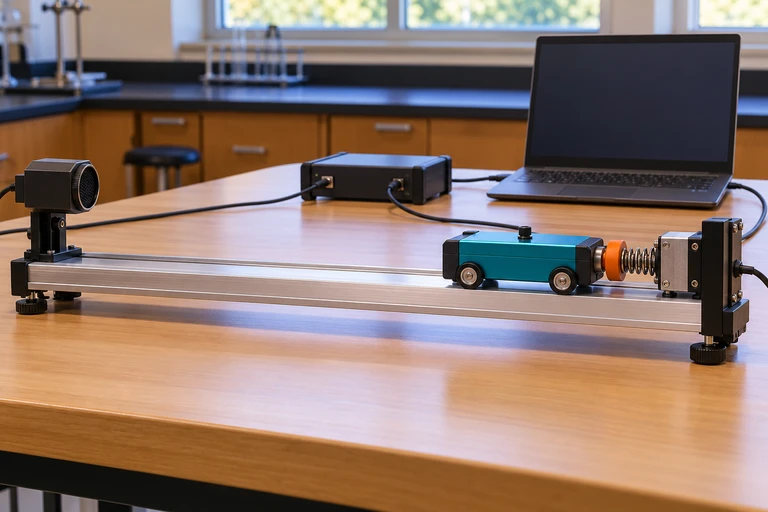
A cart on a straight track faces a spring contact and fixed force sensor,with a motion detector opposite and cables to a logger.The signed area under force versus time gives impulse. Compare that area with the cart’s measured momentum change, using one force-sign convention and including measurement uncertainty.

Force-sensor experiment links measured area and momentum change
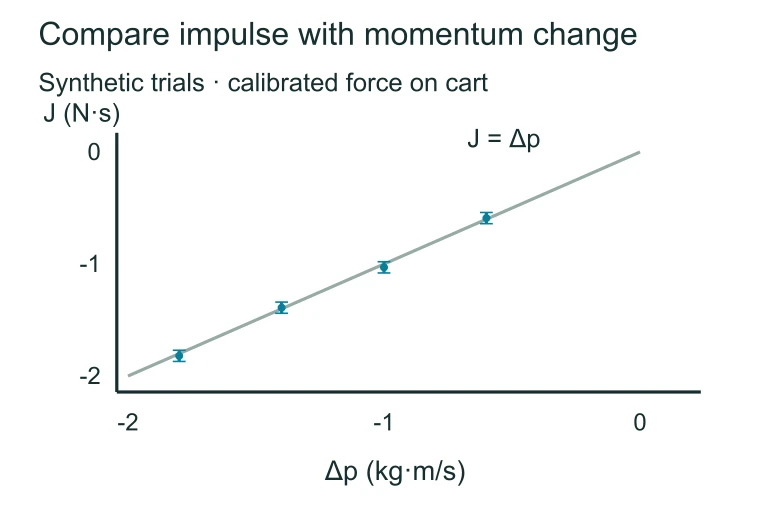
Force-sensor experiment links measured area and momentum change. The signed area under force versus time gives impulse. Compare that area with the cart’s measured momentum change, using one force-sign convention and including measurement uncertainty.The signed area under force versus time gives impulse. Compare that area with the cart’s measured momentum change, using one force-sign convention and including measurement uncertainty.

Impulse from a force trace
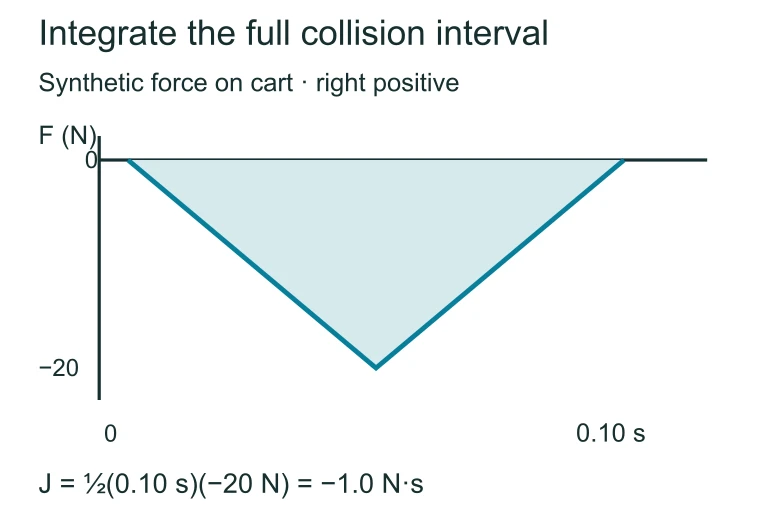
Impulse from a force trace. A triangular pulse lasting 0.10 s with peak force −20 N has signed area −1.0 N·s. With right positive, the negative impulse reduces the cart’s rightward momentum.A triangular pulse lasting 0.10 s with peak force −20 N has signed area −1.0 N·s. With right positive, the negative impulse reduces the cart’s rightward momentum.

Momentum vs. Impulse

Momentum \( \vec{p} \) Impulse \( \vec{J} \)
Definition \( m\vec{v} \) \( \vec{F}_{ \text{avg}} \, \Delta t \)
Type State quantity (snapshot) Process quantity (interval)
Units kg · m/s N · s = kg · m/s
Vector? Yes Yes
Analogy Bank balance Deposit or withdrawal

Why Extending Time Matters

Wall
Short \( \Delta t \)
Large \( F \)
Airbag
Long \( \Delta t \)
Small \( F \)
Same \( \Delta p \)
\( F_{ \text{avg}} = \frac{\Delta p}{\Delta t} \): increase \( \Delta t \) to decrease \( F \)

Seeing an impact spread through a cushion
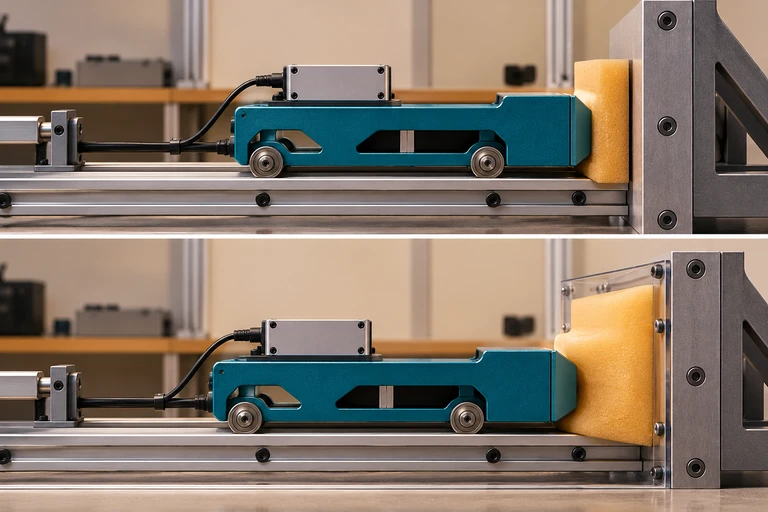
Two matched sled bays show thinner and thicker cushions compressing against rigid supports.For the same momentum change, a longer contact interval reduces the magnitude of the average force. Comparing peak forces additionally requires the pulse shapes to be specified.

Equal impulse over different times
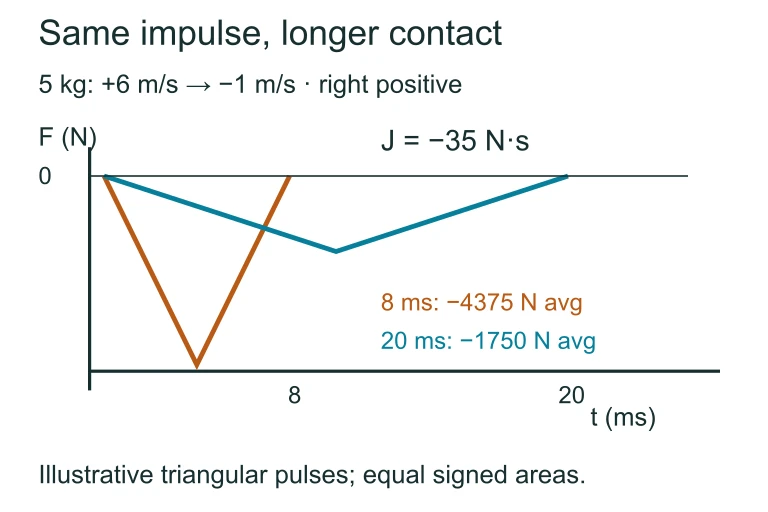
Equal impulse over different times. A 5 kg object changes velocity from +6 to −1 m/s, giving J = −35 N·s. Spreading that impulse over 8 ms or 20 ms gives average forces of −4375 N or −1750 N.A 5 kg object changes velocity from +6 to −1 m/s, giving J = −35 N·s. Spreading that impulse over 8 ms or 20 ms gives average forces of −4375 N or −1750 N.

Stopping versus rebounding
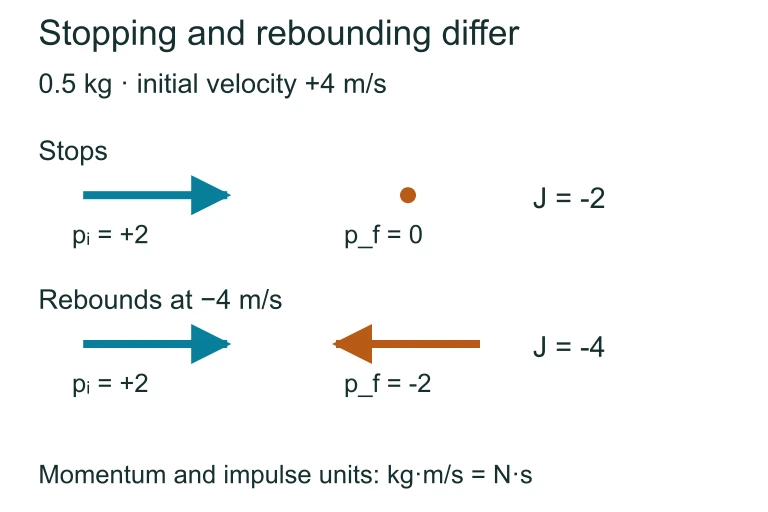
Stopping versus rebounding. A 0.5 kg object initially moves at +4 m/s. Stopping gives an impulse of −2 N·s; rebounding at −4 m/s gives −4 N·s. The final momentum determines the difference.A 0.5 kg object initially moves at +4 m/s. Stopping gives an impulse of −2 N·s; rebounding at −4 m/s gives −4 N·s. The final momentum determines the difference.

How to Apply the Theorem

1
Choose a direction as positive. Stick with it throughout the problem.
2
Identify \( m \), \( v_i \), and \( v_f \). Assign correct signs to each velocity.
3
Compute \( \Delta p = m v_f - m v_i \). A negative result means the impulse is in the negative direction.
4
If needed, find \( F_{ \text{avg}} \): \( F_{ \text{avg}} = \dfrac{\Delta p}{\Delta t} \).
5
Check units and sign. Impulse should be in N·s (or kg·m/s) and direction should make physical sense.

Example 1: Baseball Bat Hit

A \(0.145 \text{ kg}\) baseball approaches a batter at \(-40 \text{ m/s}\) (toward the batter) and leaves the bat at \(+50 \text{ m/s}\) (away). What is the impulse on the ball?

Before
\(0.145 \text{ kg}\)
\(-40 \text{ m/s}\)
After
\(0.145 \text{ kg}\)
\(+50 \text{ m/s}\)

Example 2: Braking Car

A \(1200 \text{ kg}\) car traveling at \(+25 \text{ m/s}\) brakes to a stop in \(4.0 \text{ s}\). Find the average braking force.

1
Identify values: \( m = 1200 \text{ kg}, \; v_i = +25 \text{ m/s}, \; v_f = 0, \; \Delta t = 4.0 \text{ s} \)
2
Compute \(\Delta p\): \( \Delta p = 1200(0) - 1200(25) = -30{,}000 \mathrm{ kg\,m/s} \)
3
Find \(F_{\text{avg}}\): \( F = \dfrac{-30{,}000}{4.0} = \) \(-7{,}500 \text{ N}\)

Example 3: Bouncing vs. Sticking

A \(0.5 \text{ kg}\) ball hits a wall at \(-8 \text{ m/s}\). Compare the impulse if it bounces back at \(+6 \text{ m/s}\) versus sticking to the wall.

Bounces
\( J = 0.5(6) - 0.5(-8) \)
\( J = 3 + 4 = \) +7 N·s
Sticks
\( J = 0.5(0) - 0.5(-8) \)
\( J = 0 + 4 = \) +4 N·s

Compare bounce and sticking

This source practice question is separate from the example on this slide. The cart illustration models the same initial and final velocities.

A 0.5 kg ball moving to the right at 4 m/s strikes a wall and bounces back to the left at 4 m/s. A 0.5 kg ball of clay moving to the right at 4 m/s strikes the same wall and sticks (v_f = 0). Which object experiences the greater magnitude of impulse from the wall? A. The bouncing ball, because it undergoes a larger change in momentum. B. The clay ball, because it experiences a greater force during impact. C. They experience equal impulses because they have the same initial momentum. D. The clay ball, because all of its kinetic energy is absorbed.

Show answer and explanation

A is correct. Impulse equals change in momentum. For the bouncing ball: Δp = m(v_f − v_i) = 0.5(−4 − 4) = −4.0 kg·m/s, so |Δp| = 4.0 kg·m/s. For the clay: Δp = 0.5(0 − 4) = −2.0 kg·m/s, so |Δp| = 2.0 kg·m/s. The bouncing ball's velocity reversal means its momentum change is twice as large. B is incorrect because impulse depends on Δp, not the magnitude of the force alone. C is incorrect because having the same initial momentum does not guarantee the same change — the final momenta differ. D is incorrect because kinetic energy absorbed relates to work and energy, not impulse; impulse is a momentum concept.The same 0.50 kg cart starts at +4 m/s. Stopping requires −2 N·s; rebounding at −4 m/s requires −4 N·s. These cart trials illustrate the AP Physics 1 ball-and-clay comparison; the calculus force-time companion is a separate model.
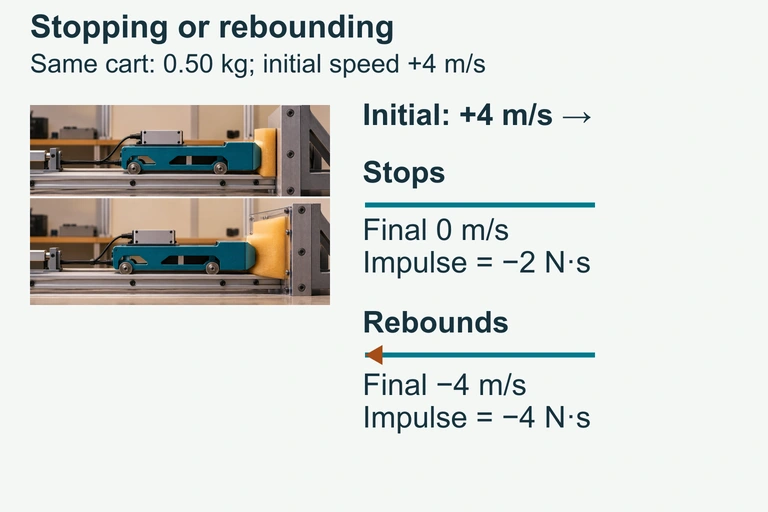
The same 0.50 kg cart starts at +4 m/s. Stopping requires −2 N·s; rebounding at −4 m/s requires −4 N·s. These cart trials illustrate the AP Physics 1 ball-and-clay comparison; the calculus force-time companion is a separate model.

Variable Force: Reading the Graph

\( t \text{ (ms)} \)
\( F \text{ (N)} \)
\(0\)
\(5\)
\(10\)
\(800\)
\(0\)
\(\text{Area} = J\)
\( F_{\text{peak}} = 800 \text{ N} \)

Real-World Applications

Airbags
Extend \( \Delta t \) during a crash, reducing \( F_{\text{avg}} \) on the occupant
Sports
Bending knees when landing or catching increases \( \Delta t \), softening the impact
Rockets
Exhaust gases carry momentum: by Newton's third law, the rocket gains equal and opposite impulse

Common Mistakes

✕ Forgetting Signs
Velocity is a vector. If the ball reverses direction, \( v_f \) and \( v_i \) have opposite signs. Missing this halves your answer.
✕ Using Speed for Velocity
Speed is magnitude only. Impulse requires signed velocities to capture direction changes.
✕ Unit Conversion
Time in milliseconds must be converted to seconds. \(5 \text{ ms} = 0.005 \text{ s}\), not \(5\).

Question 1 of 5

A \(2 \text{ kg}\) object changes velocity from \( +3 \text{ m/s} \) to \( +9 \text{ m/s} \). What is the impulse on the object?

Question 2 of 5

A \(0.4 \text{ kg}\) ball moving at \( +10 \text{ m/s} \) bounces off a wall and returns at \( -10 \text{ m/s} \). What is the impulse?

Question 3 of 5

A constant force of \( 500 \text{ N} \) acts on an object for \( 0.02 \text{ s} \). What is the impulse delivered?

Question 4 of 5

An airbag increases the stopping time from \(0.005 \text{ s}\) to \(0.08 \text{ s}\). If the momentum change is the same, by what factor does the average force decrease?

Question 5 of 5

A triangular \(F\)-vs-\(t\) graph has a peak force of \(600 \text{ N}\) and a base of \(20 \text{ ms}\). What is the impulse?