01 / 20

Angular Momentum
& Angular Impulse

Explore how rotational motion is quantified by angular momentum and changed by angular impulse: the rotational analogues of linear momentum and impulse.

AP Physics 1

What Is Angular Momentum?

Angular momentum measures how much rotational motion an object has. Just as linear momentum \( p = mv \) describes translational inertia in motion, angular momentum describes rotational inertia in motion.

The SI unit of angular momentum is \( \text{kg} \cdot \text{m}^2/\text{s} \). Angular momentum is a vector quantity: its direction is given by the right-hand rule.

Point Particle Angular Momentum

\( O \) \( \vec{r} \) \( m \) \( \vec{v} \) \( \theta \)

Direction via the Right-Hand Rule

\( \vec{L} \) \( \omega \) (CCW) Thumb points along L

Curl the fingers of your right hand in the direction of rotation. Your thumb points in the direction of \( \vec{L} \). For counter-clockwise rotation viewed from above, \( \vec{L} \) points upward (out of the page).

What Is Angular Impulse?

Angular impulse is the rotational analogue of linear impulse. It measures the effect of a net torque applied over a time interval, and it equals the change in angular momentum.

Newton's Second Law for Rotation

Net Torque
\( \vec{\tau}_{\text{net}} \)
Rate of Change
\( \frac{d\vec{L}}{dt} \)
Equivalent
\( I\alpha \)

Conservation of Angular Momentum

When the net external torque on a system is zero, angular momentum is conserved:

Large \( I \), small \( \omega \)
L = const
Small \( I \), large \( \omega \)

A figure skater pulls arms inward: \( I \) decreases, so \( \omega \) increases to keep \( L \) constant.

Collision followed by braking

This separate example applies conservation during the collision, then angular impulse while the brake acts. The collision and braking are distinct intervals.

A uniform disk turntable (I = 4.0 kg·m²) spins freely at ωᵢ = 6.0 rad/s. A 2.0-kg lump of clay is dropped vertically onto the rim at r = 1.0 m and sticks. (a) Find the angular velocity immediately after the clay sticks. (b) A brake then applies a constant friction torque of 3.0 N·m opposing rotation. How long does it take to stop?

Show answer and explanation

The clay has no initial angular momentum about the axis, and external torque is negligible during the collision. Initial L = 4.0 × 6.0 = 24 kg·m²/s. After sticking, I = 4.0 + 2.0(1.0)² = 6.0 kg·m², so ω = 24/6 = 4.0 rad/s. The brake changes angular momentum by −24 kg·m²/s, so Δt = (−24)/(−3.0) = 8.0 s. Kinetic energy falls from 72 J to 48 J during the collision.
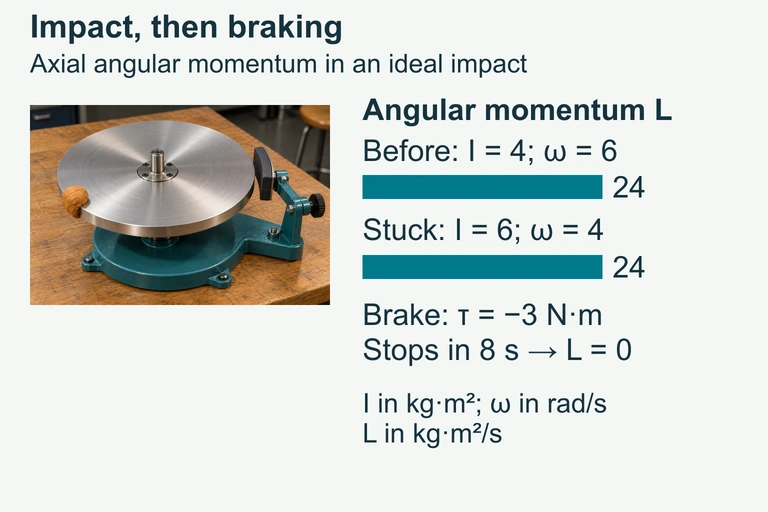
A 2 kg clay mass sticks at radius 1 m: I increases from 4 to 6 kg·m² and ω falls from 6 to 4 rad/s, keeping L = 24 kg·m²/s. A later −3 N·m brake torque stops the system in 8 s.

Mass redistribution at constant angular momentum
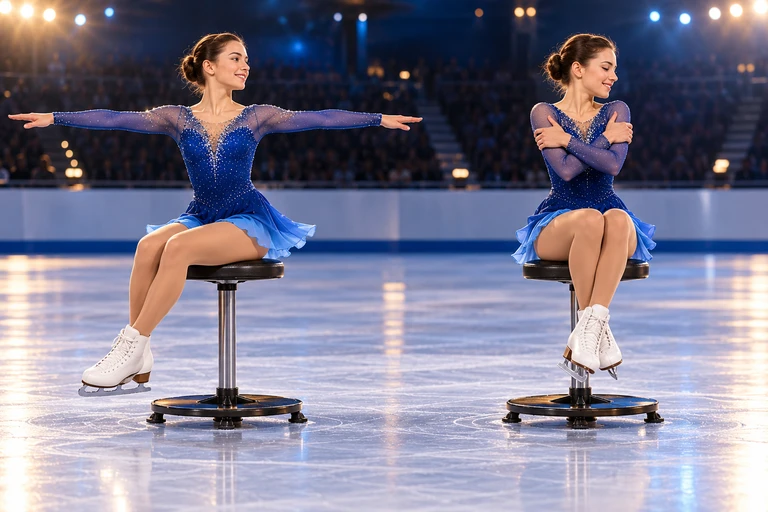
The same seated person appears with arms extended and folded around a common vertical axis. Still poses are not an animation or measured angular velocities.With negligible external torque about the rotation axis, pulling mass inward reduces rotational inertia and increases angular speed. Internal work can increase kinetic energy while angular momentum stays constant.

Mass redistribution at constant angular momentum
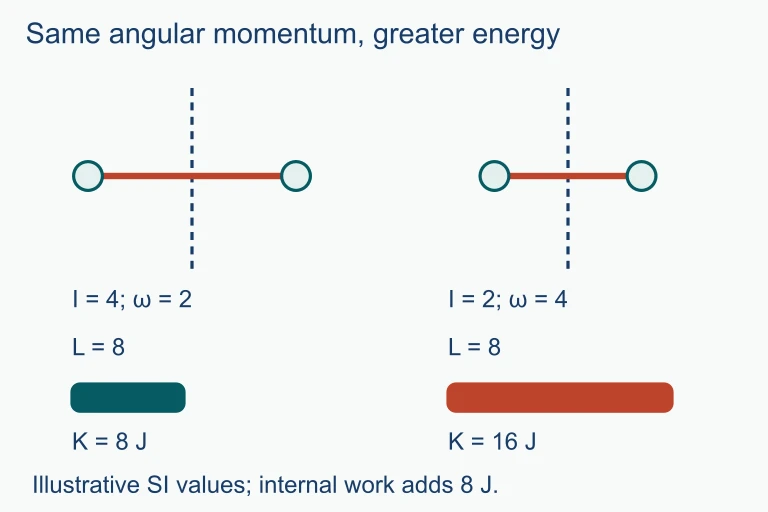
Mass redistribution at constant angular momentum. With negligible external torque about the rotation axis, pulling mass inward reduces rotational inertia and increases angular speed. Internal work can increase kinetic energy while angular momentum stays constant.With negligible external torque about the rotation axis, pulling mass inward reduces rotational inertia and increases angular speed. Internal work can increase kinetic energy while angular momentum stays constant.

Linear vs Angular Analogues

Concept Linear Angular
Inertia \( m \) \( I \)
Velocity \( v \) \( \omega \)
Momentum \( p = mv \) \( L = I\omega \)
Force / Torque \( F \) \( \tau \)
Impulse \( F \Delta t = \Delta p \) \( \tau \Delta t = \Delta L \)
Newton's 2nd Law \( F = ma \) \( \tau = I\alpha \)
Conservation If \( F_{\text{ext}} = 0 \) If \( \tau_{\text{ext}} = 0 \)

How to Solve Problems

1
Identify the system and the axis of rotation. Is the system isolated (no net external torque)?
2
Choose the right formula: \( L = I\omega \) for rigid bodies, \( L = mvr\sin\theta \) for point particles.
3
Apply conservation or the impulse-momentum theorem: \( L_i = L_f \) if no net external torque, or \( \tau \Delta t = \Delta L \) if torque acts.
4
Check signs. Define a positive rotation direction. Counter-clockwise is typically positive.
5
Solve and verify units. Angular momentum has units \( \text{kg} \cdot \text{m}^2/\text{s} \).

Example 1: Spinning Disk

A solid disk of mass \( m = 4 \) kg and radius \( r = 0.5 \) m spins at \( \omega = 10 \) rad/s. Find its angular momentum.

\( r = 0.5 \) m \( \omega \)
\( m = 4 \) kg

Example 2: Angular Impulse on a Wheel

A bicycle wheel (\( I = 0.3 \;\text{kg}\cdot\text{m}^2 \)) is initially at rest. A constant torque of \( \tau = 6 \) N·m is applied for \( \Delta t = 2 \) s. Find the final angular velocity.

Example 3: Conservation with Changing \( I \)

A figure skater spins at \( \omega_i = 4 \) rad/s with \( I_i = 5 \;\text{kg}\cdot\text{m}^2 \). She pulls her arms in, reducing her moment of inertia to \( I_f = 2 \;\text{kg}\cdot\text{m}^2 \). Find \( \omega_f \).

Example 4: Point Particle on a String

A 0.2 kg ball moves in a circle of radius 1.5 m at speed 3 m/s on a frictionless table, attached to a string through a hole. The string is pulled so the radius becomes 0.5 m. Find the new speed.

Reducing the radius by a factor of 3 increases the speed by a factor of 3.

Common Mistakes to Avoid

✕ Confusing \( L \) and \( p \)
Angular momentum \( L = I\omega \) is not the same as linear momentum \( p = mv \). They have different units and apply to different types of motion.
✕ Forgetting sign convention
Angular momentum is a vector. Always define a positive direction (e.g., CCW = positive) and keep signs consistent for all terms.
✕ Assuming KE is conserved
When \( I \) changes, \( L \) is conserved but rotational kinetic energy is not. Internal work changes KE while keeping \( L \) constant.

Summary of Key Formulas

Formula Expression When to Use
Angular Momentum (rigid body) \( L = I\omega \) Object spinning about fixed axis
Angular Momentum (particle) \( L = mvr\sin\theta \) Point mass moving relative to axis
Angular Impulse \( \tau \Delta t = \Delta L \) Torque applied over time interval
Newton's 2nd (rotational) \( \tau_{\text{net}} = \frac{dL}{dt} \) Relating torque to angular momentum change
Conservation \( I_i\omega_i = I_f\omega_f \) No net external torque on system

Question 1 of 5

A solid sphere of mass 2 kg and radius 0.1 m rolls without slipping. Its moment of inertia is \( I = \frac{2}{5}mr^2 \). If it spins at \( \omega = 50 \) rad/s, what is its angular momentum?

Question 2 of 5

A constant net torque of 12 N·m acts on a wheel for 3 seconds. The wheel starts from rest. What is the angular impulse delivered to the wheel?

Question 3 of 5

A merry-go-round (\( I = 500 \;\text{kg}\cdot\text{m}^2 \)) spins at \( 2 \) rad/s. A child (\( 40 \) kg) jumps onto the edge at radius \( 2 \) m (initially at rest relative to the ground). What is the new angular velocity? Treat the child as a point mass.

Question 4 of 5

A figure skater has angular momentum \( L = 20 \;\text{kg}\cdot\text{m}^2/\text{s} \). She reduces her moment of inertia from \( 4 \;\text{kg}\cdot\text{m}^2 \) to \( 1.6 \;\text{kg}\cdot\text{m}^2 \). What happens to her rotational kinetic energy?

Question 5 of 5

A point particle of mass 0.5 kg moves at 8 m/s along a straight line that passes 3 m from a fixed point O. What is the angular momentum of the particle about O?