

SECTION 1
Historical Context & Motivation
The modern concept of work emerged from centuries of effort to quantify how forces produce useful effects. Before physicists formalized energy transfer, engineers and natural philosophers grappled with questions about machines, motion, and efficiency — how a lever amplifies human effort, why a heavier cannonball requires more gunpowder, and what it truly means for a force to 'accomplish something.' The development of work as a precise physical quantity allowed scientists to bridge the intuitive gap between force, displacement, and the broader framework of energy conservation that underpins all of classical mechanics.
1687 • Newton's Principia
1829 • Coriolis Defines Work
1843 • Joule's Mechanical Equivalent of Heat
1847 • Conservation of Energy
The central question these developments addressed is deceptively simple: how do we quantify the effect a force has as an object moves? Newton's second law tells us how forces change motion instantaneously, but work captures the cumulative effect of a force acting over a distance. This scalar quantity became the bridge connecting dynamics (forces and acceleration) to energetics (energy transfer and transformation), and it remains the conceptual gateway to understanding the work-energy theorem, conservation of energy, and power.
SECTION 2
Core Principles & Definitions
Work in physics has a precise definition that differs sharply from everyday usage. In colloquial language, holding a heavy box overhead feels like 'work,' but physics demands both a force and a displacement in the direction of that force. Understanding this distinction is essential for success on the AP exam, where conceptual questions frequently test whether students can identify situations where zero work is done despite the presence of significant forces.
Work Is a Scalar
Only the Parallel Component Counts
Work Transfers Energy
Net Work vs. Individual Work
SECTION 3
Visual Explanation: Force, Displacement, and the Angle Between Them
The diagram above illustrates the geometric heart of the work equation. When you push a crate across a floor at an angle, your force has two components: one along the direction of motion and one perpendicular to it. The perpendicular component presses the crate into (or lifts it off) the floor, altering the normal force, but it does not contribute to the energy transfer we call work. Only the component aligned with the displacement — F cos θ — multiplied by the displacement magnitude gives the work done by that force. This is why a centripetal force, which is always perpendicular to velocity, does zero work on an object in uniform circular motion.
SECTION 4
Mathematical Framework
WORK BY A CONSTANT FORCE
W = work (J), F = magnitude of force (N), d = magnitude of displacement (m), θ = angle between the force vector and displacement vector. One joule equals one newton-meter: 1 J = 1 N·m.
This equation is the definition of work for a constant force. The cosine factor captures the projection of the force onto the displacement direction. Three special cases deserve attention: when θ = 0°, cos θ = 1 and the work is simply Fd (maximum positive work); when θ = 90°, cos θ = 0 and no work is done; when θ = 180°, cos θ = −1 and the work is −Fd (maximum negative work, as in friction opposing motion).
WORK-ENERGY THEOREM
The net work done on an object by all forces equals the change in its kinetic energy. Here m is mass (kg), is final speed (m/s), and is initial speed (m/s).
The work-energy theorem is one of the most powerful results in mechanics. It says that if you sum up the work done by every force on an object — gravity, friction, tension, applied forces — the total equals the object's change in kinetic energy. This holds whether the forces are constant or variable, and it provides an alternative to Newton's second law for solving problems where force information and displacement information are more accessible than acceleration and time.
WORK DONE BY GRAVITY
When using the convention that upward is positive, Δy = − . Gravity does negative work when an object rises and positive work when it falls.
WORK DONE BY A SPRING
k = spring constant (N/m), and are the final and initial displacements from equilibrium. The spring does negative work when being compressed or stretched further, and positive work when returning toward equilibrium.
SECTION 5
Positive, Negative, and Zero Work
The sign of work is physically meaningful: it tells you whether energy is being added to or removed from the object of interest. A thorough understanding of when work is positive, negative, or zero is essential for both conceptual reasoning and quantitative problem-solving on the AP exam.
| Scenario | Force | θ | Work Sign |
|---|---|---|---|
| Pushing a crate forward | Applied force | 0° | Positive |
| Crate sliding on rough floor | Kinetic friction | 180° | Negative |
| Carrying a box horizontally | Normal force from hands (upward) | 90° | Zero |
| Ball falling freely | Gravity | 0° | Positive |
| Ball thrown upward (rising) | Gravity | 180° | Negative |
| Moon orbiting Earth | Gravitational force | 90° | Zero |
Common scenarios classified by the sign of work
SECTION 6
Worked Example: Pulling a Sled Across Snow
A child pulls a 15 kg sled across a flat, snowy field with a rope that makes a 30° angle above the horizontal. The child exerts a constant 40 N tension on the rope, and the coefficient of kinetic friction between the sled and snow is μk = 0.10. The sled is pulled a horizontal distance of 20 m. Find (a) the work done by the tension, (b) the work done by friction, (c) the work done by gravity, (d) the net work, and (e) the final speed if the sled starts from rest.
Worked example
- 1
Step 1 — Identify Given Values
m = 15 kg, T = 40 N, θ = 30°, d = 20 m, μk = 0.10, vi = 0 m/s, g = 9.8 m/s². - 2
Step 2 — Work Done by Tension
WT = T d cos θ = (40)(20) cos 30° = (800)(0.866).= 693 J - 3
Step 3 — Find Normal Force
In the vertical direction the sled is in equilibrium: N + T sin θ − mg = 0, so N = mg − T sin θ = (15)(9.8) − (40) sin 30° = 147 − 20 = 127 N.N = 127 N - 4
Step 4 — Work Done by Friction
fk = μk N = (0.10)(127) = 12.7 N. Friction opposes displacement, so θ = 180°: Wf = fk d cos 180° = (12.7)(20)(−1).= −254 J - 5
Step 5 — Work Done by Gravity and Normal Force
Both gravity (downward) and the normal force (upward) are perpendicular to the horizontal displacement. Therefore Wg = 0 J and WN = 0 J. - 6
Step 6 — Net Work and Final Speed
Wnet = WT + Wf + Wg + WN = 693 + (−254) + 0 + 0 = 439 J. By the work-energy theorem, Wnet = ½mv² − 0, so v = √(2Wnet/m) = √(2 × 439 / 15) = √(58.5) ≈ 7.65 m/s.W_net = 439 J, ≈ 7.65 m/s
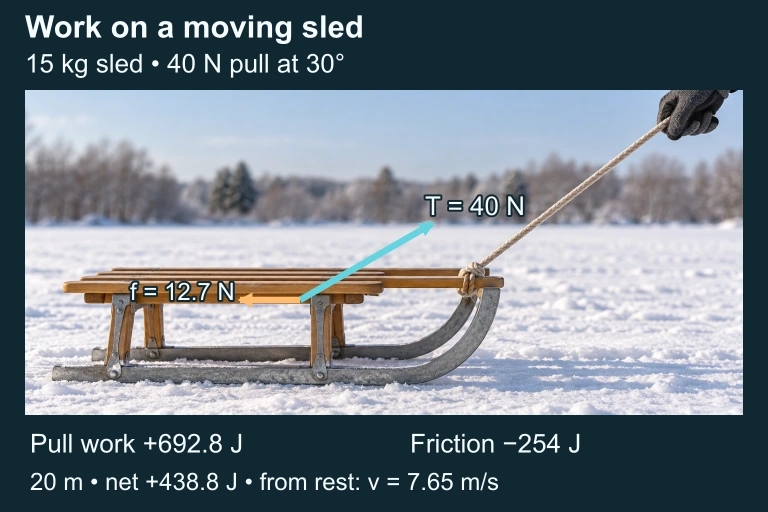 AP Physics 1 sled: m = 15 kg, pull 40 N at 30°, displacement 20 m. Pulling work is 692.8 J, friction work −254 J, net work 438.8 J and final speed 7.65 m/s from rest. Gravity and normal force do zero work on the horizontal path.
SECTION 7
Common Pitfalls & Conceptual Comparisons
| Misconception | Why It's Wrong | Correct Understanding |
|---|---|---|
| A larger force always means more work | Work depends on displacement and angle, not force alone. A huge force with zero displacement does zero work. | W = Fd cos θ — all three factors matter. |
| Work can't be negative | Negative work simply means the force opposes displacement, removing kinetic energy from the object. | Friction and drag typically do negative work. Gravity does negative work on a rising object. |
| Centripetal force does work on circular motion | The centripetal force is always perpendicular to velocity, so cos 90° = 0. | Centripetal force changes direction of velocity but not speed, so W = 0. |
| Normal force never does work | The normal force is perpendicular to the surface, not necessarily perpendicular to displacement. On an elevator floor, N is along d. | The normal force does zero work on a flat surface but nonzero work when the surface itself moves (e.g., elevator). |
Frequent AP exam misconceptions about work
SECTION 8
Connection to Advanced Theory
The AP Physics 1 treatment of work confines itself to constant forces (or the special case of springs). In more advanced courses, work generalizes significantly, and the concept serves as a gateway to Lagrangian mechanics and thermodynamics.
| AP Physics 1 (Algebra-Based) | Advanced / College Physics |
|---|---|
| W = Fd cos θ for constant forces | W = ∫ F⃗ · dr⃗ — work as a line integral along a path |
| Work-energy theorem: W_net = ΔK | First law of thermodynamics: ΔU = Q − W, connecting work to internal energy and heat |
| Conservative forces (gravity, spring) vs. nonconservative (friction) | Path independence ↔ curl F⃗ = 0; potential energy as negative gradient of work |
| Scalar calculation, no direction | Dot product F⃗ · d⃗ formalized; generalized coordinates in Lagrangian mechanics |
How the concept of work expands beyond AP Physics 1
While you will not encounter integrals or the first law of thermodynamics on the AP Physics 1 exam, recognizing that W = Fd cos θ is the constant-force special case of a more general framework helps build physical intuition. The area under a force-versus-position graph, for instance, represents work — a concept that appears on the AP exam and foreshadows integral calculus. Mastering the algebra-based formulation now provides a solid foundation for the more sophisticated treatments you will encounter in AP Physics C and university-level courses.
SECTION 9
Practice Problems
Question 1: CONCEPTUAL
- A. 0 J
- B. 98 J
- C. 2940 J
- D. 294 J
Show answer (A)
Question 2: BASIC CALCULATION
- A. 15 J
- B. 9.0 J
- C. 6.0 J
- D. 21 J
Show answer (B)
Question 3: INTERMEDIATE
- A. 6.0 m/s
- B. 7.7 m/s
- C. 10 m/s
- D. 8.9 m/s
Show answer (B)
Question 4: APPLIED
Show answer
Question 5: CRITICAL THINKING