

SECTION 1
Historical Context & Motivation
For millennia, thinkers struggled with a deceptively simple question: how does an object move when it is simultaneously pushed in two different directions? Ancient Greek philosophers such as Aristotle treated motion as inherently one-dimensional, arguing that a body could possess only one natural motion at a time. This framework made it virtually impossible to explain the curved flight of a thrown javelin or the arc of a catapult stone—phenomena that clearly involved both horizontal and vertical changes in position.
The conceptual breakthrough came during the scientific revolution, when Galileo Galilei proposed that the horizontal and vertical components of a projectile's motion could be analyzed independently. This principle of superposition became one of the most powerful ideas in classical mechanics, and it rests on the mathematics of vectors—quantities that carry both magnitude and direction. Isaac Newton later formalized this insight within his laws of motion, and the vector formalism was refined over the next two centuries into the elegant algebraic and geometric toolkit that physicists use today.
~340 BCE • Aristotle's Single-Motion Doctrine
1638 • Galileo's Parabolic Trajectory
1687 • Newton's Principia
1799–1840 • Formal Vector Algebra
The central question that vectors and two-dimensional kinematics answer is: How can we predict the position, velocity, and acceleration of an object whose motion is not confined to a straight line? As we will see, the strategy is elegant—split every vector into perpendicular components, solve each direction independently using the one-dimensional kinematic equations you already know, and then recombine the results.
SECTION 2
Core Principles & Definitions
Before tackling two-dimensional problems, you must be fluent in the language of vectors. A scalar is a quantity specified by magnitude alone—speed, mass, and temperature are all scalars. A vector requires both magnitude and direction for its complete specification. Displacement, velocity, acceleration, and force are vectors. Two vectors are equal if and only if they share the same magnitude and point in the same direction, regardless of where they are drawn in space.
Vector Components
Independence of Perpendicular Motions
Vector Addition
Relative Velocity
KEY TAKEAWAY
SECTION 3
Visual Explanation — Vector Decomposition
The diagram illustrates the central technique of two-dimensional kinematics: vector decomposition. By projecting the resultant vector onto perpendicular axes, we obtain scalar components that can each be analyzed with the one-dimensional kinematic equations. The x-component is found by multiplying the magnitude by the cosine of the angle measured from the positive x-axis, while the y-component uses the sine. This relationship comes directly from right-triangle trigonometry and is valid for any angle, including those outside the first quadrant, provided you track the signs of sine and cosine correctly.
To reconstruct the original vector from its components, you apply the Pythagorean theorem for the magnitude (A = √(Aₓ² + Aᵧ²)) and the inverse tangent function for the direction (θ = tan⁻¹(Aᵧ/Aₓ)). Always verify the quadrant of your angle by checking the signs of both components—calculators return a principal value that may need adjustment.
SECTION 4
Mathematical Framework
Decomposition and Reconstruction
COMPONENT DECOMPOSITION
A = magnitude of the vector, θ = angle measured counterclockwise from the positive x-axis, Aₓ and Aᵧ = scalar components along x and y.
MAGNITUDE AND DIRECTION
These inverse relations recover the vector's magnitude and direction from its components. Always check the quadrant to ensure the angle is correct.
Two-Dimensional Kinematic Equations
Because perpendicular motions are independent, the standard kinematic equations apply separately to each axis. For constant acceleration in two dimensions, the four kinematic equations split as follows.
HORIZONTAL (x) EQUATIONS
v₀ₓ = initial x-velocity, aₓ = x-acceleration, x₀ = initial x-position. For ideal projectile motion (no air resistance), aₓ = 0.
VERTICAL (y) EQUATIONS
v₀ᵧ = initial y-velocity, aᵧ = y-acceleration. For projectile motion near Earth's surface, aᵧ = −g = −9.8 m/s² (taking upward as positive).
The variable t is shared between the two directions—time links the x- and y-motions. This is critical: solving for t from the equation in one direction and substituting it into the equation for the other direction is the standard strategy for eliminating time and finding relationships between position, velocity, and angle.
Sign Convention Tip
SECTION 5
Projectile Motion — A Detailed Breakdown
The most iconic application of two-dimensional kinematics is projectile motion: the motion of an object launched into the air and subject only to gravitational acceleration (neglecting air resistance). Because gravity acts only in the vertical direction, the horizontal component of velocity remains constant throughout the flight, while the vertical component changes at a rate of −g = −9.8 m/s². The resulting trajectory is a parabola when the launch and landing heights are equal, or a portion of a parabola otherwise.
Several features of the diagram deserve emphasis. First, the green horizontal arrows have identical length at every position—the horizontal speed is constant because there is no horizontal acceleration. Second, the red vertical arrows grow in the downward direction as the projectile falls, reflecting the constant downward acceleration due to gravity. Third, at the apex (highest point), the vertical velocity is instantaneously zero, but the object still possesses its full horizontal velocity—it does not 'stop' at the top. Finally, the time to rise to the apex equals the time to fall back to the original launch height, a symmetry that follows directly from the constant nature of gravitational acceleration.
| Property | Horizontal (x) | Vertical (y) |
|---|---|---|
| Acceleration | aₓ = 0 | aᵧ = −g = −9.8 m/s² |
| Velocity | vₓ = v₀ cos θ (constant) | vᵧ = v₀ sin θ − gt |
| Position | x = (v₀ cos θ)t | y = (v₀ sin θ)t − ½gt² |
| At apex | vₓ = v₀ cos θ (unchanged) | vᵧ = 0 |
Summary of projectile motion quantities by direction
 The package inherits the helicopter’s horizontal velocity at release. Gravity changes its vertical velocity while both components evolve over the same elapsed time.
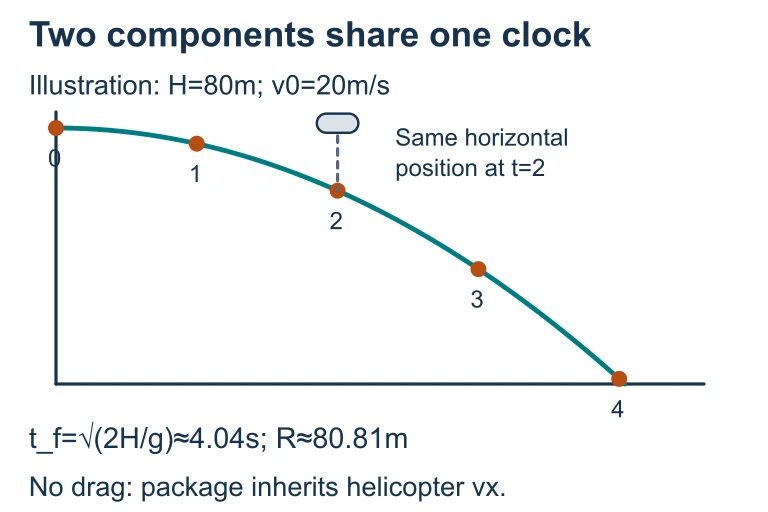 For an 80 m release height, horizontal speed 20 m/s and g = 9.8 m/s², flight time is about 4.04 s and range is about 80.81 m. Without drag, the package and helicopter retain the same horizontal velocity.
SECTION 6
Worked Example — Projectile Launched at an Angle
A soccer ball is kicked from ground level with an initial speed of 25.0 m/s at 53.0° above the horizontal. Ignoring air resistance, determine (a) the time of flight, (b) the maximum height, and (c) the horizontal range.
Soccer Ball Projectile
- 1
Step 1 — Identify Known Values and Set Up Coordinates
Take the launch point as the origin, positive-x to the right, and positive-y upward. Given: v₀ = 25.0 m/s, θ = 53.0°, y₀ = 0, aₓ = 0, aᵧ = −9.80 m/s². Because the ball lands at ground level, the final y-displacement is Δy = 0. - 2
Step 2 — Resolve Initial Velocity into Components
v₀ₓ = v₀ cos θ = 25.0 × cos 53.0° = 25.0 × 0.6018 = 15.05 m/s. v₀ᵧ = v₀ sin θ = 25.0 × sin 53.0° = 25.0 × 0.7986 = 19.97 m/s.v₀ₓ = 15.0 m/s, v₀ᵧ = 20.0 m/s - 3
Step 3 — Find Time of Flight
Use the vertical position equation with Δy = 0: 0 = v₀ᵧt − ½gt². Factor out t: t(v₀ᵧ − ½gt) = 0. The non-trivial solution gives t = 2v₀ᵧ / g = 2 × 20.0 / 9.80 = 4.08 s.Total time of flight: t = 4.08 s - 4
Step 4 — Find Maximum Height
At the apex, vᵧ = 0. Use vᵧ² = v₀ᵧ² + 2aᵧΔy: 0 = (20.0)² + 2(−9.80)Δy. Solving: Δy = 400 / 19.6 = 20.4 m.Maximum height: H = 20.4 m - 5
Step 5 — Find Horizontal Range
Since aₓ = 0, the horizontal distance is R = v₀ₓ × t = 15.0 × 4.08 = 61.2 m. Alternatively, the range formula R = v₀² sin(2θ) / g = (25.0)² × sin(106°) / 9.80 = 625 × 0.9613 / 9.80 = 61.3 m, which agrees within rounding.Horizontal range: R ≈ 61.2 m
Exam Strategy
SECTION 7
Strengths, Limitations & Common Misconceptions
| Aspect | Strength | Limitation |
|---|---|---|
| Independence of components | Reduces 2-D problems to two manageable 1-D problems; powerful and general. | Only valid when axes are perpendicular and acceleration does not couple directions (breaks down with certain drag forces). |
| Neglecting air resistance | Greatly simplifies analysis; produces closed-form solutions for range, height, and flight time. | Real projectiles experience drag that couples x and y motions and shortens range; model is less accurate at high speeds. |
| Flat-Earth approximation | g is treated as constant and downward, valid for ranges much smaller than Earth's radius. | For long-range ballistics (thousands of km), curvature and variation of g must be included. |
| Symmetry of trajectory | Landing speed equals launch speed (same height); time up equals time down—useful shortcuts. | Symmetry breaks if launch and landing heights differ or if air resistance is present. |
Strengths and limitations of the ideal projectile model
Common Misconceptions
- "The object stops at the top." Only the vertical component is zero at the apex; the horizontal component is unchanged. The speed at the top equals v₀ cos θ, not zero.
- "Acceleration is zero at the highest point." Gravitational acceleration is constant throughout the flight, including at the apex. The velocity is momentarily horizontal, but it is still changing.
- "A larger launch angle always gives a longer range." Maximum range on level ground occurs at 45°. Angles above 45° trade horizontal distance for extra height.
KEY TAKEAWAY
SECTION 8
Connections to Advanced Topics
The component-decomposition method you have learned in this lesson is not limited to projectile motion. It generalizes immediately to any situation involving constant acceleration in two dimensions, and with appropriate modifications, it extends to non-constant acceleration as well. Understanding these connections helps you see two-dimensional kinematics as the foundation of a much larger edifice.
| This Lesson (AP Physics 1) | Advanced Extension |
|---|---|
| Constant acceleration (gravity) with no air resistance | Variable acceleration from drag: requires numerical integration or differential equations (AP Physics C, college dynamics) |
| Velocity and acceleration as component pairs (vₓ, vᵧ) | Full vector notation with unit vectors: v = vₓ î + vᵧ ĵ, manipulated with calculus (Physics C and engineering statics) |
| Independence of x and y: perpendicular Cartesian axes | Curvilinear coordinates (tangential/normal): acceleration decomposed along and perpendicular to the path (circular motion, AP Physics 1 Unit 7) |
| Relative velocity addition: v_AC = v_AB + v_BC | Galilean relativity; at high speeds, Lorentz velocity addition in special relativity |
How two-dimensional kinematics connects to more advanced topics
Looking ahead within the AP Physics 1 curriculum, the vector decomposition skills you practice here will be essential for analyzing forces (free-body diagrams require resolving weight, normal force, and tension into components), circular motion (centripetal acceleration is perpendicular to velocity), and even momentum (impulse and momentum are vector quantities). Mastering two-dimensional kinematics therefore pays dividends across virtually every subsequent unit.
SECTION 9
Practice Problems
Question 1: CONCEPTUAL
- A. The launched ball hits the ground first because it has a greater initial speed.
- B. The dropped ball hits the ground first because it falls straight down along the shortest path.
- C. Both balls hit the ground at the same time because their vertical motions are identical.
- D. The dropped ball hits the ground first because it has no horizontal velocity to 'use up' its energy.
Show answer (C)
Question 2: BASIC CALCULATION
- A. 7.0 m/s
- B. 13 m/s
- C. 17 m/s
- D. 169 m/s
Show answer (B)
Question 3: INTERMEDIATE
- A. 16 m
- B. 24 m
- C. 36 m
- D. 72 m
Show answer (B)
Question 4: APPLIED
4 ptsShow answer
Question 5: CRITICAL THINKING
4 ptsShow answer
SUMMARY
Lesson Summary
Summary
This lesson established that vectors are quantities possessing both magnitude and direction, and that any vector can be split into perpendicular components using trigonometric decomposition (Aₓ = A cos θ, Aᵧ = A sin θ). The independence of perpendicular motions allows every two-dimensional kinematics problem to be separated into two one-dimensional problems linked by the shared variable time. For projectile motion (no air resistance), horizontal velocity is constant while vertical motion is uniformly accelerated by gravity, producing a parabolic trajectory.
Key results include the Pythagorean reconstruction of a vector's magnitude (A = √(Aₓ² + Aᵧ²)), the inverse-tangent direction formula (θ = tan⁻¹(Aᵧ/Aₓ)), and the range equation R = v₀² sin(2θ)/g for level-ground launches. Common misconceptions—such as believing the projectile 'stops' at the apex or that acceleration is zero there—must be explicitly corrected. These vector skills form the foundation for subsequent AP Physics 1 topics including forces, circular motion, and momentum.