

SECTION 1
Historical Context & Motivation
The idea that a moving body carries something intrinsic—a quantity related to both its bulk and its swiftness—predates modern physics by centuries. Early natural philosophers such as Galileo recognized that a cannonball in flight could do far more damage than one at rest, but the precise mathematical relationship between mass, speed, and the capacity to do work remained contentious throughout the seventeenth and eighteenth centuries. The concept we now call translational kinetic energy crystallized only after prolonged debate over whether the correct measure of a body's "living force" was proportional to velocity or to the square of velocity—a dispute known as the vis viva controversy.
1686 • Leibniz Proposes Vis Viva
1743 • d'Alembert's Clarification
1829 • Coriolis Introduces ½mv²
1847 • Helmholtz & Conservation of Energy
1905 • Einstein's Relativistic Extension
The central question that drove this entire line of inquiry was deceptively simple: How do we quantify the energy an object possesses solely because it is moving in a straight line? Understanding translational kinetic energy allows us to predict how much work a moving object can perform, how it exchanges energy with other objects during collisions, and how forces acting over distances change a system's state of motion. In AP Physics 1, this concept is foundational to the work–energy theorem, conservation of energy, and the analysis of both elastic and inelastic collisions.
SECTION 2
Core Principles & Definitions
Translational kinetic energy is the energy an object possesses due to its motion through space along a straight or curved path—as opposed to rotational kinetic energy, which arises from spinning about an axis. Before diving into the mathematics, it is essential to establish several foundational ideas that govern how this energy behaves within physical systems.
Scalar Quantity
Always Non-Negative
Quadratic Dependence on Speed
Frame-Dependent
Linked to Work
KEY TAKEAWAY
SECTION 3
Visual Explanation
The following diagram illustrates how translational kinetic energy scales with speed for a fixed mass. Notice the characteristic parabolic shape—the hallmark of the v² dependence—and observe how modest increases in speed produce dramatically larger increases in kinetic energy.
The parabolic shape of the KE-versus-speed curve has profound practical consequences. Consider the data points plotted above: moving from 2 m/s to 4 m/s increases kinetic energy by 12 J (from 4 J to 16 J), whereas moving from 8 m/s to 10 m/s increases it by 36 J (from 64 J to 100 J). The same 2 m/s increment in speed produces three times more kinetic energy at higher speeds than at lower speeds. This nonlinear relationship is the fundamental reason why braking distances on highways grow much faster than speed itself, and why engineers must account for the v² factor when designing crash safety systems, projectile defenses, and energy-absorbing materials.
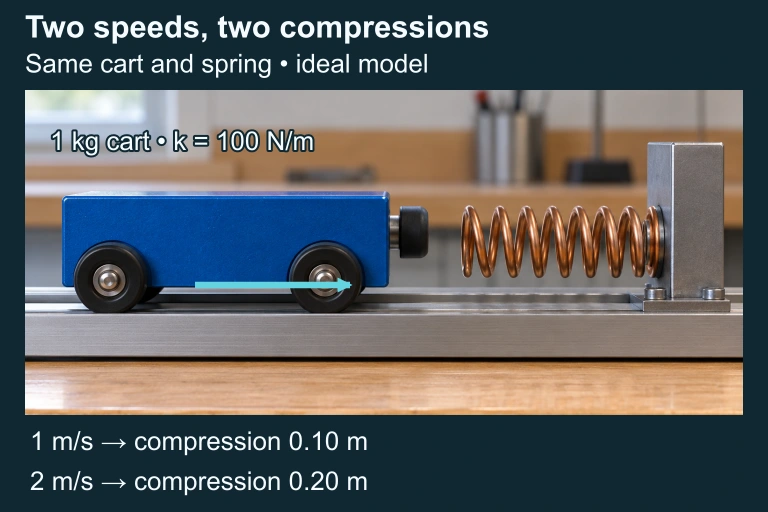 The same 1 kg cart encounters a 100 N/m spring. Incoming speeds 1 and 2 m/s give kinetic energies 0.5 and 2 J and maximum compressions 0.10 and 0.20 m. The required companion compares compression on one common ruler.
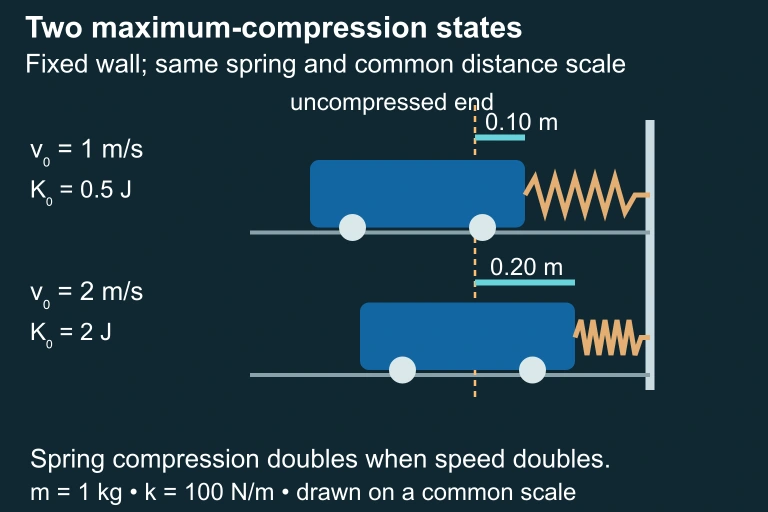 Two exact maximum-compression states at a common scale.
SECTION 4
Mathematical Framework
The expression for translational kinetic energy can be derived directly from Newton's second law and the definitions of work and acceleration. This derivation connects the force-based (Newtonian) description of motion to the energy-based description that is often more convenient for solving complex problems.
Derivation from the Work–Energy Theorem
Consider a constant net force F applied to an object of mass m that starts from rest and accelerates uniformly over a displacement d. By Newton's second law, F = ma. The kinematic equation v² = v₀² + 2ad gives, for v₀ = 0, the result a = v²/(2d). Substituting into the work expression W = Fd yields W = m × [v²/(2d)] × d = ½mv². Because the object started from rest (KE₀ = 0), the net work equals the final kinetic energy. More generally, when the object has initial speed v₀, the net work equals the change in kinetic energy: W_net = ½mv² − ½mv₀².
TRANSLATIONAL KINETIC ENERGY
KE = translational kinetic energy (J), m = mass of the object (kg), v = speed of the object (m/s). The SI unit of kinetic energy is the joule (1 J = 1 kg·m²/s²).
WORK–ENERGY THEOREM
W_net = net work done on the object (J), = final speed (m/s), = initial speed (m/s). Positive net work increases kinetic energy; negative net work decreases it.
ALTERNATIVE FORM USING MOMENTUM
p = mv is the object's linear momentum. This form is useful when momentum is known (e.g., after a collision analysis) and you wish to find kinetic energy without first solving for speed.
AP Exam Tip
SECTION 5
Mass vs. Speed: A Detailed Comparison
One of the most important conceptual insights about translational kinetic energy is the asymmetric role played by mass and speed. While both contribute to KE, the quadratic dependence on speed means that changes in velocity have a disproportionately large effect compared to equivalent changes in mass. The diagram below presents a side-by-side comparison of how doubling mass and doubling speed each affect kinetic energy for the same baseline object.
| Scenario | Mass | Speed | KE (relative to baseline) |
|---|---|---|---|
| Baseline | m | v | 1× |
| Double mass | 2m | v | 2× |
| Double speed | m | 2v | 4× |
| Triple speed | m | 3v | 9× |
| Double both | 2m | 2v | 8× |
| Halve speed | m | v/2 | ¼× |
Scaling of kinetic energy with changes in mass and speed
SECTION 6
Worked Example
A 1200 kg car accelerates from 15 m/s to 30 m/s along a straight, level road. Determine (a) the initial and final translational kinetic energies, (b) the change in kinetic energy, and (c) the net work done on the car during this acceleration.
Car Acceleration on a Level Road
- 1
Step 1 — Identify Given Values
Mass m = 1200 kg, initial speed vi = 15 m/s, final speed vf = 30 m/s. The road is level, so gravitational potential energy does not change. - 2
Step 2 — Calculate Initial Kinetic Energy
KEi = ½mvi² = ½ × 1200 kg × (15 m/s)² = ½ × 1200 × 225 = 135,000 JKE_i = 135,000 J = 135 kJ - 3
Step 3 — Calculate Final Kinetic Energy
KEf = ½mvf² = ½ × 1200 kg × (30 m/s)² = ½ × 1200 × 900 = 540,000 JKE_f = 540,000 J = 540 kJ - 4
Step 4 — Find the Change in Kinetic Energy
ΔKE = KEf − KEi = 540,000 J − 135,000 J = 405,000 JΔKE = 405 kJ - 5
Step 5 — Apply the Work–Energy Theorem
By the work–energy theorem, Wnet = ΔKE. Therefore, the net work done on the car is 405 kJ. Note that even though the speed only doubled (from 15 to 30 m/s), the kinetic energy quadrupled (from 135 kJ to 540 kJ), confirming the v² dependence.W_net = 405 kJ
SECTION 7
Strengths & Limitations of the KE Framework
Using translational kinetic energy as an analytical tool is enormously powerful, but like all physical models it has a defined domain of applicability. Understanding both the strengths and the limitations of this framework will help you choose the right approach on the AP exam and in real-world problem-solving.
| Strengths | Limitations |
|---|---|
| Scalar quantity—no vector components needed, simplifying calculations. | Does not encode directional information; cannot determine the direction of motion from KE alone. |
| Work–energy theorem provides an elegant shortcut, bypassing detailed force analysis over a path. | Only applies to translational (center-of-mass) motion; rotating or vibrating objects require additional energy terms. |
| Directly links to conservation of energy, allowing analysis of complex multi-step processes. | Frame-dependent: observers in different reference frames assign different KE values to the same object. |
| Valid for all speeds in AP Physics 1 (non-relativistic regime). | Breaks down at speeds approaching the speed of light; relativistic kinetic energy must be used instead. |
| Pairs naturally with momentum for collision analysis (both conserved or semi-conserved). | KE is not always conserved in collisions (only in perfectly elastic ones); inelastic collisions convert KE to thermal/sound energy. |
Strengths and limitations of the translational kinetic energy framework
KEY TAKEAWAY
SECTION 8
Connection to Advanced Theory
The ½mv² formula you master in AP Physics 1 is the foundation upon which more sophisticated energy concepts are built. In AP Physics C and beyond, the same quantity re-emerges within calculus-based frameworks and extends into domains where the algebra-based expression breaks down. The table below contrasts the AP Physics 1 treatment of kinetic energy with the approaches used in more advanced courses.
| Feature | AP Physics 1 (Algebra-Based) | AP Physics C / University Physics |
|---|---|---|
| KE formula | KE = ½mv² | KE = ∫F · ds derived via calculus; same result for constant mass |
| Variable forces | Handled via energy bar charts or conservation of energy | Work integral W = ∫F(x) dx gives exact KE change for any force function |
| Rotational extension | KE_rot = ½Iω² introduced conceptually | Full rolling-without-slipping analysis: KE_total = ½mv² + ½Iω² |
| Relativistic regime | Not covered; ½mv² assumed valid | KE = (γ − 1)mc² where γ = 1/√(1 − v²/c²) |
| Lagrangian mechanics | Not applicable | KE appears as the T term in L = T − V; used in generalized coordinates |
AP Physics 1 vs. advanced treatments of kinetic energy
For the AP Physics 1 exam, your focus should remain squarely on the algebra-based expression KE = ½mv² and the work–energy theorem. However, recognizing that this expression is the low-speed limit of a more general relativistic formula, and that rotational kinetic energy adds a separate term for spinning objects, provides valuable conceptual depth. In particular, the AP exam now includes rotational dynamics, so distinguishing between translational and rotational kinetic energy is an important skill.
SECTION 9
Practice Problems
Question 1: CONCEPTUAL
- A. KE_A = KE_B
- B. KE_A = 3 × KE_B
- C. KE_B = 3 × KE_A
- D. KE_A = 9 × KE_B
Show answer (B)
Question 2: BASIC CALCULATION
- A. 5.6 J
- B. 11.3 J
- C. 140.6 J
- D. 281.3 J
Show answer (C)
Question 3: INTERMEDIATE
- A. 0.20
- B. 0.44
- C. 0.56
- D. 1.44
Show answer (B)
Question 4: APPLIED
5 ptsShow answer
Question 5: CRITICAL THINKING
4 ptsShow answer
SUMMARY
Lesson Summary
Summary
Translational kinetic energy is the energy an object possesses due to its straight-line (or center-of-mass) motion, given by the formula KE = ½mv². It is a scalar quantity that is always non-negative and depends on the square of speed, meaning that doubling an object's speed quadruples its kinetic energy. The work–energy theorem (W_net = ΔKE) provides the bridge between forces acting over distances and changes in kinetic energy, making it one of the most powerful tools in mechanics.
Key exam skills include recognizing the quadratic dependence on speed in conceptual comparison problems, applying the alternative form KE = p²/(2m) when momentum is known, and distinguishing translational from rotational kinetic energy. Remember that kinetic energy is frame-dependent and is conserved only in perfectly elastic collisions; in inelastic collisions, some KE converts to thermal or other forms of energy.