AP Physics 1 • Energy and Momentum of Rotating Systems

Torque and Work

Understanding how rotational forces transfer energy to spinning objects through angular displacement.

An orbit with symbols for force and motion.
Inside this lesson 10 sections 5 questions 9 figures

SECTION 1

Historical Context & Motivation

The study of rotational motion has ancient roots, but the formal connection between torque and work emerged only through centuries of careful analysis. From Archimedes' exploration of levers to the industrial revolution's demand for efficient engines, understanding how rotational forces produce energy transfer proved essential to both theoretical physics and engineering practice. The key insight—that torque acting through an angular displacement performs work analogous to a linear force acting through a linear displacement—unified translational and rotational mechanics under a single energy framework.

~250 BCE • Archimedes and the Lever

Archimedes formalized the law of the lever, recognizing that a force applied at a greater distance from the fulcrum produces a larger turning effect. This was the earliest quantitative treatment of what we now call torque.

1687 • Newton's Principia

Isaac Newton published the laws of motion and the concept of force. Although Newton focused on translational dynamics, his framework provided the mathematical language needed to extend force concepts to rotational settings.

1743 • d'Alembert's Principle

Jean le Rond d'Alembert introduced a principle connecting virtual work to equilibrium of both translating and rotating systems, laying groundwork for the concept of rotational work.

1788 • Lagrange's Analytical Mechanics

Joseph-Louis Lagrange published his Mécanique analytique, which treated energy methods in generalized coordinates. Rotational work and torque found their natural mathematical home within this energy-based approach to mechanics.

1840s • Industrial Revolution & Engines

The development of steam and water turbines demanded precise calculations of the work performed by rotating shafts. Engineers such as James Watt defined horsepower by measuring torque and rotational speed, cementing the practical importance of rotational work.

The central question that this lesson addresses is deceptively simple: when a torque causes an object to rotate, how much energy is transferred? Answering this question requires bridging the familiar concept of work (force times displacement) with the rotational quantities of torque and angular displacement, revealing a deep symmetry between linear and rotational physics.

SECTION 2

Core Principles & Definitions

Before computing rotational work, you need a firm grasp of the foundational quantities involved. Torque (τ) measures the tendency of a force to cause rotation about an axis, while angular displacement (Δθ) quantifies how far the object actually rotates. The product of these two quantities yields rotational work, which changes the rotational kinetic energy of the system through the work–energy theorem for rotation.

1

Torque (τ)

The rotational analog of force. Defined as τ = rF sin θ, where r is the distance from the axis, F is the applied force, and θ is the angle between the force and the lever arm. Measured in N·m.
2

Angular Displacement (Δθ)

The angle through which an object rotates, measured in radians. A full revolution corresponds to 2π rad. This quantity plays the same role for rotation that linear displacement plays for translation.
3

Rotational Work (W)

The energy transferred to or from a rotating system by a net torque. For a constant torque: W = τΔθ. Measured in joules (J), just like translational work.
4

Rotational Kinetic Energy (K)

The kinetic energy of a spinning object: K = ½Iω², where I is the moment of inertia and ω is the angular velocity. Rotational work changes this energy.
5

Work–Energy Theorem (Rotation)

The net work done by all torques on a rigid body equals the change in its rotational kinetic energy: W_net = ΔK_rot = ½Iω_f² − ½Iω_i².
✦

KEY TAKEAWAY

Think of a torque wrench tightening a bolt. The torque is how hard you twist, and the angular displacement is how far the bolt turns. The work you do is the product of those two—just as in the linear case where work equals force times distance. Rotating something by a larger angle or with a larger torque always means more energy is transferred.

SECTION 3

Visual Explanation

Torque and Rotational Work: Force on a Rotating Lever ArmAxis of rotationrPoint of applicationFF sin θ (tangential)θΔθ(angular displacement)Rotational Workτ = rF sin θW = τ ΔθUnits: N·m × rad = J
A force F (pink arrow) is applied at distance r (cyan dashed line) from the axis of rotation. The torque τ = rF sin θ acts through an angular displacement Δθ (gold arc), performing rotational work W = τΔθ.

The diagram above illustrates the essential geometry of rotational work. Notice that only the tangential component of the force—the part perpendicular to the lever arm—contributes to torque, which is why the sin θ factor appears in the torque equation. A purely radial force (one directed along the lever arm) produces no torque and therefore does no rotational work, regardless of how large the force is. As the lever arm sweeps through an angular displacement Δθ, the torque transfers energy to the system at a rate proportional to both the torque magnitude and the angle swept. The resulting work, measured in joules, can increase the object's rotational kinetic energy, overcome friction, or perform useful mechanical tasks—just as linear work changes translational kinetic energy.
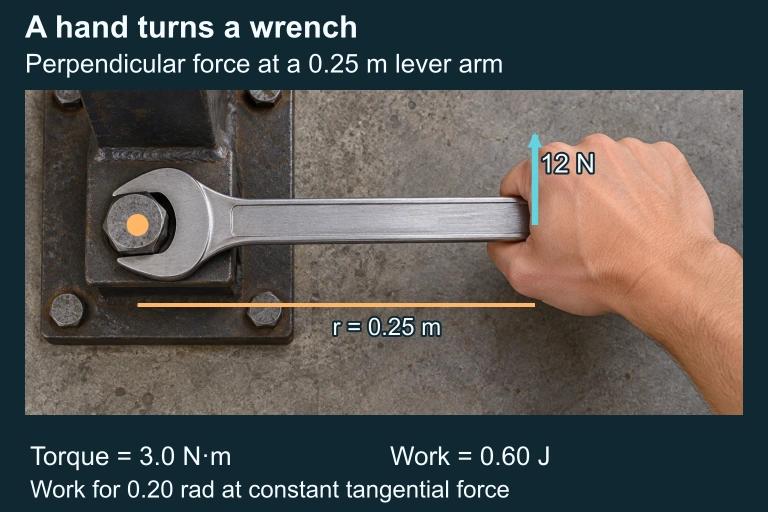
A 12 N perpendicular force on a 0.25 m wrench produces 3 N·m torque and does 0.60 J over 0.20 rad.A 12 N perpendicular force on a 0.25 m wrench produces 3 N·m torque and does 0.60 J over 0.20 rad.
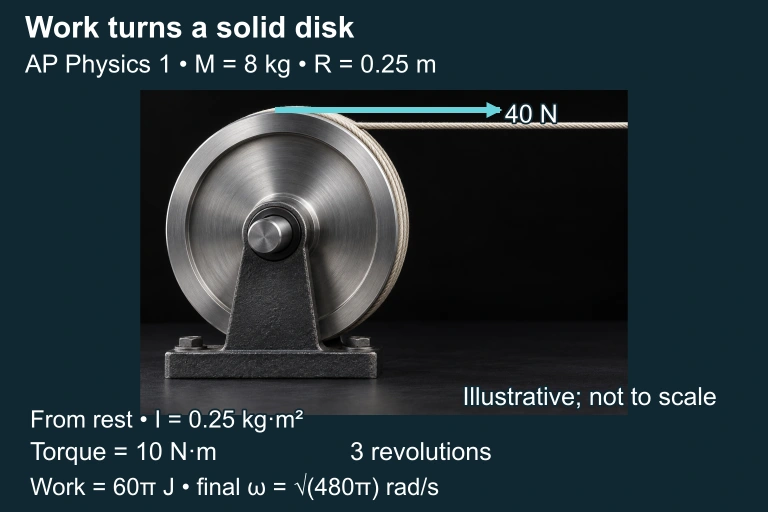
AP Physics 1 • M = 8 kg • R = 0.25 m; illustrative apparatus not to scale.AP Physics 1 • M = 8 kg • R = 0.25 m; illustrative apparatus not to scale.

SECTION 4

Mathematical Framework

The mathematical formulation of rotational work mirrors its translational counterpart almost exactly. In linear mechanics, work is defined as W = FΔx for a constant force along the direction of displacement. By replacing force with torque and linear displacement with angular displacement, we arrive at the rotational analog. The following equations form the complete mathematical framework you need for the AP exam.

TORQUE

τ=rFsinθτ = rF sin θ

τ = torque (N·m), r = distance from axis to point of force application (m), F = magnitude of applied force (N), θ = angle between r and F vectors.

ROTATIONAL WORK (CONSTANT TORQUE)

W=τΔθW = τΔθ

W = work done (J), τ = net torque about the rotation axis (N·m), Δθ = angular displacement (rad). The radian is dimensionless, so N·m × rad = N·m = J.

ROTATIONAL KINETIC ENERGY

Krot=½Iω2K_rot = ½Iω²

Krot = rotational kinetic energy (J), I = moment of inertia (kg·m²), ω = angular velocity (rad/s).

WORK–ENERGY THEOREM (ROTATION)

Wnet=½Iωf2−½Iωi2W_net = ½Iω_f² − ½Iω_i²

The net work done by all external torques equals the change in rotational kinetic energy. ωf is the final angular velocity and ωi is the initial angular velocity.

💡

Derivation Connection

You can derive W = τΔθ from the linear definition of work. Consider a point on a rotating body at distance r from the axis. It moves through arc length s = rΔθ. The tangential force is Ft = τ/r. Then W = Ft × s = (τ/r)(rΔθ) = τΔθ. This confirms the rotational work formula is fully consistent with the translational definition.

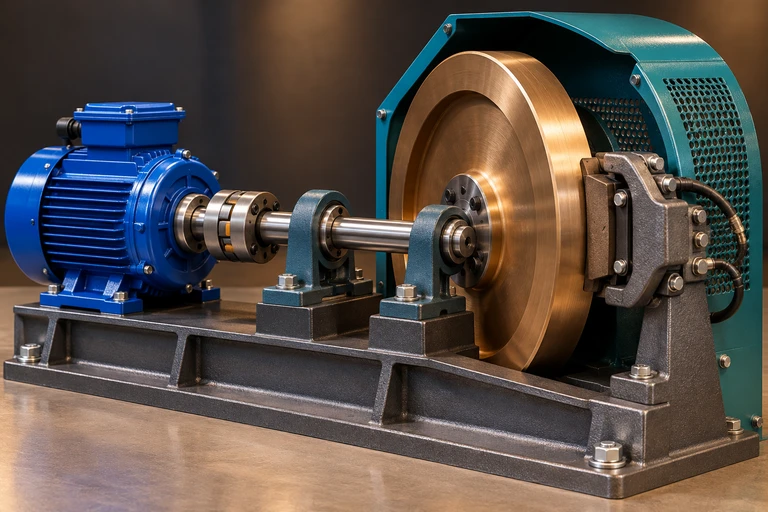
A blue motor drives a gold flywheel through a continuous horizontal shaft with two bearings. A fixed brake caliper contacts the wheel rim inside a partial protective guard.A flywheel stores kinetic energy as it rotates. Net torque changes that energy through rotational work, while drive and load torques can transfer power even at steady speed.
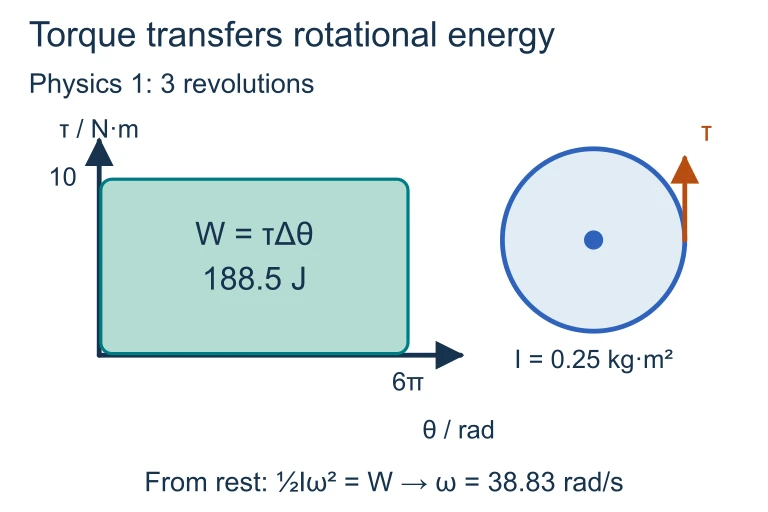
Work under a torque–angle graph. A constant 10 N·m net torque through 6π radians transfers 60π J. Starting from rest with I = 0.25 kg·m², the disk reaches about 38.83 rad/s.A constant 10 N·m net torque through 6π radians transfers 60π J. Starting from rest with I = 0.25 kg·m², the disk reaches about 38.83 rad/s.

SECTION 5

Translational vs. Rotational Analogs

One of the most powerful strategies in rotational mechanics is recognizing the systematic correspondence between translational and rotational quantities. Every translational variable has a rotational counterpart, and the equations governing work and energy maintain the same algebraic structure. The following table and diagram make this parallel explicit.

Translational QuantityRotational AnalogRelationship
Force (F)Torque (τ)τ = rF sin θ
Displacement (Δx)Angular displacement (Δθ)Δs = rΔθ (arc length)
Mass (m)Moment of inertia (I)I = Σmiri2
Velocity (v)Angular velocity (ω)v = rω
Work: W = FΔxRotational work: W = τΔθBoth measured in joules
KE = ½mv²Krot = ½Iω²Same functional form

Parallel structure between translational and rotational mechanics

Translational Work vs. Rotational WorkTRANSLATIONALW = F ΔxForce × displacementmFΔxKE = ½mv²Translational kinetic energychangesW_net = ΔKE = ½mv_f² − ½mv_i²Work–energy theoremROTATIONALW = τ ΔθTorque × angular displacementrτ, ΔθK_rot = ½Iω²Rotational kinetic energychangesW_net = ½Iω_f² − ½Iω_i²Work–energy theorem (rotation)
Side-by-side comparison of translational and rotational work frameworks. Note the identical algebraic structure: force ↔ torque, displacement ↔ angular displacement, mass ↔ moment of inertia, and velocity ↔ angular velocity.
🔗

PATTERN RECOGNITION

If you know the translational equations, you already know the rotational ones—just swap in the rotational analogs. This substitution pattern (F → τ, m → I, v → ω, Δx → Δθ) works throughout mechanics and is a reliable strategy for deriving or checking rotational formulas on the AP exam.

SECTION 6

Worked Example

Let's work through a full problem that connects torque, rotational work, and the work–energy theorem. This type of multi-step problem is representative of what you will encounter in the AP Physics 1 free-response section.

Spinning Up a Grinding Wheel

  1. 1

    Step 1 — Identify Given Values

    A uniform solid disk (grinding wheel) has mass m = 8.0 kg and radius R = 0.25 m. A constant tangential force F = 40 N is applied at the rim for exactly 3 full revolutions, starting from rest. We want to find: (a) the torque, (b) the work done, and (c) the final angular velocity.
  2. 2

    Step 2 — Calculate the Torque

    The force is tangential (perpendicular to the radius), so θ = 90° and sin 90° = 1. Thus τ = rF sin θ = (0.25 m)(40 N)(1) = 10 N·m.
    τ = 10 N·m
  3. 3

    Step 3 — Convert Revolutions to Radians

    Angular displacement Δθ = 3 rev × 2π rad/rev = 6π rad ≈ 18.85 rad. Always convert to radians before computing work.
    Δθ = 6π rad
  4. 4

    Step 4 — Compute Rotational Work

    W = τΔθ = (10 N·m)(6π rad) = 60π J ≈ 188.5 J. This is the energy transferred to the wheel by the applied force.
    W ≈ 188.5 J
  5. 5

    Step 5 — Find the Final Angular Velocity

    The moment of inertia of a solid disk is I = ½mR² = ½(8.0 kg)(0.25 m)² = 0.25 kg·m². Applying the work–energy theorem with ωi = 0: W = ½Iωf². Solving: ωf = √(2W/I) = √(2 × 60π / 0.25) = √(480π) ≈ 38.8 rad/s.
    ω_f ≈ 38.8 rad/s
  6. 6

    Step 6 — Verify Units and Reasonableness

    Converting to RPM: (38.8 rad/s)(60 s/min)/(2π rad/rev) ≈ 370 RPM. This is a realistic speed for a small grinding wheel. The units check out: N·m × rad = J, and √(J / kg·m²) = √(s⁻²) = rad/s ✓.

SECTION 7

Strengths, Limitations & Common Pitfalls

The rotational work–energy approach is powerful but has boundaries. Knowing when it works well and when it fails will save you time on the exam and prevent conceptual errors.

StrengthsLimitations
Bypasses the need to find angular acceleration—you can go directly from torque and displacement to energy.Requires constant torque (or integration for variable torque, which is beyond AP Physics 1).
Scalar equation—no vector components needed, reducing sign errors.Does not directly tell you how long the process takes; you need kinematics for time information.
Unifies with translational work via the same energy conservation framework.Applicable only to rigid bodies rotating about a fixed axis (for AP Physics 1 purposes).
Naturally accounts for friction as negative work, simplifying energy-loss calculations.Does not provide force or torque direction—use Newton's second law for rotation if you need those.

When to use (and when not to use) the rotational work approach

⚠

Common Exam Pitfall

Students frequently forget to convert revolutions to radians before computing W = τΔθ. If Δθ is in revolutions instead of radians, your answer will be off by a factor of 2π. Another frequent error is confusing torque units (N·m) with energy units (J)—they are dimensionally identical but conceptually distinct. Torque is not energy; it is a rotational analog of force.
✦

WHEN TO USE ROTATIONAL WORK

Use the rotational work–energy approach whenever a problem gives you torque and angular displacement (or enough information to find them) and asks about speed or energy. If the problem asks about time or angular acceleration directly, consider using τ = Iα and rotational kinematics instead. Often, the most efficient strategy combines both: use kinematics to find Δθ, then use W = τΔθ to find the energy transferred.

SECTION 8

Connection to Power & Advanced Theory

Rotational work connects seamlessly to the concept of rotational power and, at higher levels of study, to generalized energy methods in Lagrangian mechanics. Understanding these connections gives you a preview of where rotational physics leads beyond the AP exam and helps reinforce the fundamental ideas within the exam's scope.

AP Physics 1 ConceptExtension / Advanced VersionKey Difference
W = τΔθ (constant torque)W = ∫τ dθ (variable torque, calculus-based)Integration handles non-constant torque
P = W/Δt (average power)P = τω (instantaneous rotational power)Product of torque and angular velocity gives instantaneous rate of energy transfer
Fixed-axis rotation onlyGeneral rigid body motion (translation + rotation)Total KE = ½mv²_cm + ½I_cm ω² (rolling, for example)
Work–energy theoremLagrangian energy methodsGeneralized coordinates handle complex constraints automatically

From AP Physics 1 to more advanced treatments

Within the AP Physics 1 exam scope, the most important extension is rotational power: P = τω. This formula, analogous to the translational P = Fv, is particularly useful for problems involving motors, engines, and turbines that operate at steady angular velocity. Although the AP exam rarely asks you to derive it, recognizing that power equals the rate of doing work (P = dW/dt = τ dθ/dt = τω) reinforces the conceptual chain connecting torque, work, and energy. For systems that both translate and rotate—like a ball rolling down a ramp—the total kinetic energy includes both ½mv² and ½Iω², and conservation of energy problems require you to account for both contributions.

SECTION 9

Practice Problems

Question 1: CONCEPTUAL

A constant net torque acts on a wheel that is free to rotate about a fixed axis. As the wheel completes its first full revolution starting from rest, the net work done by the torque is W₁. The net work done during the second full revolution is W₂. Which of the following correctly compares W₁ and W₂?
  • A. W₂ = W₁ because the torque and the angular displacement are the same for each revolution.
  • B. W₂ > W₁ because the wheel is spinning faster during the second revolution.
  • C. W₂ < W₁ because less torque is needed once the wheel is already moving.
  • D. W₂ = 2W₁ because kinetic energy doubles with each revolution.
Show answer (A)
The correct answer is A. Since W = τΔθ and both the torque τ and the angular displacement Δθ = 2π rad are identical for each revolution, the work done is the same: W₁ = W₂ = τ(2π). Choice B is tempting because the wheel is indeed faster during the second revolution, but speed affects power (rate of doing work), not the total work—work depends only on torque and angular displacement. Choice C incorrectly assumes the torque changes; the problem states it is constant. Choice D is incorrect because while the kinetic energy gained is W₁ during the first revolution and the total KE after two revolutions is 2W₁, the work done during the second revolution alone is still W₁ (the KE increases from W₁ to 2W₁, a change of W₁).

Question 2: BASIC CALCULATION

A constant torque of 15 N·m is applied to a flywheel, causing it to rotate through 4.0 revolutions. How much work does this torque do on the flywheel?
  • A. 60 J
  • B. 120π J ≈ 377 J
  • C. 60π J ≈ 188 J
  • D. 240π J ≈ 754 J
Show answer (B)
The correct answer is B. First convert revolutions to radians: Δθ = 4.0 rev × 2π rad/rev = 8π rad. Then W = τΔθ = (15 N·m)(8π rad) = 120π J ≈ 377 J. Choice A (60 J) results from multiplying 15 × 4 without converting to radians—a very common error. Choice C (60π J) would correspond to only 2 revolutions. Choice D (240π J) uses 16π rad, as if each revolution were 4π rad instead of 2π rad.

Question 3: INTERMEDIATE

A solid cylinder (I = ½MR²) of mass 6.0 kg and radius 0.20 m is initially rotating at 10 rad/s. A braking torque is applied until the cylinder comes to rest after rotating through 5.0 revolutions. What is the magnitude of the braking torque?
  • A. 0.19 N·m
  • B. 0.38 N·m
  • C. 1.2 N·m
  • D. 0.60 N·m
Show answer (A)
The correct answer is A. The moment of inertia is I = ½MR² = ½(6.0)(0.20)² = 0.12 kg·m². The initial rotational KE is KiK_i = ½Iω_i² = ½(0.12)(10)² = 6.0 J. Since the cylinder comes to rest, KfK_f = 0, so the net work is W_net = 0 − 6.0 = −6.0 J (negative because the brake removes energy). The angular displacement is Δθ = 5.0 × 2π = 10π rad. Using W = τΔθ: |τ| = |W|/Δθ = 6.0/(10π) ≈ 0.19 N·m. Choice B (0.38 N·m) results from using I = MR² instead of ½MR². Choice C (1.2 N·m) comes from forgetting to convert revolutions to radians. Choice D (0.60 N·m) uses Δθ = 10 instead of 10π.

Question 4: APPLIED

5 pts
A student wants to experimentally verify the relationship W = τΔθ for a horizontal turntable that can rotate freely about a vertical axis through its center. The student has access to: a turntable with known moment of inertia I, a string that can be wrapped around the turntable's rim, a set of hanging masses, a protractor or angle-measuring sensor, and a photogate with a flag attached to the turntable. (a) Describe an experimental procedure the student could follow to test whether W = τΔθ is consistent with the work–energy theorem. Include specific measurements to be made. (b) Describe how the student should analyze the data to verify the relationship. (c) Identify one potential source of systematic error and explain how it would affect the results.
Show answer
Point 1 (Procedure – creating known torque): The student wraps the string around the turntable rim and hangs a known mass m over a pulley at the table edge, so the string tension provides a tangential force F = mg at the rim of radius R, producing torque τ = mgR. Point 2 (Procedure – measuring angular displacement and final speed): The student releases the mass from rest and allows the turntable to rotate through a measured angular displacement Δθ (using the protractor or angle sensor). The photogate and flag measure the final angular velocity ω_f by timing how long the flag (of known width) takes to pass through the gate. Point 3 (Analysis – comparing work to kinetic energy): The student calculates W = τΔθ = mgRΔθ for each trial and compares it to the measured change in rotational kinetic energy ΔK = ½Iω_f² (since ω_i = 0). If W = τΔθ is valid, a graph of W vs. ΔK should yield a straight line with slope 1 and y-intercept 0. Point 4 (Multiple trials): The student repeats the experiment for several different masses (changing τ) and/or several different release angles (changing Δθ) to generate multiple data points. Point 5 (Systematic error): Friction at the turntable's axle acts as an additional negative torque that removes energy from the system. This means the measured ΔK = ½Iω_f² will consistently be less than the calculated W = mgRΔθ, causing the data points to fall below the ideal W = ΔK line. The student could account for this by including a friction torque term or by measuring the deceleration of the turntable when no driving torque is applied.

Question 5: CRITICAL THINKING

4 pts
Two disks, A and B, are mounted on separate fixed axles and are initially at rest. Disk A has moment of inertia I and disk B has moment of inertia 4I. The same constant torque τ is applied to each disk. (a) After the same amount of work W has been done on each disk, which disk has the greater angular velocity? Justify your answer. (b) After the same amount of time t has elapsed, has the same amount of work been done on each disk? If not, on which disk has more work been done? Justify your answer using the relationship between torque, angular acceleration, and angular displacement.
Show answer
Point 1 (Part a – applying work–energy theorem): Since both disks start from rest, W = ½Iω² for each. For disk A: W = ½Iω_A² → ω_A = √(2W/I). For disk B: W = ½(4I)ω_B² → ω_B = √(2W/4I) = √(W/2I). Since √(2W/I) > √(W/2I), disk A has the greater angular velocity. Point 2 (Part a – physical reasoning): Disk A has a smaller moment of inertia, so the same energy input produces a larger angular velocity—just as a lighter object reaches a higher speed than a heavier one given the same kinetic energy. Point 3 (Part b – finding angular displacement for each disk): Using τ = Iα, disk A has α_A = τ/I and disk B has α_B = τ/(4I). From kinematics, Δθ = ½αt². So Δθ_A = ½(τ/I)t² and Δθ_B = ½(τ/4I)t² = Δθ_A/4. The work done on each is WAW_A = τΔθ_A and WBW_B = τΔθ_B = τ(Δθ_A/4) = WAW_A/4. Point 4 (Part b – conclusion with justification): More work has been done on disk A. Because disk A has a smaller moment of inertia, it accelerates faster and therefore rotates through a larger angle in the same time. Since work equals torque times angular displacement and the torques are equal, the disk with the larger angular displacement receives more work.

SUMMARY

Summary & Review

Summary

Torque (τ = rF sin θ) is the rotational analog of force, and rotational work (W = τΔθ) is the energy transferred when a torque acts through an angular displacement measured in radians. The work–energy theorem for rotation states that the net work done by all torques equals the change in rotational kinetic energy: Wnet = ½Iωf2 − ½Iωi2. Only the tangential component of a force contributes to torque, and angular displacement must always be in radians for the formula W = τΔθ to yield the correct energy in joules.

The deep parallel between translational and rotational mechanics—F ↔ τ, Δx ↔ Δθ, m ↔ I, v ↔ ω—means that every translational work–energy relationship has an exact rotational counterpart. Use W = τΔθ when you know (or can find) both the torque and the angular displacement, and apply the work–energy theorem to connect work to changes in angular speed. Extending to rotational power (P = τω) completes the framework for analyzing rotating systems in energy terms.

Varsity Tutors • AP Physics 1: Algebra-Based • Torque and Work