

SECTION 1
Historical Context & Motivation
The study of elastic forces stretches back to the earliest quantitative investigations of material behavior. Long before modern physics codified Newton's laws of motion, natural philosophers were fascinated by the observation that bent bows, stretched tendons, and compressed metals all seemed to return to their original shapes with a force that depended on how far they had been deformed. This regularity suggested an underlying mathematical law—one that would eventually become a cornerstone of mechanics, materials science, and wave theory.
The pivotal figure in this story is Robert Hooke, a contemporary and rival of Isaac Newton, whose 1676 anagram ceiiinosssttuv concealed the Latin phrase ut tensio, sic vis—"as the extension, so the force." This deceptively simple statement, now called Hooke's law, established the first linear relationship between the deformation of an elastic body and the restoring force it exerts, laying the groundwork for continuum mechanics and the modern theory of elasticity.
1676 • Hooke's Anagram Published
1687 • Newton's Principia
1822 • Cauchy's Stress Theory
1905 • Einstein & Atomic Vibrations
From Hooke's simple observation to Einstein's quantum oscillators, the spring force has remained one of the most important force models in physics. The central question this lesson addresses is: How does a spring's restoring force depend on its deformation, and what consequences does this relationship have for equilibrium, motion, and energy storage?
SECTION 2
Core Principles & Definitions
Before diving into the mathematics, it is essential to establish a clear conceptual vocabulary. Spring forces belong to the broader category of contact forces and arise whenever an elastic object is deformed from its natural length. Unlike gravitational or electromagnetic forces, which act at a distance, the spring force requires physical contact with the deformed medium. The following principles form the conceptual backbone of this topic.
Restoring Force
Linear Proportionality
Spring Constant (k)
Equilibrium Position
Elastic Limit
KEY TAKEAWAY
SECTION 3
Visual Explanation — Hooke's Law in Action
The diagram above captures the essential physics of Hooke's law in a single visual. Notice that in every case the spring force vector (green) is antiparallel to the displacement vector (red). This antiparallel relationship is encoded mathematically by the negative sign in Fs = −kx. If we define the positive x-direction to the right, then a positive displacement produces a negative (leftward) force, and a negative displacement produces a positive (rightward) force. This sign convention is critical on the AP exam: forgetting the negative sign transforms a restoring force into a runaway force that accelerates objects away from equilibrium—a physically absurd result.
SECTION 4
Mathematical Framework
Hooke's Law — The Force Equation
HOOKE'S LAW
Fₛ = spring (restoring) force (N) • k = spring constant (N/m) • x = displacement from equilibrium position (m). The negative sign ensures the force direction opposes the displacement direction.
Hooke's law is a vector equation in one dimension. The displacement x is measured from the spring's natural (equilibrium) length, not from an arbitrary origin. If a spring has natural length L₀ and its current length is L, then x = L − L₀ for stretching (x > 0) and x = L − L₀ < 0 for compression. The magnitude of the spring force is |Fₛ| = k|x|, which is always nonnegative. On the AP exam, you will often see the magnitude form written without the negative sign; context and free-body diagrams then determine the direction.
Elastic Potential Energy
ELASTIC POTENTIAL ENERGY
Uₛ = elastic potential energy stored in the spring (J). This expression follows from the work-energy theorem: the work done by an external agent to stretch or compress a spring by x equals the area under the F-vs-x graph, which is a triangle of base x and height kx.
Because x is squared, elastic potential energy is always nonnegative regardless of whether the spring is stretched or compressed. This energy is stored in the deformed spring and can be fully recovered (in the ideal, lossless case) when the spring returns to equilibrium. The connection between force and energy here is deep: the spring force is the negative derivative of the potential energy with respect to position, Fₛ = −dUₛ/dx, although this calculus-based derivation is beyond the scope of AP Physics 1. What is within scope is recognizing that the area under a force-vs-displacement graph gives the work done, and thus the energy stored.
Newton's Second Law with a Spring Force
NET FORCE & ACCELERATION
When the spring force is the only horizontal force, the acceleration is proportional to displacement but opposite in sign. This is the hallmark of simple harmonic motion (SHM), a topic that builds directly on Hooke's law.
AP EXAM TIP
SECTION 5
Force-vs-Displacement Graph & Energy Interpretation
One of the most powerful representations of Hooke's law is the force-vs-displacement graph. Plotting the magnitude of the applied force (or the magnitude of the spring force) against displacement yields a straight line through the origin with slope equal to the spring constant k. This graphical approach is not merely illustrative—it provides a direct method for determining k experimentally and for computing the elastic potential energy as the area under the curve.
The graphical interpretation is especially valuable for the AP exam because several FRQ and MCQ items require students to extract the spring constant from the slope of a linear fit, or to compute energy as the area of a triangle. Remember that the area of a triangle is ½ × base × height = ½ × x × kx = ½kx², which is precisely the elastic potential energy formula. If the graph is curved rather than linear, the spring is operating outside the Hookean regime, and you would need to compute the area under the curve by other means—though this is uncommon on the AP Physics 1 exam.
COMMON MISCONCEPTION
SECTION 6
Worked Example — Vertical Spring with a Hanging Mass
A 0.40 kg block is hung from a vertical spring whose spring constant is k = 80 N/m. The spring is initially at its natural length. The block is gently lowered until it reaches a new static equilibrium position. Determine (a) the extension of the spring at equilibrium and (b) the elastic potential energy stored in the spring at this position.
Vertical Spring Equilibrium
- 1
Step 1 — Draw a Free-Body Diagram
At the new equilibrium, the block is at rest, so the net force is zero. Two forces act on the block: the gravitational force Fg = mg downward and the spring force Fₛ = kx upward. Setting the coordinate axis positive upward, the equilibrium condition is ΣF = 0 → kx − mg = 0. - 2
Step 2 — Solve for Extension x
From the equilibrium condition: kx = mg, so x = mg/k. Substituting: x = (0.40 kg)(9.8 m/s²) / (80 N/m) = 3.92 / 80.x = 0.049 m = 4.9 cm - 3
Step 3 — Calculate Elastic Potential Energy
Using Uₛ = ½kx²: Uₛ = ½(80 N/m)(0.049 m)² = ½(80)(0.002401) = 0.0960 J.Uₛ ≈ 0.096 J - 4
Step 4 — Verify Reasonableness
The extension is about 5 cm for a moderately stiff spring supporting a light block—this is physically reasonable. The stored energy (≈ 0.1 J) is modest, which makes sense given the small displacement. We can also check units: (N/m)(m²) = N·m = J ✓. Note that the loss in gravitational PE of the block (mgh = 0.40 × 9.8 × 0.049 ≈ 0.192 J) is twice the elastic PE—the remaining 0.096 J would have been converted to kinetic energy and then dissipated if the block were simply released, but because it was "gently lowered," an external agent absorbed that extra energy.
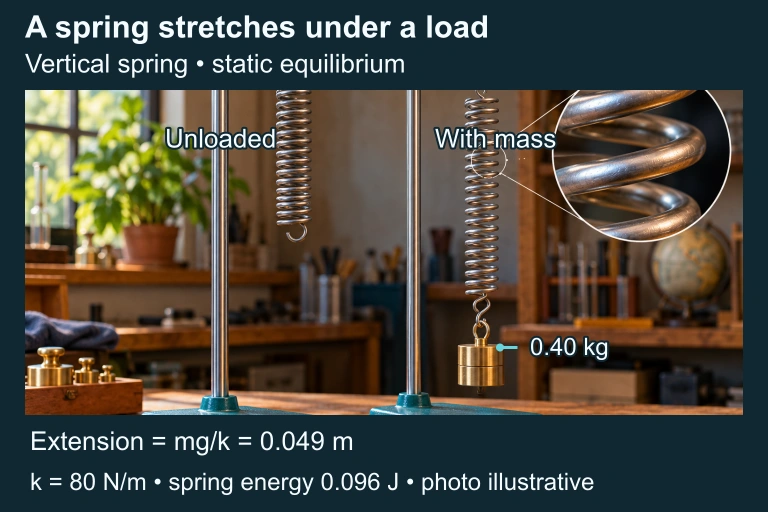 AP Physics 1: gently lowering a 0.40 kg mass on an 80 N/m spring produces equilibrium extension 0.049 m and stored energy 0.096 J. The Physics C incline companion is a separate 2 kg model, also requiring extension.
SECTION 7
Spring Forces Compared with Other Common Forces
To deepen understanding, it is helpful to contrast the spring force with other forces encountered in AP Physics 1. The table below highlights the defining characteristics of each force type, making clear what is unique about elastic restoring forces and where potential conceptual overlaps might lead to errors.
| Force | Formula | Direction | Constant or Variable? |
|---|---|---|---|
| Spring (Hooke's law) | Fₛ = −kx | Opposite to displacement from equilibrium | Variable — changes with position |
| Gravity (near Earth) | Fg = mg | Always downward (toward Earth's center) | Approximately constant near surface |
| Normal force | N (adjusts to maintain contact) | Perpendicular to surface | Variable — adjusts as needed |
| Kinetic friction | fₖ = μₖN | Opposite to velocity | Constant (for given N) |
| Tension | T (along string/rope) | Along the string, away from object | Variable — adjusts as needed |
Comparison of common forces in AP Physics 1
KEY TAKEAWAY
SECTION 8
Connection to Advanced Theory
Hooke's law as presented in AP Physics 1 is the simplest member of a much richer family of elastic and oscillatory models. Understanding where the introductory treatment ends and more advanced frameworks begin helps you appreciate both the power and the limitations of the linear spring model.
| Feature | AP Physics 1 Treatment | Advanced / College Physics |
|---|---|---|
| Force law | F = −kx (linear, 1D) | Generalized to 3D stress-strain tensors; nonlinear elasticity for large deformations |
| Energy | U = ½kx² (scalar, quadratic) | Anharmonic corrections: U = ½kx² + αx³ + βx⁴ + … |
| Motion | Qualitative SHM reasoning (period, amplitude, energy exchange) | Full differential equation x(t) = A cos(ωt + φ); damped and driven oscillations |
| Spring combinations | Series and parallel equivalent spring constants | Coupled oscillators, normal modes, phonon dispersion in solids |
| Scope | Ideal, massless springs | Massive springs, wave propagation along elastic media |
AP Physics 1 vs. advanced treatments of spring physics
Perhaps the most profound extension of Hooke's law is the realization that any smooth potential energy minimum behaves like a spring for small displacements. Mathematically, a Taylor expansion of any differentiable potential energy function U(x) about a stable equilibrium point x₀ gives U ≈ U(x₀) + ½U″(x₀)(x − x₀)², which has exactly the same quadratic form as ½kx² with k = U″(x₀). This is why interatomic bonds, pendulums near the vertical, and even the electromagnetic fields inside a laser cavity all exhibit approximately harmonic behavior. Mastering Hooke's law therefore provides a gateway to virtually every oscillatory phenomenon in physics.
SECTION 9
Practice Problems
Question 1: CONCEPTUAL
- A. The spring force is directed toward the compressed position and has magnitude kd.
- B. The spring force is directed away from the compressed position (toward equilibrium) and has magnitude kd.
- C. The spring force is directed away from the compressed position and has magnitude ½kd².
- D. The spring force is zero because the spring is compressed rather than stretched.
Show answer (B)
Question 2: BASIC CALCULATION
- A. 30.0 J
- B. 15.0 J
- C. 2.25 J
- D. 1.50 J
Show answer (C)
Question 3: INTERMEDIATE
- A. 4.0 N
- B. 8.0 N
- C. 12.0 N
- D. 20.0 N
Show answer (D)
Question 4: APPLIED
5 ptsShow answer
Question 5: CRITICAL THINKING
4 ptsShow answer
SUMMARY
Summary — Spring Forces
Summary
Spring forces are restoring forces governed by Hooke's law: Fₛ = −kx, where k is the spring constant (N/m) and x is the displacement from the equilibrium position. The negative sign encodes the restoring nature of the force: it always opposes displacement. The elastic potential energy stored in a spring is Uₛ = ½kx², derivable as the area of the triangle under a force-vs-displacement graph. This quadratic energy function is always nonnegative, regardless of compression or extension.
The spring force is unique among AP Physics 1 forces in its explicit position dependence, which leads to simple harmonic motion when combined with Newton's second law (a = −(k/m)x). Springs in parallel add spring constants (k_eff = k₁ + k₂), while springs in series add reciprocals (1/k_eff = 1/k₁ + 1/k₂). On the AP exam, you must be able to apply Hooke's law in free-body diagrams, energy conservation problems, and graphical analysis contexts—including extracting k from experimental data.