

SECTION 1
Historical Context & Motivation
The study of rotation has ancient roots—potters' wheels, waterwheels, and grinding stones all rely on spinning motion to perform useful work. Yet for centuries, the energy stored in a rotating body was understood only intuitively. It was not until the development of classical mechanics in the seventeenth and eighteenth centuries that physicists formalized the idea that a spinning object possesses rotational kinetic energy, an energy entirely analogous to the translational kinetic energy of a moving object but governed by different physical quantities—moment of inertia and angular velocity.
1687 • Newton's Principia
1750 • Euler's Rigid-Body Mechanics
1788 • Lagrangian Mechanics
1850s • Industrial Flywheels
The central question this concept addresses is straightforward yet profound: how much energy does a rotating object possess, and what determines that amount? Answering this question requires moving beyond the familiar ½mv² of translational motion and recognizing that the distribution of mass around an axis matters just as much as the rate of spinning. This insight is essential for analyzing rolling objects, spinning disks, orbiting systems, and any scenario where rotational and translational motions coexist.
SECTION 2
Core Principles & Definitions
Rotational kinetic energy describes the energy an object possesses due to its rotation about an axis. Just as translational kinetic energy depends on mass and linear speed, rotational kinetic energy depends on the moment of inertia (I) and the angular velocity (ω). The moment of inertia quantifies how the mass of an object is distributed relative to the axis of rotation; objects with mass concentrated far from the axis have a larger I and therefore store more rotational kinetic energy at the same angular velocity. Angular velocity measures how rapidly the object spins, expressed in radians per second.
Moment of Inertia (I)
Angular Velocity (ω)
K_rot = ½Iω²
Axis Dependence
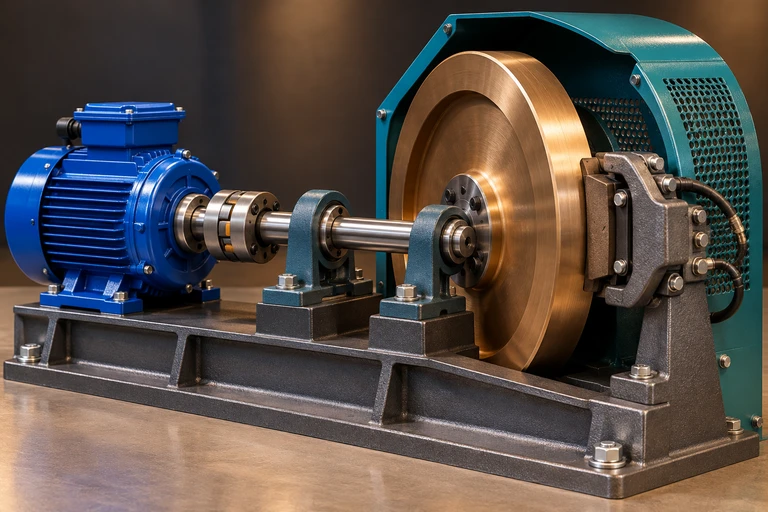 A flywheel stores kinetic energy as it rotates. Net torque changes that energy through rotational work, while drive and load torques can transfer power even at steady speed.
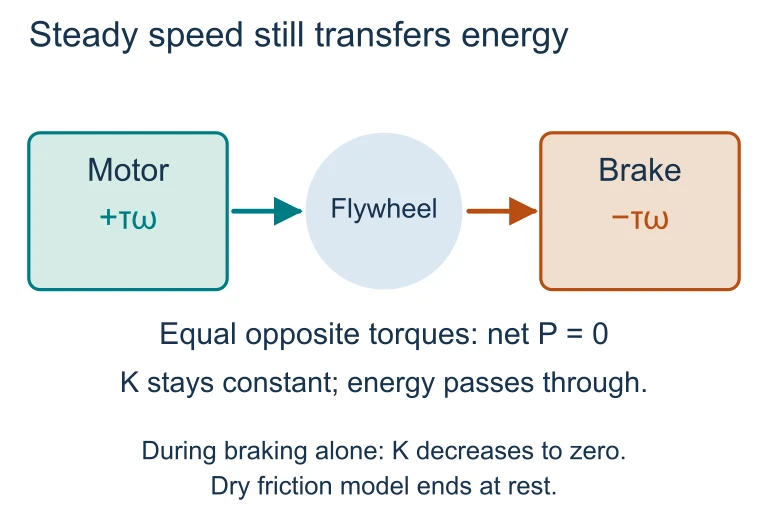 Equal drive and brake torques keep angular speed and kinetic energy constant while energy flows through the flywheel. With only a dry-friction brake acting, kinetic energy decreases until the flywheel stops.
SECTION 3
Visual Explanation
The diagram above emphasizes the structural analogy between translational and rotational kinetic energy. Every translational quantity has a rotational counterpart: mass (m) maps to moment of inertia (I), linear velocity (v) maps to angular velocity (ω), and force maps to torque. This parallel structure means that nearly every translational energy principle—the work-energy theorem, conservation of energy, power—has a rotational version obtained by substituting the appropriate rotational quantities. Recognizing this correspondence is one of the most powerful problem-solving strategies on the AP exam.
SECTION 4
Mathematical Framework
The mathematical derivation of rotational kinetic energy begins with a rigid body composed of many small mass elements, each at a different distance from the rotation axis. Consider a single point mass mi located at distance ri from the axis. Its linear speed is vi = riω, so its translational kinetic energy is ½mivi² = ½miri²ω². Summing over all mass elements and factoring out the common ½ω² yields the rotational kinetic energy expression.
MOMENT OF INERTIA (DISCRETE)
where mi is the mass of each particle and ri is its perpendicular distance from the axis of rotation.
ROTATIONAL KINETIC ENERGY
I = moment of inertia (kg·m²), ω = angular velocity (rad/s). This is the central equation of the lesson.
TOTAL KINETIC ENERGY (ROLLING OBJECT)
For an object that both translates and rotates (e.g., a ball rolling down a ramp), the total kinetic energy is the sum of translational and rotational contributions. If rolling without slipping, v = Rω.
SECTION 5
Common Moments of Inertia
The moment of inertia depends on both the object's mass and its geometry—specifically, how that mass is distributed around the rotation axis. The AP Physics 1 exam provides a table of common moments of inertia, but understanding why different shapes have different values is crucial. A hoop, for instance, has all its mass at radius R, so I = MR². A solid disk distributes mass more evenly from the center outward, yielding a smaller I = ½MR². The takeaway: for the same M and R, objects with mass concentrated farther from the axis have larger moments of inertia and store more rotational kinetic energy at the same ω.
| Shape | Moment of Inertia | Axis |
|---|---|---|
| Hoop or thin ring | MR² | Through center, perpendicular to plane |
| Solid disk / cylinder | ½MR² | Through center, perpendicular to flat face |
| Solid sphere | ⅖MR² | Through center |
| Hollow sphere (thin shell) | ⅔MR² | Through center |
| Thin rod | ¹⁄₁₂ML² | Through center, perpendicular to length |
| Thin rod | ⅓ML² | Through one end, perpendicular to length |
Moments of inertia provided on the AP Physics 1 equation sheet
SECTION 6
Worked Example: Rolling Down a Ramp
A solid sphere of mass 2.0 kg and radius 0.10 m starts from rest at the top of a ramp of height 3.0 m. It rolls without slipping to the bottom. Using conservation of energy, find the translational speed of the sphere at the bottom and the fraction of total kinetic energy that is rotational.
Worked example
- 1
Step 1 — Identify Known Quantities
Mass M = 2.0 kg, radius R = 0.10 m, height h = 3.0 m, initial speed v₀ = 0. The sphere is solid, so I = ⅖MR². Rolling without slipping gives v = Rω. - 2
Step 2 — Write the Energy Conservation Equation
Taking the bottom of the ramp as the reference level: Mgh = ½Mv² + ½Iω². Substitute I = ⅖MR² and ω = v/R:Mgh = ½Mv² + ½(⅖MR²)(v/R)² = ½Mv² + ⅕Mv² - 3
Step 3 — Simplify and Solve for v
Mgh = ½Mv² + ⅕Mv² = (7/10)Mv². Cancel M: gh = (7/10)v². Solve: v² = 10gh/7.v = √(10 × 9.8 × 3.0 / 7) = √(42.0) ≈ 6.48 m/s - 4
Step 4 — Find the Rotational Fraction
K_rot = ⅕Mv² and K_total = (7/10)Mv². The fraction is K_rot / K_total = (⅕Mv²) / (7/10 Mv²) = (1/5) / (7/10) = 2/7 ≈ 0.286.About 28.6% of the total kinetic energy is rotational. - 5
Step 5 — Check the Result
If the sphere were sliding (no rotation), v would be √(2gh) = √(58.8) ≈ 7.67 m/s. The rolling sphere is slower (6.48 m/s) because some gravitational PE is diverted into rotational KE. The 2/7 fraction is geometry-dependent and does not depend on M, R, or h—only on the shape of the object.
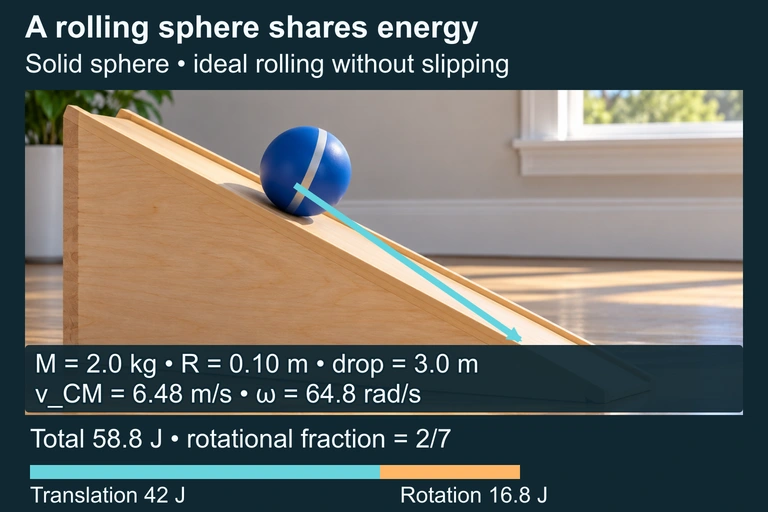 AP Physics 1 solid sphere: M = 2.0 kg, R = 0.10 m and vertical drop 3.0 m. Ideal rolling gives v_CM = 6.48 m/s, ω = 64.8 rad/s, 42 J translation and 16.8 J rotation, totaling 58.8 J. The rotational fraction is 2/7.
SECTION 7
Translational vs. Rotational Energy Comparisons
Rotational kinetic energy is not an independent form of energy but rather a manifestation of kinetic energy in the rotational domain. It obeys the same conservation laws and work-energy theorem as its translational counterpart. The table below summarizes the parallel structure between translational and rotational variables, highlighting both the conceptual mapping and the limitations to keep in mind.
| Translational Quantity | Rotational Analog | Key Difference |
|---|---|---|
| Mass (m) | Moment of inertia (I) | I depends on mass distribution, not just total mass |
| Velocity (v) | Angular velocity (ω) | ω is the same for all points in a rigid body; v varies with r |
| K = ½mv² | K = ½Iω² | Same functional form; different physical quantities |
| Force (F) | Torque (τ) | τ depends on where and at what angle force is applied |
| W = Fd cos θ | W = τΔθ | Rotational work uses angular displacement, not linear |
| Momentum (p = mv) | Angular momentum (L = Iω) | L is conserved when net external torque is zero |
Translational–rotational analogy table
 At the same center-of-mass height loss, each rolling body has the same total kinetic energy per unit mass. Its rotational inertia determines how that energy divides between translation and rotation.
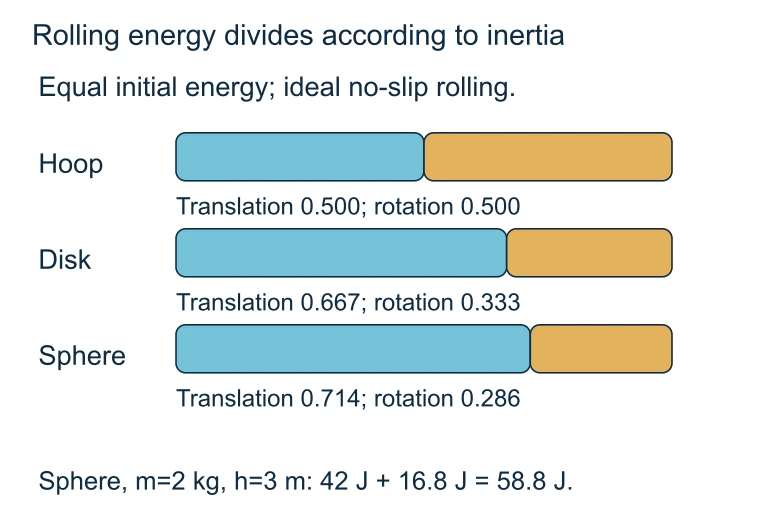 After the same center-of-mass height loss, the hoop stores half its kinetic energy in rotation, the disk one-third and the solid sphere two-sevenths. For a 2 kg sphere dropping 3 m with g = 9.8 m/s², the parts are 42 J and 16.8 J.
SECTION 8
Connection to Advanced Theory
AP Physics 1 treats objects as rigid bodies rotating about fixed or easily identified axes. In more advanced physics courses—particularly AP Physics C: Mechanics and university-level classical mechanics—you encounter the full inertia tensor, a 3×3 matrix that describes how mass is distributed about all three spatial axes. The simple scalar I you use now is, in fact, a single component of that tensor. Additionally, calculus-based derivations use integration (I = ∫ r² dm) to compute moments of inertia for continuous mass distributions, replacing the discrete sum Σ miri² with an integral. These extensions are beyond the AP Physics 1 scope but rest on exactly the same conceptual foundation.
| AP Physics 1 Scope | Advanced Extension |
|---|---|
| I = Σ mᵢrᵢ² (discrete point masses) | I = ∫ r² dm (continuous mass distribution via calculus) |
| Single rotation axis | Inertia tensor for 3-D rotation about arbitrary axes |
| K_rot = ½Iω² (scalar) | K_rot = ½ω⃗ · I̿ · ω⃗ (tensor notation) |
| Conservation of angular momentum (magnitude) | Vector angular momentum; precession and nutation |
AP Physics 1 vs. advanced mechanics
Even though the AP Physics 1 exam does not require calculus, understanding that your equations are simplified cases of a broader framework builds physical intuition and prepares you for more rigorous treatment later. The key insight to carry forward is that energy is always conserved—whether it is stored in translation, rotation, gravitational potential, or elastic potential. Rotational kinetic energy simply expands your accounting ledger to include spinning objects.
SECTION 9
Practice Problems
Question 1: CONCEPTUAL
- A. The hollow sphere, because it has more rotational inertia.
- B. The solid sphere, because a smaller fraction of its energy goes into rotation.
- C. They arrive at the same time, because they have equal mass.
- D. The solid sphere, because its radius is smaller.
Show answer (B)
Question 2: BASIC CALCULATION
- A. 900 J
- B. 1800 J
- C. 3600 J
- D. 7200 J
Show answer (A)
Question 3: INTERMEDIATE
- A. 1/2
- B. 1/3
- C. 2/5
- D. 2/3
Show answer (B)
Question 4: APPLIED
Show answer
Question 5: CRITICAL THINKING