

SECTION 1
Historical Context & Motivation
Long before physicists could describe the rotation of rigid bodies with mathematical precision, engineers and artisans had an intuitive grasp of a crucial fact: it is not just how much mass an object has that determines how hard it is to spin, but where that mass is located relative to the axis of rotation. Ancient potters knew that a wheel with a heavy rim spun more steadily than one with mass concentrated at its center, and medieval millwrights designed flywheels to smooth out the jerky torque delivered by waterwheels. These practical observations foreshadowed the formal concept of rotational inertia (also called the moment of inertia), which quantifies an object's resistance to changes in its angular velocity.
1673 • Huygens and the Compound Pendulum
1687 • Newton's Principia
1749 • Euler's Rotational Equations
1765 • Euler's Tensor Formulation
The central question these developments addressed is straightforward: if Newton's second law tells us that a net force causes linear acceleration proportional to mass, what plays the role of mass when a net torque causes angular acceleration? The answer is rotational inertia, and understanding it is essential for analyzing everything from spinning figure skaters to orbiting satellites.
SECTION 2
Core Principles & Definitions
Rotational inertia serves as the rotational analog of mass in translational dynamics. While mass tells you how strongly an object resists linear acceleration, rotational inertia tells you how strongly it resists angular acceleration about a specified axis. The key insight is that rotational inertia depends not only on the total mass of an object but also on how that mass is distributed relative to the axis of rotation. A 2 kg barbell with its weights at the ends of a long bar is far harder to spin than the same 2 kg barbell with its weights pushed toward the center.
Dependence on Mass
Dependence on Mass Distribution
Axis Dependence
Rotational Newton's Second Law
KEY TAKEAWAY
SECTION 3
Visual Explanation: How Mass Distribution Affects I
The diagram above crystallizes the central idea: for a collection of point masses, rotational inertia is the sum of each mass element multiplied by the square of its distance from the axis. Moving mass outward dramatically increases I because of the r² dependence. This is why a hollow cylinder has a greater rotational inertia than a solid cylinder of equal mass and radius—the hollow cylinder's mass is concentrated at the maximum possible distance from the axis.
 For bodies rolling without slipping from the same initial center-of-mass height, mass distribution determines acceleration and the partition of kinetic energy. Equal elapsed time and equal height loss are separate comparisons.
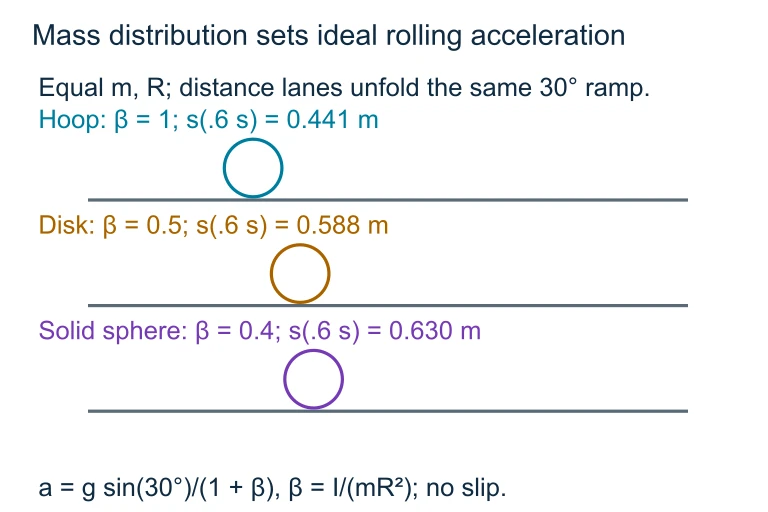 Equal-mass, equal-radius bodies start together on a 30° ramp. At 0.6 s, the hoop travels 0.441 m, the disk 0.588 m and the solid sphere 0.630 m, with no slipping.
SECTION 4
Mathematical Framework
The mathematical definition of rotational inertia follows directly from Newton's second law for rotation. Just as translational inertia (mass) links force to linear acceleration, rotational inertia links torque to angular acceleration. We begin with the simplest case—a system of discrete point masses—and then present the key results for common rigid bodies that appear on the AP Physics 1 exam.
ROTATIONAL INERTIA (POINT MASSES)
where I is the rotational inertia (kg·m²), mᵢ is the mass of the i-th particle (kg), and rᵢ is the perpendicular distance from that particle to the rotation axis (m). The summation runs over all particles in the system.
NEWTON'S SECOND LAW FOR ROTATION
where τnet is the net torque (N·m), I is the rotational inertia (kg·m²), and α is the angular acceleration (rad/s²). This equation is the direct rotational analog of Fnet = ma.
ROTATIONAL KINETIC ENERGY
where ω is the angular velocity (rad/s). Compare with the translational kinetic energy ½mv². Rotational inertia I plays the role of mass m, and angular velocity ω plays the role of linear velocity v.
On the AP Physics 1 exam, you will typically be given the formulas for the rotational inertia of standard shapes (solid sphere, hollow sphere, solid cylinder, thin rod, etc.) on the equation sheet. The crucial skill is recognizing which formula applies, understanding why certain shapes have larger or smaller moments of inertia, and applying τnet = Iα to solve for unknown quantities. Note that for a system of extended objects, you can add individual rotational inertias: Itotal = I1 + I2 + … , provided they share the same rotation axis.
SECTION 5
Rotational Inertia of Common Rigid Bodies
While the point-mass formula I = Σmᵢrᵢ² is conceptually foundational, most AP Physics 1 problems involve continuous rigid bodies whose rotational inertia has been pre-computed via integration (calculus not required on this exam). The table below lists the standard shapes you should recognize, along with the fraction of MR² that each represents. The key physical insight is that shapes with mass concentrated farther from the axis have larger coefficients.
| Shape | Axis Location | Rotational Inertia | Coefficient |
|---|---|---|---|
| Point mass | Distance r from axis | mr² | 1 |
| Thin hoop / ring | Through center, ⊥ to plane | MR² | 1 |
| Solid disk / cylinder | Through center, ⊥ to face | ½MR² | 0.5 |
| Thin spherical shell | Through center | ⅔MR² | 0.667 |
| Solid sphere | Through center | ⅖MR² | 0.4 |
| Thin rod | Through center, ⊥ to rod | ¹⁄₁₂ML² | 0.083 |
| Thin rod | Through end, ⊥ to rod | ⅓ML² | 0.333 |
Standard rotational inertia formulas provided on the AP Physics 1 equation sheet
SECTION 6
Worked Example: Pulley System with Rotational Inertia
A classic AP Physics 1 scenario involves a mass hanging from a string wrapped around a pulley with non-negligible rotational inertia. Let us solve such a problem in full detail to illustrate how τnet = Iα connects to translational dynamics.
PROBLEM STATEMENT
Solution
- 1
Step 1 — Identify the Rotational Inertia of the Pulley
The pulley is a solid cylinder rotating about its central axis, so I = ½MR² = ½(4.0 kg)(0.20 m)² = 0.080 kg·m².I = 0.080 kg·m² - 2
Step 2 — Apply Newton's Second Law to the Block
Taking downward as positive for the block, the forces on it are its weight mg (downward) and the string tension T (upward). Newton's second law gives: mg − T = ma, where a is the linear acceleration of the block.mg − T = ma …(1) - 3
Step 3 — Apply Newton's Second Law for Rotation to the Pulley
The only torque on the pulley comes from the tension T acting at radius R. Since the string unwinds, the torque is τ = TR. Applying τnet = Iα: TR = Iα.TR = Iα …(2) - 4
Step 4 — Relate Linear and Angular Quantities
Because the string does not slip on the pulley, the tangential acceleration of the rim equals the linear acceleration of the block: a = Rα, so α = a/R.α = a / R - 5
Step 5 — Solve for the Linear Acceleration
From equation (2): T = Iα/R = I(a/R)/R = Ia/R². Substituting into equation (1): mg − Ia/R² = ma. Solving for a: a = mg / (m + I/R²). Plugging in: a = (3.0)(9.8) / (3.0 + 0.080/0.04) = 29.4 / (3.0 + 2.0) = 29.4 / 5.0 = 5.88 m/s².a ≈ 5.9 m/s² - 6
Step 6 — Find the Angular Acceleration
α = a/R = 5.88 / 0.20 = 29.4 rad/s².α ≈ 29 rad/s² - 7
Step 7 — Find the Tension in the String
T = Ia/R² = (0.080)(5.88)/(0.04) = 11.76 N. Alternatively, T = m(g − a) = 3.0(9.8 − 5.88) = 3.0(3.92) = 11.76 N. Both methods agree, confirming our result.T ≈ 11.8 N
PHYSICAL CHECK
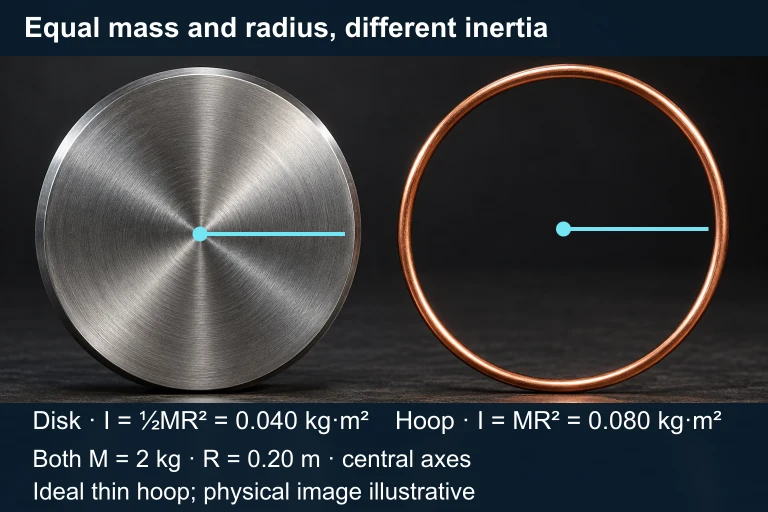 For equal mass 2 kg and radius 0.20 m about central axes, a solid disk has I = 0.040 kg·m² and a thin hoop has I = 0.080 kg·m².
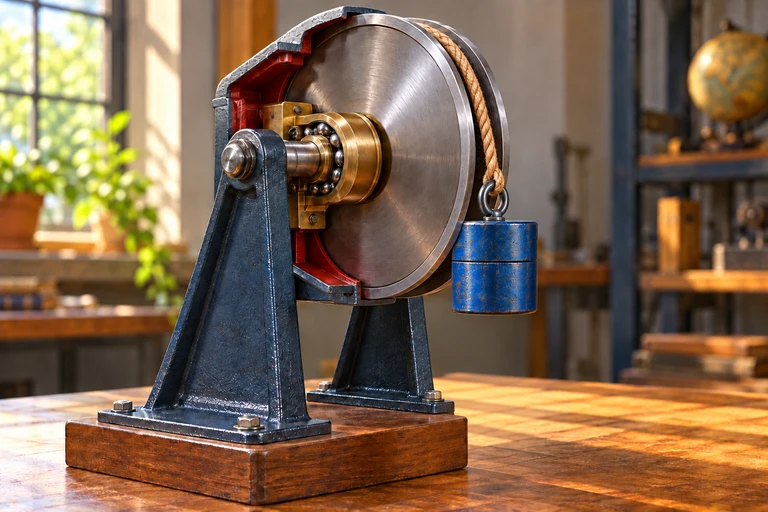 The falling load accelerates while cord tension supplies torque to the pulley. With no slip, the load acceleration and pulley angular acceleration satisfy a = Rα; tension is smaller than the load’s weight.
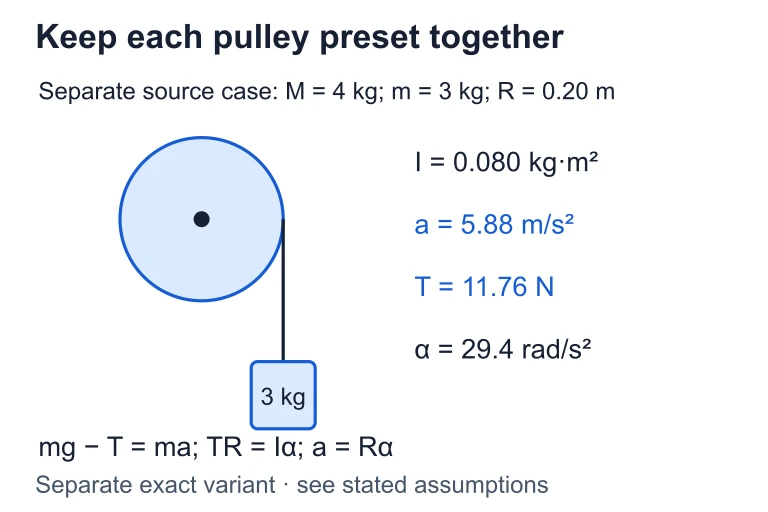 A 3 kg load drives a 4 kg solid pulley of radius 0.20 m. With I = 0.080 kg·m², the no-slip equations give a = 5.88 m/s², T = 11.76 N and α = 29.4 rad/s².
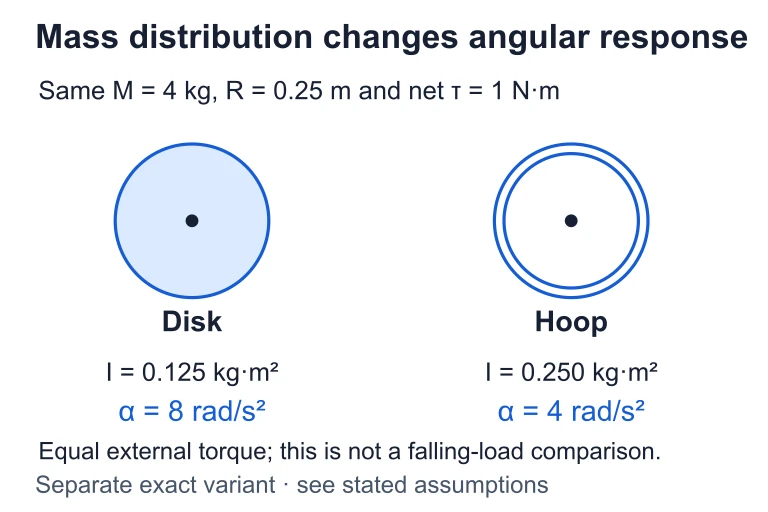 A 4 kg disk and hoop, each of radius 0.25 m, experience the same 1 N·m net torque. Their inertias are 0.125 and 0.250 kg·m², so their angular accelerations are 8 and 4 rad/s².
SECTION 7
Translational vs. Rotational Analogs
One of the most powerful strategies for mastering rotational dynamics on the AP exam is recognizing the systematic correspondence between translational and rotational quantities. Every translational variable has a rotational analog, and every translational equation has a rotational counterpart. The table below maps these analogs side by side, with rotational inertia occupying the position that mass holds in translational mechanics.
| Translational Quantity | Symbol | Rotational Analog | Symbol |
|---|---|---|---|
| Displacement | x | Angular displacement | θ |
| Velocity | v | Angular velocity | ω |
| Acceleration | a | Angular acceleration | α |
| Mass (inertia) | m | Rotational inertia | I |
| Force | F | Torque | τ |
| Newton's 2nd Law: F = ma | τ = Iα | ||
| Momentum: p = mv | Angular momentum: L = Iω | ||
| Kinetic energy: ½mv² | Rotational KE: ½Iω² |
Translational–Rotational Analogs
KEY TAKEAWAY
SECTION 8
Connection to Advanced Topics
The scalar rotational inertia you study in AP Physics 1 is actually a simplified version of a richer mathematical object. In advanced mechanics courses, you will encounter the inertia tensor—a 3 × 3 matrix that fully characterizes how mass is distributed in three dimensions. The AP formula I = Σmᵢrᵢ² gives only one diagonal component of this tensor, valid for rotation about a single specified axis. The tensor formulation becomes essential when analyzing tumbling objects, gyroscopic precession, and the stability of spinning spacecraft.
| Feature | AP Physics 1 Treatment | Advanced Treatment |
|---|---|---|
| Mathematical object | Scalar (I) | 3 × 3 symmetric tensor (Iᵢⱼ) |
| Axis of rotation | Single, fixed axis | Arbitrary, can change direction |
| Parallel-axis theorem | Introduced qualitatively | Derived and applied quantitatively: I = I_cm + Md² |
| Angular momentum | L = Iω (scalar) | L⃗ = I̿ω⃗ (vector/tensor product) |
| Derivation of I | Formulas given; no integration | Computed via integration: I = ∫r²dm |
AP Physics 1 vs. Advanced Rotational Mechanics
Another important theorem you may encounter briefly is the parallel-axis theorem: I = Icm + Md², which states that the rotational inertia about any axis parallel to one through the center of mass equals the center-of-mass value plus the total mass times the square of the distance between the two axes. This explains, for example, why a rod rotated about its end (I = ⅓ML²) has a larger rotational inertia than one rotated about its center (I = ¹⁄₁₂ML²)—the shift by d = L/2 adds the term M(L/2)² = ¼ML², and indeed ¹⁄₁₂ + ¼ = ⅓.
SECTION 9
Practice Problems
Question 1: CONCEPTUAL
- A. 1 : 1
- B. 2 : 1
- C. 4 : 1
- D. 8 : 1
Show answer (C)
Question 2: BASIC CALCULATION
- A. 0.12 kg·m²
- B. 0.24 kg·m²
- C. 0.96 kg·m²
- D. 2.88 kg·m²
Show answer (B)
Question 3: INTERMEDIATE
- A. 0.225 kg·m²
- B. 0.315 kg·m²
- C. 0.405 kg·m²
- D. 0.630 kg·m²
Show answer (C)
Question 4: APPLIED
5 ptsShow answer
Question 5: CRITICAL THINKING
5 ptsShow answer
SUMMARY
Summary & Review
Summary
Rotational inertia (moment of inertia, I) quantifies an object's resistance to angular acceleration. For a system of point masses, I = Σmᵢrᵢ², where each mass element's contribution depends on the square of its distance from the rotation axis. Common rigid bodies—hoops, disks, spheres, and rods—have standard formulas that the AP exam provides, all of the form I = (constant) × MR² or ML². The key physical insight is that mass distributed farther from the axis produces a larger rotational inertia, even for the same total mass.
The rotational form of Newton's second law, τ_net = Iα, governs angular dynamics in the same way Fnet = ma governs linear dynamics. Rotational inertia also appears in the rotational kinetic energy expression KErot = ½Iω² and in angular momentum L = Iω. Mastering the translational-rotational analogy and understanding how mass distribution determines I will equip you to solve pulley problems, rolling-without-slipping scenarios, and conservation of angular momentum questions on the AP Physics 1 exam.