

SECTION 1
Historical Context & Motivation
The physics of rolling motion has been intertwined with the development of mechanics since the earliest investigations into how wheels, spheres, and cylinders move along surfaces. Although rolling is ubiquitous in everyday life—from the wheels of a cart to the spin of a bowling ball—its formal analysis required the union of translational and rotational dynamics, a synthesis that took centuries to mature. The essential difficulty lies in the fact that rolling simultaneously involves the center-of-mass translating forward and the body rotating about that center, two motions that are coupled through the rolling constraint. Understanding this coupling is the central goal of this lesson.
1638 • Galileo's Inclined-Plane Experiments
1687 • Newton's Principia
1750 • Euler's Rigid-Body Mechanics
1834 • Hamilton & Lagrangian Methods
The central question that rolling addresses is deceptively simple: when a round object moves along a surface, how do we properly account for the energy, velocity, and acceleration given that the object is both translating and spinning? As we will see, the answer hinges on the constraint that the contact point is momentarily at rest—meaning static friction, not kinetic friction, governs the interaction with the surface.
SECTION 2
Core Principles of Rolling
Rolling motion is the superposition of two elementary motions: pure translation of the center of mass and pure rotation about the center of mass. When no slipping occurs, these two motions are linked by a simple geometric condition that constrains the linear speed of the center to be proportional to the angular speed. This section introduces the foundational ideas that underpin the full mathematical treatment to follow.
Rolling Without Slipping
Static Friction as the Agent
Combined Kinetic Energy
Moment of Inertia Matters
KEY TAKEAWAY
SECTION 3
Visualizing Rolling Motion
A rolling object can be decomposed visually into two additive motions. The diagram below shows a disk rolling to the right on a flat surface. The left panel illustrates pure translation (every point has the same velocity vcm), the center panel illustrates pure rotation about the center (the top point moves at +Rω while the bottom point moves at −Rω), and the right panel shows the superposition—the actual rolling motion. Notice that the contact point's velocity cancels to zero in the combined view.
The key insight from this decomposition is that the velocity of any point on the rolling body is the vector sum of the translational velocity of the center and the tangential velocity due to rotation about the center. At the topmost point, both contributions point in the same direction, so the speed is 2vcm. At the contact point with the ground, the rotation velocity is directed backward and exactly cancels the forward translational velocity, producing an instantaneous speed of zero. This zero-velocity contact is the physical meaning of rolling without slipping.
SECTION 4
Mathematical Framework
The mathematics of rolling without slipping rests on a single kinematic constraint and the familiar energy and force equations of translational and rotational mechanics. Here we develop the key relationships needed for AP Physics 1 problems.
ROLLING CONSTRAINT
vcm = speed of the center of mass, R = radius of the rolling object, ω = angular speed. Differentiating: acm = Rα.
TOTAL KINETIC ENERGY OF A ROLLING BODY
The first term is translational KE and the second is rotational KE. Since ω = vcm/R, we can write K = ½mv²cm(1 + I/(mR²)).
USEFUL SUBSTITUTION (ROLLING KE)
Here c = I/(mR²) is a dimensionless constant that depends on shape: c = 2/5 for a solid sphere, c = 1/2 for a solid cylinder, c = 2/3 for a hollow sphere, and c = 1 for a thin ring. Memorizing c-values lets you quickly solve energy problems.
ENERGY CONSERVATION ON AN INCLINE
When a body rolls from rest down a height h, gravitational PE converts into both translational and rotational KE. Solving for vcm gives vcm = √(2gh/(1 + c)). Larger c means more energy goes into rotation and the object is slower.
Why Static Friction Does No Work
SECTION 5
How Shape Determines Speed
A classic AP Physics 1 scenario asks which object reaches the bottom of an incline first when several shapes are released from rest at the same height. The answer depends entirely on how the object's mass is distributed relative to its rotation axis, captured by the dimensionless factor c = I/(mR²). The diagram below illustrates the race, and the table quantifies the differences.
| Shape | I | c = I/(mR²) | v_cm at bottom |
|---|---|---|---|
| Solid Sphere | ⅖ mR² | 2/5 = 0.40 | √(10gh/7) ≈ 1.195√(gh) |
| Solid Cylinder | ½ mR² | 1/2 = 0.50 | √(4gh/3) ≈ 1.155√(gh) |
| Hollow Sphere | ⅔ mR² | 2/3 ≈ 0.67 | √(6gh/5) ≈ 1.095√(gh) |
| Thin Ring / Hoop | mR² | 1 | √(gh) = 1.000√(gh) |
Comparison of rolling objects released from height h on an incline
A crucial AP insight: the outcome of the rolling race is independent of mass and radius. A small solid sphere beats a large solid sphere down the same incline, arriving at exactly the same time—just as Galileo's free-fall argument implies for pure translation. What matters is only the geometric factor c, which encodes how mass is distributed relative to the axis.
 For bodies rolling without slipping from the same initial center-of-mass height, mass distribution determines acceleration and the partition of kinetic energy. Equal elapsed time and equal height loss are separate comparisons.
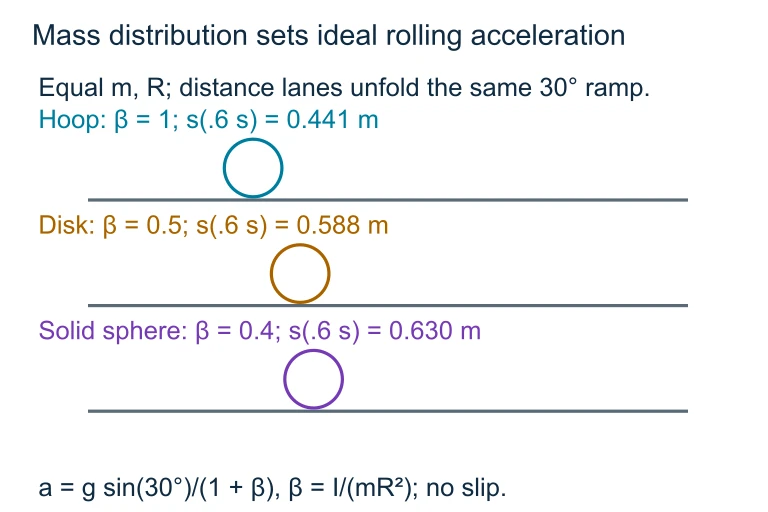 Equal-mass, equal-radius bodies start together on a 30° ramp. At 0.6 s, the hoop travels 0.441 m, the disk 0.588 m and the solid sphere 0.630 m, with no slipping.
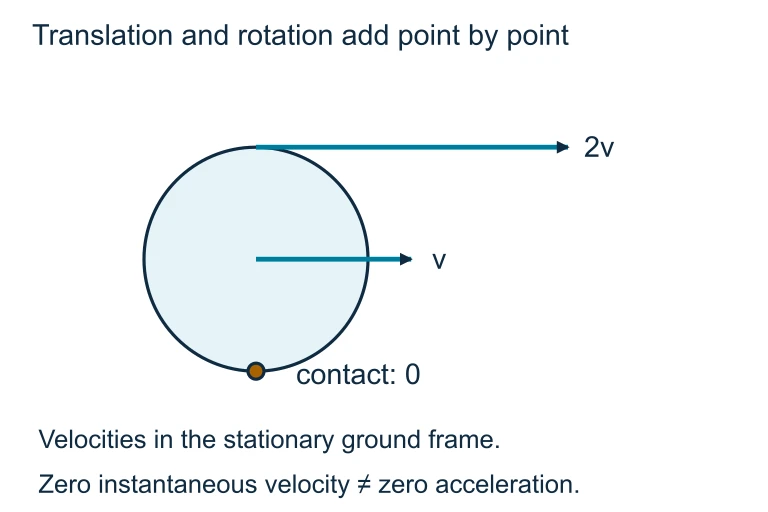 In the stationary ground frame, translation and rotation combine to give zero velocity at the contact point, v at the center and 2v at the top. Zero instantaneous velocity does not imply zero acceleration.
SECTION 6
Worked Example: Solid Cylinder on a Ramp
A uniform solid cylinder of mass m = 4.0 kg and radius R = 0.10 m starts from rest at the top of an incline of height h = 2.0 m. It rolls without slipping to the bottom. Find (a) the speed of the center of mass at the bottom, (b) the translational kinetic energy, and (c) the rotational kinetic energy.
Solid Cylinder Rolling Down an Incline
- 1
Step 1 — Identify Known Quantities and the Energy Equation
The cylinder starts from rest (v₀ = 0, ω₀ = 0) at height h = 2.0 m. For a solid cylinder, I = ½mR², so c = I/(mR²) = 1/2. We use conservation of mechanical energy: mgh = ½mv²cm(1 + c). - 2
Step 2 — Solve for v_cm
Substituting c = 1/2: mgh = ½mv²cm(1 + 1/2) = ½mv²cm(3/2) = ¾mv²cm. Therefore v²cm = 4gh/3 = 4(9.8)(2.0)/3 = 26.13 m²/s².vcm = √(26.13) ≈ 5.11 m/s - 3
Step 3 — Calculate Translational KE
Ktrans = ½mv²cm = ½(4.0)(26.13) = 52.3 J.Ktrans ≈ 52.3 J - 4
Step 4 — Calculate Rotational KE
Krot = ½Iω² = ½(½mR²)(vcm/R)² = ¼mv²cm = ¼(4.0)(26.13) = 26.1 J. As a check, Ktrans + Krot = 52.3 + 26.1 = 78.4 J ≈ mgh = (4.0)(9.8)(2.0) = 78.4 J. ✓Krot ≈ 26.1 J - 5
Step 5 — Interpret the Result
For a solid cylinder, exactly 1/3 of the gravitational PE goes into rotational KE and 2/3 into translational KE. This ratio is universal for all solid cylinders regardless of mass or radius—it depends only on c. Notice that the speed (5.11 m/s) is less than the 6.26 m/s a frictionless sliding block would achieve, because energy is 'stored' in rotation.
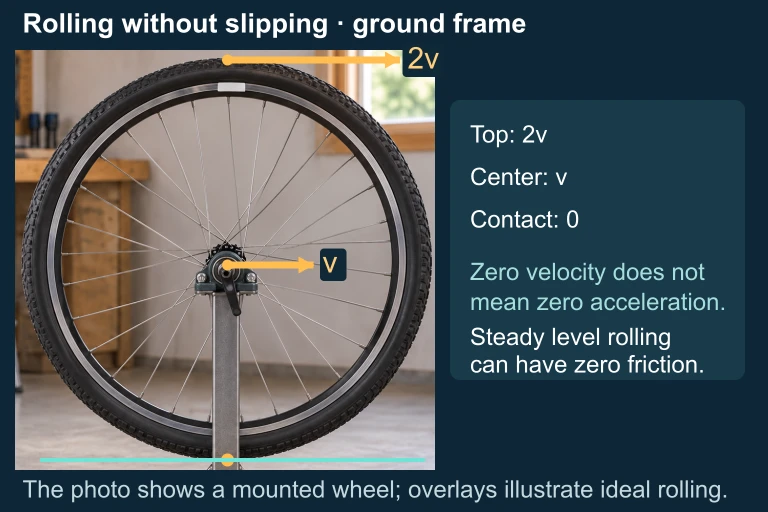 The photograph shows mounted apparatus. The modeled arrows describe ideal rightward rolling on a stationary surface: top speed 2v, center speed v, contact speed zero. The required vector-sum companion explains translation plus rotation; zero speed does not imply zero acceleration.
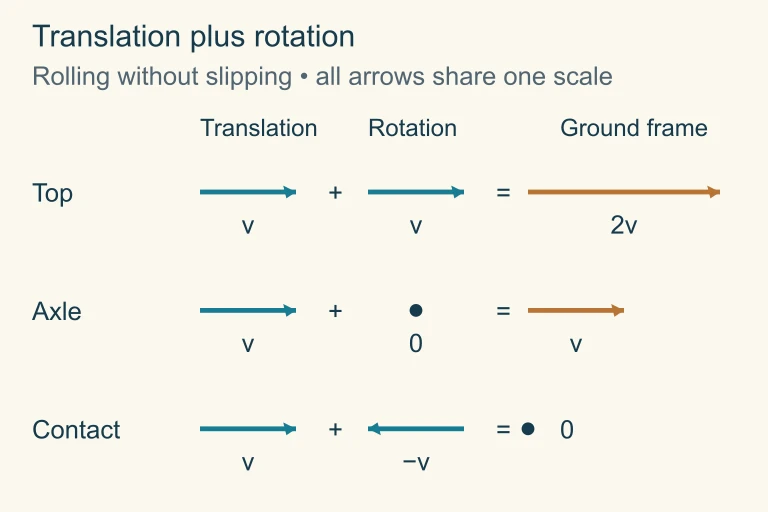 In the ground frame, v_point = v_CM + ω × r. Top: v + v = 2v; center: v + 0 = v; contact: v − v = 0. Zero contact velocity does not imply zero contact acceleration.
SECTION 7
Rolling vs. Sliding vs. Spinning
Students sometimes confuse rolling without slipping with other types of motion. The table below clarifies the distinctions among the three limiting cases: pure sliding (no rotation), pure spinning (no translation), and rolling without slipping (both, constrained).
| Property | Pure Sliding | Pure Spinning | Rolling (No Slip) |
|---|---|---|---|
| Translational motion | Yes | No | Yes |
| Rotational motion | No | Yes | Yes |
| Contact-point velocity | v_cm ≠ 0 | Rω (tangential) | 0 (instantaneously) |
| Friction type | Kinetic | Kinetic | Static |
| Friction does work? | Yes (negative) | Yes (negative) | No |
| Energy conserved? | No (heat generated) | No (heat generated) | Yes (ideal) |
| Kinetic energy formula | ½mv² | ½Iω² | ½mv² + ½Iω² |
Comparison of three modes of motion for a round object on a surface
KEY TAKEAWAY
SECTION 8
Connection to Advanced Theory
The rolling-without-slipping condition you have studied is an example of a holonomic constraint in classical mechanics—one that relates positions (or velocities) through an integrable equation. In more advanced courses, such constraints are naturally incorporated using Lagrangian or Hamiltonian mechanics, where the rolling condition reduces the number of independent generalized coordinates and simplifies the equations of motion. Additionally, the concept of an instantaneous axis of rotation (the contact point itself) provides a powerful shortcut: the entire kinetic energy of a rolling body can be written as K = ½Icontactω², where Icontact is found from the parallel-axis theorem.
| Feature | AP Physics 1 Treatment | Advanced (University Physics) |
|---|---|---|
| Rolling constraint | v_cm = Rω stated as a condition | Derived from ds = R dθ integration; classified as holonomic |
| Energy approach | K = ½mv² + ½Iω² with substitution | Lagrangian L = T − V with constraint built in via generalized coordinate |
| Friction force | Recognized as static, does no work | Appears as a Lagrange multiplier or constraint force; evaluated explicitly |
| Non-flat surfaces | Not assessed | Rolling on curved surfaces, rolling with slipping, gyroscopic effects |
AP-level vs. university-level treatment of rolling motion
Although the AP exam does not require Lagrangian mechanics or explicit friction-force calculations for rolling, understanding that these tools exist provides motivation for the energy-based approach you are learning. The beauty of the energy method is that it sidesteps the need to calculate the static friction force entirely, relying instead on the fact that static friction does no work under the rolling constraint.
SECTION 9
Practice Problems
Question 1: CONCEPTUAL
- A. They reach the bottom at the same time because they have the same mass and radius.
- B. The solid sphere reaches the bottom first because a larger fraction of its gravitational PE becomes translational KE.
- C. The hollow sphere reaches the bottom first because it has a larger moment of inertia and therefore more angular momentum.
- D. The outcome depends on the angle of the incline.
Show answer (B)
Question 2: BASIC CALCULATION
- A. 7.1 m/s
- B. 8.5 m/s
- C. 10.0 m/s
- D. 5.3 m/s
Show answer (B)
Question 3: INTERMEDIATE
- A. 1/4
- B. 1/3
- C. 1/2
- D. 2/5
Show answer (B)
Question 4: APPLIED
5 ptsShow answer
Question 5: CRITICAL THINKING
4 ptsShow answer
SUMMARY
Lesson Summary
Summary
Rolling without slipping is the simultaneous translation and rotation of a round body under the constraint that the contact point has zero velocity. This constraint yields the fundamental relation v_cm = Rω (and its derivative acm = Rα), links the two kinds of motion, and ensures that static friction—not kinetic friction—acts at the contact, doing no work and preserving mechanical energy.
The total kinetic energy of a rolling body is K = ½mv²cm(1 + c), where c = I/(mR²) is a dimensionless shape factor. Objects with smaller c (like a solid sphere, c = 2/5) devote less energy to rotation and translate faster, beating objects with larger c (like a ring, c = 1) in a race down a ramp. The outcome is independent of mass and radius—only mass distribution matters.