

AP Physics 1 • Fluids

Pressure

Understanding how force distributed over area governs the behavior of fluids at rest and in motion.

An orbit with symbols for force and motion.
Inside this lesson 9 sections 5 questions 8 figures

SECTION 1

Historical Context & Motivation

The concept of pressure arose from centuries of practical questions: why do sharp blades cut more easily than dull ones, why does water rise in a pump, and why does the atmosphere exert a measurable force on everything beneath it? These questions drove natural philosophers to formalize the relationship between force and the area over which it acts, ultimately laying the groundwork for the modern study of fluids. The history of pressure is inseparable from the history of understanding the atmosphere, vacuums, and hydraulic systems—concepts that remain central to AP Physics 1.

1643 • Torricelli's Barometer

Evangelista Torricelli inverted a mercury-filled tube into a dish, demonstrating that the atmosphere exerts a finite pressure capable of supporting a column of mercury roughly 760 mm high—creating the first barometer.

1648 • Pascal's Puy-de-Dôme Experiment

Blaise Pascal's brother-in-law carried a barometer up a mountain, confirming that atmospheric pressure decreases with altitude and establishing the concept of pressure as a distributed force per unit area.

1654 • Magdeburg Hemispheres

Otto von Guericke demonstrated the enormous force of atmospheric pressure by evacuating two joined copper hemispheres; teams of horses on each side could not pull them apart, dramatizing the power of pressure differences.

1738 • Bernoulli's Hydrodynamica

Daniel Bernoulli published his treatise linking fluid speed and pressure, showing that pressure is not merely a static quantity but varies dynamically within a moving fluid.

These milestones converge on a single foundational question: how do we quantify the effect of a force spread over a surface, and how does that quantity—pressure—govern the behavior of fluids at rest and in motion? The answer forms one of the pillars of the AP Physics 1 fluids unit.

SECTION 2

Core Principles & Definitions

Pressure is a scalar quantity that describes how a force is distributed across a surface. Unlike force, which is a vector, pressure has no direction—it acts equally in all directions at any point within a fluid. Grasping the following foundational ideas is essential before tackling calculations and applications on the AP exam.

1

Pressure as Force per Area

Pressure (P) is defined as the magnitude of the normal force (F⊥) exerted on a surface divided by the area (A) of that surface: P = F⊥ / A. The SI unit is the pascal (Pa), where 1 Pa = 1 N/m².
2

Pressure Is a Scalar

At any point in a fluid, pressure pushes equally in every direction. There is no preferred orientation—this isotropy is what distinguishes pressure from stress in a solid.
3

Gauge vs. Absolute Pressure

Absolute pressure is measured relative to a perfect vacuum. Gauge pressure is the difference between absolute pressure and atmospheric pressure: Pgauge = Pabs − Patm. Most pressure gauges read zero at atmospheric conditions.
4

Atmospheric Pressure

At sea level, the atmosphere exerts approximately 1.013 × 10⁵ Pa (101.3 kPa or 1 atm). This value serves as the baseline for gauge pressure and many AP problems.

SECTION 3

Visual Explanation

Pressure Increases with Depth in a FluidSurface (P = P₀)small depth h₁larger depth h₂greatest depth h₃h₁h₂h₃Arrow length ∝ pressure magnitude at that depthKeyLow PMedium PHigh P
A container of fluid showing three test points at increasing depths. At each point, pressure acts equally in all directions (shown by arrows radiating from a small circle), but the magnitude of the pressure (arrow length) increases linearly with depth h. The surface pressure P₀ is typically atmospheric pressure.

The diagram above illustrates two essential features of pressure in a static fluid. First, at any given depth, the arrows point outward equally in every direction—this reflects the isotropic nature of pressure (it is a scalar, not a vector). Second, the arrows grow longer as depth increases because the weight of the overlying fluid adds to the pressure. The quantitative relationship is P = P₀ + ρgh, which we develop in Section 4.

SECTION 4

Mathematical Framework

Three equations capture the essential physics of pressure in the AP Physics 1 curriculum. The first defines pressure itself; the second relates pressure to depth in a fluid; the third—Pascal's law—connects pressure changes across a closed hydraulic system.

DEFINITION OF PRESSURE

P=F⊥/AP = F⊥ / A

P = pressure (Pa), F⊥ = component of force perpendicular to the surface (N), A = area of the surface (m²). One pascal equals one newton per square meter.

PRESSURE AT DEPTH (HYDROSTATIC PRESSURE)

P=P0+ρghP = P₀ + ρgh

P₀ = pressure at the surface (Pa), ρ = fluid density (kg/m³), g = gravitational field strength (m/s²), h = depth below the surface (m). This equation assumes the fluid is incompressible and at rest.

PASCAL'S LAW

F1/A1=F2/A2F₁ / A₁ = F₂ / A₂

A change in pressure applied to an enclosed, incompressible fluid is transmitted undiminished to every portion of the fluid and to the walls of the container. In a hydraulic system, a small force on a small piston produces the same pressure as a large force on a large piston.

ℹ
AP Exam Note

It is worth emphasizing the derivation of the depth-pressure equation, since AP FRQs may ask you to justify it. Consider a horizontal slab of fluid at depth h with area A. The fluid above the slab has volume Ah and mass ρAh. Its weight is ρAhg. The pressure at the top of the column is P₀, so the force pushing down on the slab from above is P₀A + ρAhg. Dividing by A yields P = P₀ + ρgh. This derivation rests on Newton's second law applied to a static fluid element—an important conceptual connection the exam may probe.

SECTION 5

Pressure at Depth & Hydraulic Systems

Hydraulic Press — Pascal's LawF₁ (small)A₁F₂ (large)A₂Enclosed Fluid (incompressible)Pressure is uniform: P = F₁/A₁ = F₂/A₂same horizontal level → same pressureMechanical AdvantageF₂ = F₁ × (A₂ / A₁) → Force is amplified by area ratio
A hydraulic press with a small piston (area A₁, yellow) and a large piston (area A₂, pink). Applying a small force F₁ on the left creates the same pressure throughout the enclosed fluid, producing a much larger output force F₂ on the right. The mechanical advantage equals the ratio A₂ / A₁.

The hydraulic press is the quintessential application of Pascal's law. When you push down on a small piston, the pressure increase ΔP = F₁/A₁ is transmitted undiminished throughout the enclosed fluid. At the large piston, this same ΔP acts over the larger area A₂, producing the output force F₂ = ΔP × A₂ = F₁(A₂/A₁). Energy conservation still holds: the small piston must move a proportionally larger distance, so work in equals work out (ignoring friction). This principle operates in car brakes, hydraulic lifts, and syringes.

QuantitySmall PistonLarge Piston
AreaA₁ (small)A₂ (large)
ForceF₁ (small)F₂ = F₁ × (A₂/A₁) (large)
Displacementd₁ (large)d₂ = d₁ × (A₁/A₂) (small)
PressureP = F₁/A₁P = F₂/A₂ (same)

Comparison of quantities across a hydraulic press
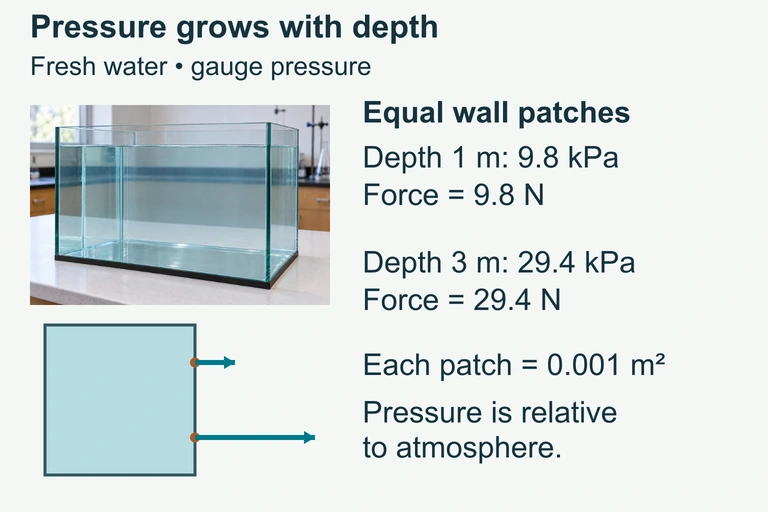
In fresh water, gauge pressure at depths 1 m and 3 m is 9.8 kPa and 29.4 kPa. On equal 0.001 m² patches it produces 9.8 N and 29.4 N normal force. Gauge pressure is relative to outside atmosphere.In fresh water, gauge pressure at depths 1 m and 3 m is 9.8 kPa and 29.4 kPa. On equal 0.001 m² patches it produces 9.8 N and 29.4 N normal force. Gauge pressure is relative to outside atmosphere.
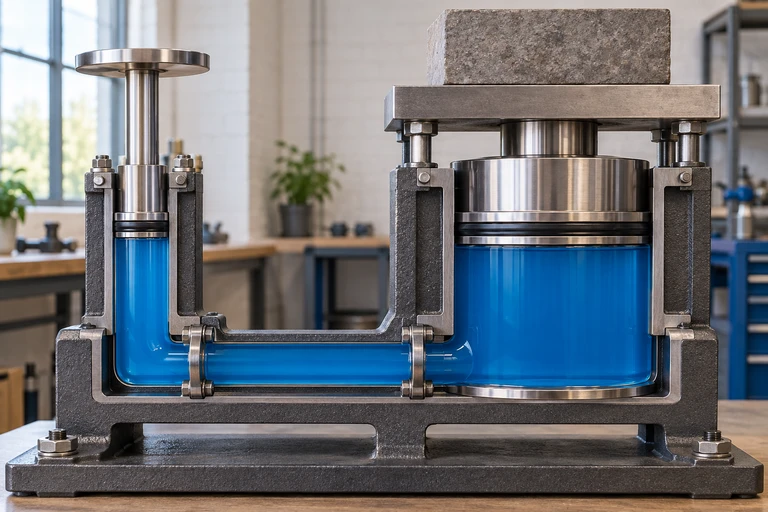
Sealed continuous blue fluid connects two pistons with visible seals and supporting frame. No air gap is apparent under pistons. Piston area ratios are model labels, not generated dimensions. Separate exact panel: Connected small and large hydraulic pistons illustrate fourfold force accompanied by one-quarter displacement.An ideal hydraulic system transmits the same pressure change to both pistons. A larger output area increases force while reducing displacement, preserving displaced volume and work.
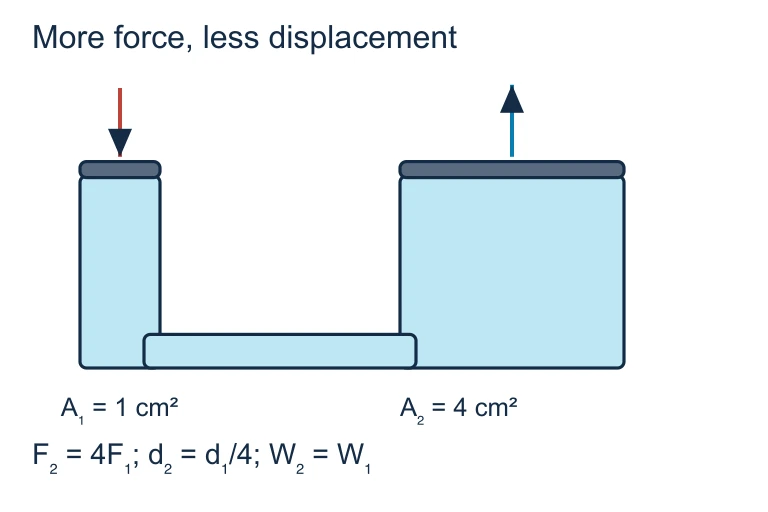
An ideal hydraulic force advantage preserves volume and work rather than multiplying energy.. An ideal hydraulic system transmits the same pressure change to both pistons. A larger output area increases force while reducing displacement, preserving displaced volume and work.An ideal hydraulic system transmits the same pressure change to both pistons. A larger output area increases force while reducing displacement, preserving displaced volume and work.

SECTION 6

Worked Example

Worked example

  1. 1

    Step 1 — Identify Given Values

    A swimming pool is 3.0 m deep and filled with fresh water (ρ = 1000 kg/m³). The pool is open to the atmosphere, so P₀ = 1.013 × 10⁵ Pa. We use g = 9.8 m/s².
  2. 2

    Step 2 — Select the Appropriate Equation

    Because the fluid is static and incompressible, we apply the hydrostatic pressure equation: P = P₀ + ρgh.
  3. 3

    Step 3 — Substitute and Calculate

    P = 1.013 × 10⁵ Pa + (1000 kg/m³)(9.8 m/s²)(3.0 m) = 1.013 × 10⁵ Pa + 2.94 × 10⁴ Pa.
    P = 1.307 × 10⁵ Pa ≈ 1.31 × 10⁵ Pa
  4. 4

    Step 4 — Interpret the Result

    The absolute pressure at the bottom of the pool is about 1.31 atm—roughly 29% higher than atmospheric pressure. The gauge pressure (the pressure above atmospheric) is 2.94 × 10⁴ Pa, which is entirely due to the weight of the 3.0 m water column.
  5. 5

    Step 5 — Check Reasonableness

    A useful rule of thumb: each 10 m of water adds approximately 1 atm of pressure. At 3.0 m, we expect roughly 0.3 atm of gauge pressure, consistent with our answer of 0.29 atm.

SECTION 7

Strengths & Limitations of the Pressure Model

AspectStrengthLimitation
Incompressible fluid assumptionP = P₀ + ρgh is simple and accurate for liquids like water over typical depth ranges.Breaks down for gases (density changes with pressure) and for extreme depths where liquid compressibility matters.
Static fluid assumptionHydrostatic analysis works perfectly for pools, dams, and manometers at rest.Moving fluids require Bernoulli's equation or more complex fluid dynamics models.
Pascal's lawEnables force multiplication in hydraulic systems with elegant simplicity.Assumes no energy loss to friction, no compressibility in the fluid, and rigid containers.
Scalar natureSimplifies analysis: pressure at a point needs no direction specification.Cannot capture shear stresses in viscous fluids; stress tensors are needed for full treatment.

Strengths and limitations of the pressure model used in AP Physics 1

SECTION 8

Connection to Advanced Fluid Mechanics

AP Physics 1 (This Course)Advanced / College Physics
P = F⊥ / A (scalar definition)Stress tensor σᵢⱼ describes internal forces in all directions, with pressure as the isotropic (diagonal) component.
P = P₀ + ρgh (constant density)Barometric formula P = P₀ exp(−mgh / k_BT) for compressible atmospheres with temperature-dependent density.
Pascal's law for enclosed static fluidsNavier-Stokes equations govern pressure distribution in viscous, moving fluids with turbulence.
Gauge pressure and absolute pressureThermodynamic pressure connects to equations of state (PV = nRT) and statistical mechanics.

How pressure concepts extend beyond AP Physics 1

The pressure concepts you learn in AP Physics 1 are not oversimplifications—they are the exact building blocks upon which more advanced fluid mechanics is constructed. When you encounter Bernoulli's equation later in this unit, you will see how the hydrostatic pressure term ρgh reappears alongside kinetic energy density terms. In college-level thermodynamics, pressure becomes a state variable linked to temperature and volume through equations of state. Mastering the scalar definition P = F/A and the depth relation P = P₀ + ρgh equips you with the conceptual vocabulary for all of these extensions.

SECTION 9

Practice Problems

Question 1: CONCEPTUAL

A scuba diver is 20 m below the surface of a lake. If the diver moves horizontally 50 m while remaining at the same depth, what happens to the pressure on the diver? A) The pressure increases because the diver has moved farther from shore. B) The pressure decreases because the diver is farther from the surface. C) The pressure remains the same because the depth has not changed. D) The pressure increases because the diver has traveled a greater total distance through the fluid.
  • A. The pressure increases because the diver has moved farther from shore.
  • B. The pressure decreases because the diver is farther from the surface.
  • C. The pressure remains the same because the depth has not changed.
  • D. The pressure increases because the diver has traveled a greater total distance through the fluid.
Show answer (C)
The correct answer is C. Hydrostatic pressure depends only on depth h (vertical distance below the surface), fluid density ρ, and gravitational field strength g: P = P₀ + ρgh. Since the diver's depth remains 20 m, the pressure is unchanged. A is wrong because horizontal distance from shore has no bearing on pressure in a fluid at uniform depth. B is wrong because the diver's depth below the surface has not changed—horizontal displacement does not affect vertical depth. D is wrong because total path length through the fluid is irrelevant; only vertical depth matters for hydrostatic pressure.

Question 2: BASIC CALCULATION

A sealed container holds water (ρ = 1000 kg/m³) with a gauge pressure of 2.0 × 10⁴ Pa at the surface. What is the absolute pressure at a depth of 5.0 m? Use g = 10 m/s² and P_atm = 1.0 × 10⁵ Pa. A) 5.0 × 10⁴ Pa B) 1.7 × 10⁵ Pa C) 1.5 × 10⁵ Pa D) 7.0 × 10⁴ Pa
  • A. 5.0 × 10⁴ Pa
  • B. 1.7 × 10⁵ Pa
  • C. 1.5 × 10⁵ Pa
  • D. 7.0 × 10⁴ Pa
Show answer (B)
The correct answer is B. First, find the absolute pressure at the surface: P₀ = P_atm + P_gauge = 1.0 × 10⁵ + 2.0 × 10⁴ = 1.2 × 10⁵ Pa. Then apply P = P₀ + ρgh = 1.2 × 10⁵ + (1000)(10)(5.0) = 1.2 × 10⁵ + 5.0 × 10⁴ = 1.7 × 10⁵ Pa. A is wrong because it only accounts for ρgh and ignores both atmospheric and gauge pressure at the surface. C is wrong because it uses P₀ = 1.0 × 10⁵ Pa (atmospheric only), neglecting the additional 2.0 × 10⁴ Pa gauge pressure at the surface. D is wrong because it adds gauge pressure to ρgh but omits atmospheric pressure entirely.

Question 3: INTERMEDIATE

In a hydraulic lift, the small piston has a radius of 2.0 cm and the large piston has a radius of 10.0 cm. If a mechanic applies a force of 150 N to the small piston, what is the maximum weight the large piston can support? (Assume negligible height difference between pistons.) A) 750 N B) 3750 N C) 30 N D) 1500 N
  • A. 750 N
  • B. 3750 N
  • C. 30 N
  • D. 1500 N
Show answer (B)
The correct answer is B. By Pascal's law, F₁/A₁ = F₂/A₂, so F₂ = F₁ × (A₂/A₁). Since area is proportional to radius squared: A₂/A₁ = (10.0)²/(2.0)² = 100/4 = 25. Therefore F₂ = 150 × 25 = 3750 N. A (750 N) incorrectly uses the ratio of radii (10/2 = 5) instead of the ratio of areas. C (30 N) inverts the ratio, dividing by 5 instead of multiplying. D (1500 N) uses the ratio of diameters (10) rather than the ratio of areas (25).

Question 4: APPLIED

A student wants to experimentally verify that pressure in a static liquid increases linearly with depth. The student has access to a tall transparent cylinder, water, a pressure sensor that measures gauge pressure, a meter stick, and a ring stand with clamps. (a) Describe a procedure the student could use to collect data to verify the relationship P_gauge = ρgh. Include enough detail that another student could replicate the experiment. (b) What quantities should the student measure, and how should the data be plotted to produce a straight line? (c) How can the student determine ρg from the graph? (d) Describe one source of systematic error and how it would affect the results.
Show answer
(a) Fill the tall cylinder with water. Attach the pressure sensor to the ring stand clamp and zero it at the water surface. Lower the sensor to at least 5 different depths (e.g., 5 cm, 10 cm, 15 cm, 20 cm, 25 cm), measured from the water surface using the meter stick. At each depth, allow the reading to stabilize and record both the depth h and the gauge pressure P_gauge. (b) Measure depth h (m) with the meter stick and gauge pressure P_gauge (Pa) with the sensor. Plot P_gauge on the vertical axis versus h on the horizontal axis. If the relationship is linear, the data should fall on a straight line through the origin. (c) The slope of the P_gauge vs. h graph equals ρg. The student can calculate ρg = ΔP_gauge / Δh from the best-fit line and compare to the expected value of (1000 kg/m³)(9.8 m/s²) = 9800 Pa/m. (d) If the pressure sensor is not properly zeroed at the surface, all gauge pressure readings will be offset by a constant amount. This systematic error would produce a y-intercept that is nonzero (shifted up or down), though the slope (and thus the inferred value of ρg) would remain correct.

Question 5: CRITICAL THINKING

Two open containers are filled with water to the same depth h. Container A has a wide base (area 0.50 m²) and Container B has a narrow base (area 0.10 m²). (a) Compare the pressure at the bottom of each container. Justify your answer. (b) Compare the total force exerted by the water on the bottom of each container. (c) Container A holds more water and therefore has a greater weight of water. Yet the pressure at the bottom is the same as in Container B. Resolve this apparent paradox by explaining where the 'extra' force from the weight of water in Container A is supported.
Show answer
(a) The pressure at the bottom of both containers is identical. Since both are open to the atmosphere (same P₀), contain the same fluid (same ρ), and are filled to the same depth h, P = P₀ + ρgh is the same for both. Pressure depends on depth, not on the shape or volume of the container. (b) The total force on the bottom is F = P × A_base. Since P is the same but A_base for Container A (0.50 m²) is five times that of Container B (0.10 m²), the force on the bottom of A is five times greater: FAF_A = 5F_B. (c) This is known as the hydrostatic paradox. If Container A has straight vertical walls, then the force on the bottom exactly equals the weight of the water, and there is no paradox—the wider container simply holds more water. However, if Container A has walls that taper inward as they go up (so it is wide at the bottom but narrow at the top), the force on the bottom can exceed the weight of the water. The resolution is that the slanted walls push inward and downward on the fluid, adding a downward force component. Conversely, if the container widens toward the top, the walls support some of the water's weight with an upward force component, so the force on the bottom is less than the total weight. In all cases, pressure at the bottom depends only on the depth of the fluid, not on the container's shape.

Varsity Tutors • AP Physics 1: Algebra-Based • Pressure