

SECTION 1
Historical Context & Motivation
The concept of power arose from a deeply practical problem: during the Industrial Revolution, engineers and industrialists needed a way to compare the output of steam engines with the draft horses they were replacing. Knowing that a machine could perform a certain amount of work was useful, but it was equally critical to know how fast that work could be accomplished. Two engines might lift the same total mass of coal from a mine shaft, but the one that did it in half the time was clearly more valuable. This insight—that the rate of doing work matters just as much as the total work done—drove the formalization of power as a distinct physical quantity.
1687 • Newton's Principia Published
1782 • Watt Defines Horsepower
1824 • Carnot's Heat Engine Analysis
1889 • The Watt Becomes Standard
1960 • SI System Formalized
The historical development of power reveals a central question that remains at the heart of modern physics and engineering: given that energy is conserved and can be transferred through work, how do we characterize the temporal efficiency of that transfer? Whether comparing car engines, electrical circuits, or human muscles, the answer lies in understanding power as the bridge between energy and time.
SECTION 2
Core Principles & Definitions
At its foundation, power is defined as the rate at which work is done or, equivalently, the rate at which energy is transferred or transformed. While work tells you the total energy moved from one system to another, power tells you how quickly that transfer occurs. A 60 W light bulb and a 100 W light bulb both convert electrical energy into light and thermal energy, but the 100 W bulb does so at a faster rate, producing more energy output every second. This distinction is essential in physics because many real-world constraints—engine capacity, biological metabolism, electrical circuit design—are governed not by total energy budgets but by the maximum rate at which energy can flow.
Power as a Rate Quantity
Average vs. Instantaneous Power
Scalar Nature
Connection to the Work-Energy Theorem
KEY TAKEAWAY
SECTION 3
Visual Explanation
Work, Time, and Power: A Comparative Diagram
The diagram above captures the fundamental relationship between power, work, and time. Notice that on a Power vs. Time graph, the area under the curve represents the total work done—this is directly analogous to how the area under a velocity-time graph represents displacement. The cyan rectangle (Scenario A) is tall and narrow, while the pink rectangle (Scenario B) is short and wide, yet both enclose the same area of 5000 J. This graphical interpretation is a powerful tool for AP Physics 1 problems: if power varies with time, the work done in any interval is the integral (or, for piecewise-constant functions, the sum of rectangular areas) of power over that interval.
SECTION 4
Mathematical Framework
The mathematical definition of power follows directly from the concept of work. Because AP Physics 1 is algebra-based, we work with average power and the instantaneous power expression that results from multiplying force and velocity. Both forms appear frequently on the exam, and understanding their derivation deepens conceptual fluency.
AVERAGE POWER
Where Pavg is average power (watts, W), W is the work done (joules, J), and Δt is the elapsed time interval (seconds, s). This expression gives the average rate of energy transfer over the interval Δt.
INSTANTANEOUS POWER (FORCE-VELOCITY FORM)
Where F is the applied force (N), v is the instantaneous velocity (m/s), and θ is the angle between the force and velocity vectors. When F is parallel to v, this simplifies to P = Fv.
Derivation of P = Fv
Begin with the definition of work done by a constant force along a displacement: W = F · d · cos θ. Substituting this into the average power expression gives Pavg = (F · d · cos θ) / Δt. Recognizing that d / Δt is the average velocity vavg, we obtain Pavg = F · vavg · cos θ. In the limit as Δt approaches zero, this becomes the instantaneous power P = Fv cos θ. This derivation shows that power couples force to velocity—a force does work at a rate proportional to how fast the object is moving along the force's line of action.
POWER AND ENERGY
More generally, power equals the rate of change of any form of energy. If a system's total energy changes by ΔE over a time interval Δt, the average power associated with that change is ΔE/Δt. This form applies to gravitational potential energy, elastic potential energy, thermal energy, and any other energy type.
UNIT ANALYSIS
SECTION 5
Power in Different Physical Contexts
Power appears in virtually every domain of physics tested on the AP exam. Whether an object is being lifted against gravity, accelerated along a surface, or held at constant velocity against friction, the power equation adapts to each scenario. The following diagram and table explore how power manifests in several common physical contexts that AP Physics 1 students must master.
| Scenario | Power Expression | Key Detail |
|---|---|---|
| Lifting mass m at constant speed v | P = mgv | Applied force equals weight (mg); net force = 0 |
| Pushing against friction at constant v | P = fkv = μkmgv | Applied force equals kinetic friction; all power dissipated as thermal energy |
| Net force causing acceleration | Pnet = Fnet · v = mav | Power increases with velocity; P is not constant even with constant force |
| Object at terminal velocity | P = mgvterm | Gravity's power input equals drag's power dissipation; net power = 0 |
Common power expressions for AP Physics 1 scenarios
SECTION 6
Worked Example
Elevator Motor Problem
An elevator of mass 1200 kg carries passengers with a combined mass of 300 kg. The elevator motor lifts the system at a constant velocity of 2.5 m/s. Determine the power output of the motor. Then calculate the total energy the motor delivers over a 12-second ride.
Elevator Motor Power and Energy
- 1
Step 1 — Identify Given Values
Total mass: m = 1200 kg + 300 kg = 1500 kg. Constant velocity: v = 2.5 m/s (upward). Acceleration due to gravity: g = 9.8 m/s². Time of ride: Δt = 12 s. Because the elevator moves at constant velocity, the net force is zero, so the motor's upward tension force equals the total weight.m = 1500 kg, v = 2.5 m/s, g = 9.8 m/s², Δt = 12 s - 2
Step 2 — Calculate the Required Force
At constant velocity, the applied force must balance gravity: F = mg = 1500 kg × 9.8 m/s² = 14,700 N. This is the tension in the cable (assuming no friction or cable mass).F = 14,700 N - 3
Step 3 — Apply P = Fv
Since the force and velocity are both directed upward (θ = 0°, cos 0° = 1): P = Fv = 14,700 N × 2.5 m/s = 36,750 W.P = 36,750 W ≈ 36.8 kW - 4
Step 4 — Calculate Total Energy Delivered
Rearranging P = W/Δt gives W = P × Δt = 36,750 W × 12 s = 441,000 J. This equals the gravitational potential energy gained: ΔPE = mgh = 1500 × 9.8 × (2.5 × 12) = 1500 × 9.8 × 30 = 441,000 J. ✓ The energy balance confirms our result.W = 441,000 J = 441 kJ - 5
Step 5 — Verify Units and Reasonableness
Unit check: [kg][m/s²][m/s] = kg·m²/s³ = W ✓. A 36.8 kW motor is roughly 49 hp, which is reasonable for a commercial elevator. The 441 kJ of energy delivered equals the gravitational potential energy gained over a 30-meter rise, consistent with a 12-story building.
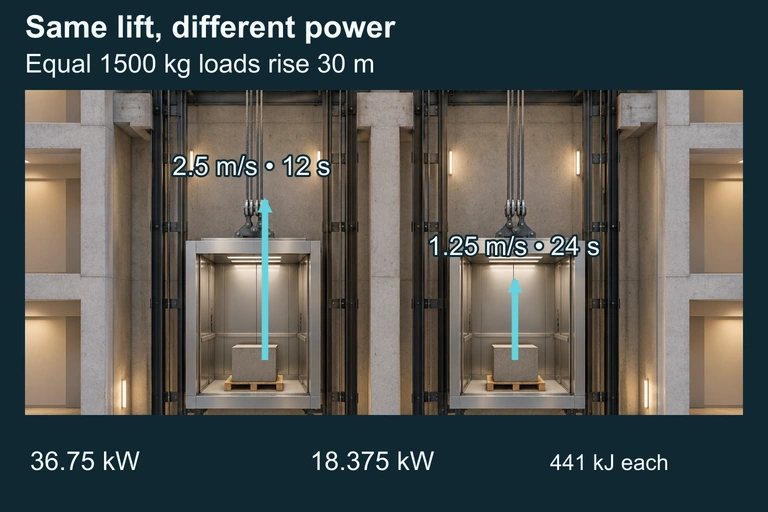 Equal 1500 kg loads rise 30 m and each gain 441 kJ. At 2.5 m/s the lift takes 12 s and delivers 36.75 kW; at 1.25 m/s it takes 24 s and delivers 18.375 kW. This is a comparison illustration in the separate Physics C car lesson.
SECTION 7
Common Pitfalls & Comparisons
Students frequently confuse power with closely related quantities—work, energy, and force—leading to errors on the AP exam. The table below clarifies the distinctions, and the key takeaway addresses the most persistent misconception.
| Quantity | Definition | SI Unit | Key Distinction from Power |
|---|---|---|---|
| Work (W) | Energy transferred via force over displacement: W = Fd cos θ | Joule (J) | Work is the total energy transferred; power is the rate. Same work can be done at vastly different power levels. |
| Energy (E) | A system's capacity to do work; exists in kinetic, potential, and thermal forms | Joule (J) | Energy is a state quantity (how much stored); power describes the flow rate of energy transfer. |
| Force (F) | A push or pull that can cause acceleration: F = ma | Newton (N) | Force alone does no work without displacement; power requires both force and velocity. |
| Power (P) | Rate of doing work: P = W/Δt = Fv cos θ | Watt (W = J/s) | The only quantity that explicitly incorporates time as a rate. |
Comparing power with related quantities
MOST COMMON EXAM MISTAKE
EXAM TIP
SECTION 8
Connections to Advanced Topics
While AP Physics 1 focuses on mechanical power, the concept extends seamlessly into every branch of physics and engineering. Understanding how power generalizes beyond P = Fv prepares you for AP Physics 2, AP Physics C, and college-level courses. The table below connects the AP Physics 1 treatment to more advanced formulations.
| AP Physics 1 Concept | Advanced Extension | Where It Appears |
|---|---|---|
| P = W/Δt (average power) | P = dW/dt (instantaneous, calculus-based) | AP Physics C: Mechanics |
| P = Fv (mechanical) | P = τω (rotational power, where τ is torque and ω is angular velocity) | AP Physics C: Mechanics; engineering dynamics |
| Power as energy/time | P = IV (electrical power, current × voltage) | AP Physics 2; circuit analysis |
| Power dissipated by friction | P = I²R = V²/R (resistive dissipation in circuits) | AP Physics 2; electrical engineering |
| Constant power scenarios | Radiation power: P = σAT⁴ (Stefan-Boltzmann law) | AP Physics 2; astrophysics; thermal physics |
How power concepts scale from AP Physics 1 to advanced courses
The rotational analog P = τω is particularly noteworthy because it mirrors P = Fv exactly: torque replaces force, and angular velocity replaces linear velocity. This parallel structure—where every translational concept has a rotational counterpart—is a central theme in mechanics. For students continuing to AP Physics C, the calculus-based instantaneous power P = dW/dt allows analysis of systems where force or velocity vary continuously, such as a rocket whose mass decreases as it burns fuel. Even within AP Physics 1, recognizing that power is fundamentally about rates of energy transfer will help you reason about any new context the exam presents.
SECTION 9
Practice Problems
Question 1: CONCEPTUAL
- A. Student 1 does more work and delivers more power than Student 2.
- B. Both students do the same work, but Student 1 delivers more power.
- C. Both students do the same work and deliver the same power.
- D. Student 1 does more work but delivers the same power as Student 2.
Show answer (B)
Question 2: BASIC CALCULATION
- A. 30 W
- B. 300 W
- C. 12,000 W
- D. 294,000 W
Show answer (C)
Question 3: INTERMEDIATE
- A. 2,000 W
- B. 4,000 W
- C. 5,000 W
- D. 10,000 W
Show answer (B)
Question 4: APPLIED
4 ptsShow answer
Question 5: CRITICAL THINKING
4 ptsShow answer
SUMMARY
Summary
Summary
Power is the rate at which work is done or energy is transferred, measured in watts (W = J/s). The two essential equations are P = W/Δt for average power and P = Fv cos θ for instantaneous power. The force-velocity form reveals that even with constant force, power changes as velocity changes—an accelerating object requires increasing power over time.
On a Power vs. Time graph, the area under the curve equals the total work done. Common AP scenarios include lifting objects at constant speed (P = mgv), pushing against friction at constant speed (P = μmgv), and finding maximum speed when engine power is fully consumed by resistive forces. Always remember: no velocity means no power, regardless of the force applied.