

SECTION 1
Historical Context & Motivation
The concept of potential energy arose from centuries of inquiry into what it means for a system to store the capacity to do work. Early natural philosophers recognized that a raised weight or a compressed spring could produce motion when released, but it was not until the eighteenth and nineteenth centuries that physicists formalized this intuition into a quantitative framework. The development of potential energy is deeply intertwined with the broader story of energy conservation, one of the most powerful unifying principles in all of physics. Understanding how this concept evolved reveals why it remains indispensable for analyzing everything from roller coasters to planetary orbits.
1687 • Newton's Principia
1788 • Lagrange's Analytical Mechanics
1834 • Hamilton's Principle
1847 • Helmholtz and Conservation of Energy
1860 • Rankine Coins 'Potential Energy'
The central question that potential energy addresses is deceptively simple: how do we account for the energy a system possesses by virtue of its configuration rather than its motion? Without this concept, the conservation of energy—arguably the most important principle in physics—would be incomplete. Every time a ball is tossed upward and momentarily stops, its kinetic energy does not vanish; it transforms into gravitational potential energy. Every time a spring is compressed, the work done on it is stored as elastic potential energy. The rest of this lesson develops the mathematical and conceptual tools you need to analyze these transformations on the AP Physics 1 exam.
SECTION 2
Core Principles & Definitions
Potential energy is fundamentally a property of a system, not of a single object in isolation. When we say a ball has gravitational potential energy, we really mean the ball–Earth system stores energy because of the relative positions of the ball and Earth. Similarly, elastic potential energy belongs to the object–spring system. This system-level perspective is essential in AP Physics 1, where the College Board emphasizes that energy is stored in interactions between objects, not within a single body.
Energy of Configuration
Conservative Forces
Reference Point Dependence
Negative Work Connection
Two AP Types
KEY TAKEAWAY
SECTION 3
Visual Explanation — Energy on an Incline
The diagram above captures the essence of energy conservation in a gravitational context. At Position A near the base, the block moves quickly, so nearly all the system's mechanical energy is kinetic. As the block ascends, it decelerates because gravity performs negative work on it, transferring energy from the kinetic "account" into the gravitational potential energy "account." At Position C near the top, the block has barely any speed remaining, and almost all energy is now stored as gravitational potential energy. Crucially, the total height of the stacked bars stays the same at every position, visually confirming that Emech = KE + Ug is constant when only conservative forces do work.
SECTION 4
Mathematical Framework
The two potential energy expressions tested on the AP Physics 1 exam are straightforward, but each encodes important physical reasoning. Understanding not just the formulas but why they take their particular forms will deepen your problem-solving flexibility.
Gravitational Potential Energy (Near Earth's Surface)
GRAVITATIONAL POTENTIAL ENERGY
where m = mass (kg), g = gravitational field strength (≈ 9.8 m/s²), and h = height above the chosen reference level (m). This expression is linear in height, reflecting the constant gravitational force near Earth's surface.
This formula is derived from the work–energy theorem. When you lift an object of mass m vertically through a displacement Δh at constant velocity, the work done by the applied force equals mgΔh. Because the gravitational force is conservative, this work is fully stored as potential energy. The linearity of the expression means that doubling the height doubles the stored energy, and the choice of where h = 0 is entirely up to you. The value of Ug at any single point is arbitrary; only differences ΔUg = mgΔh carry physical significance.
Elastic Potential Energy
ELASTIC POTENTIAL ENERGY
where k = spring constant (N/m) and x = displacement from the spring's natural (equilibrium) length (m). This expression is quadratic in displacement, which means doubling the compression quadruples the stored energy.
The quadratic form arises because the spring force increases linearly with displacement (Hooke's law: F = −kx). The work required to stretch or compress the spring equals the area under the force-versus-displacement graph, which is a triangle with base x and height kx, yielding W = ½kx². Note that Us is always non-negative because x is squared—both stretching and compressing the spring store energy.
CONSERVATION OF MECHANICAL ENERGY
When only conservative forces do work (no friction, no applied external forces doing net work), the total mechanical energy of the system is conserved. This equation is the workhorse for most energy problems on the AP exam.
WORK–ENERGY THEOREM WITH NON-CONSERVATIVE FORCES
When non-conservative forces (friction, air resistance, applied pushes) act, the work they do equals the change in total mechanical energy. If friction removes energy, Wnc is negative, and the system's mechanical energy decreases.
SECTION 5
Detailed Breakdown — Energy Bar Charts & Diagrams
One of the most powerful representational tools in AP Physics 1 is the LOL diagram (also called an energy bar chart), which tracks how energy is distributed among kinetic, gravitational potential, and elastic potential forms at different instants. The name "LOL" comes from the visual pattern of the chart: a bar chart on the Left, an Object/system definition circle in the middle, and another bar chart on the Right. These diagrams enforce a disciplined accounting of energy transfers and are particularly useful for qualitative–quantitative translation problems on the free-response section of the exam.
Energy bar charts are not merely qualitative sketches—they provide a systematic method for setting up conservation-of-energy equations. Each bar represents a term in the equation KEi + Ug,i + Us,i + Wnc = KEf + Ug,f + Us,f. Bars with zero height correspond to terms you can eliminate. On the AP exam, drawing these charts during the planning phase of a free-response question clarifies which terms survive and which vanish, reducing algebraic errors dramatically.
AP EXAM TIP
SECTION 6
Worked Example — Spring Launcher on a Ramp
A horizontal spring with spring constant k = 400 N/m is compressed by x = 0.15 m. A 0.50 kg block is placed against the compressed spring on a frictionless surface. When the spring is released, the block slides along the surface and then up a frictionless ramp. Find the maximum height the block reaches above the spring's release point.
Spring Launcher → Ramp Height
- 1
Step 1 — Define the System and Identify Energy Types
The system consists of the block, the spring, and Earth. At the initial instant, the spring is compressed and the block is at rest, so all energy is elastic potential energy. At the final instant the block is at maximum height (momentarily at rest) and the spring is at its natural length, so all energy is gravitational potential energy. Because there is no friction, Wnc = 0 and mechanical energy is conserved. - 2
Step 2 — Write the Conservation of Energy Equation
Starting from the general form: KEi + Ug,i + Us,i = KEf + Ug,f + Us,f. Eliminating zero terms: 0 + 0 + ½kx² = 0 + mgh + 0, which simplifies to ½kx² = mgh.½kx² = mgh - 3
Step 3 — Solve for h
Rearranging: h = kx² / (2mg).h = kx² / (2mg) - 4
Step 4 — Substitute Values
h = (400 N/m)(0.15 m)² / [2(0.50 kg)(9.8 m/s²)] = (400)(0.0225) / (9.8) = 9.0 / 9.8 ≈ 0.918 m.h ≈ 0.92 m - 5
Step 5 — Check Reasonableness
A stiff spring (k = 400 N/m) compressed 15 cm launches a light block (0.50 kg) about 0.92 m high—roughly the height of a table. This is physically plausible. Also verify units: [N/m × m²] / [kg × m/s²] = [N·m] / [N] = m. ✓
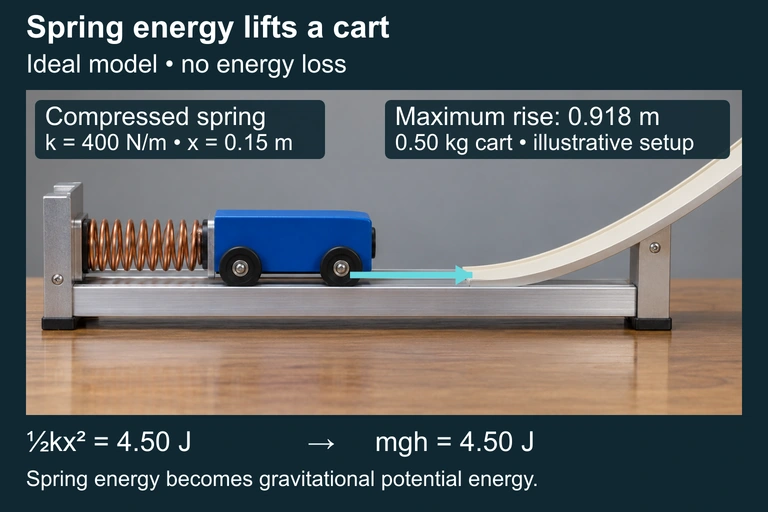 AP Physics 1: a 0.50 kg cart placed against a 400 N/m spring compressed by 0.15 m receives 4.50 J and rises 0.918 m on an ideal ramp. The cart is not attached; the required release panel shows contact ending at natural length.
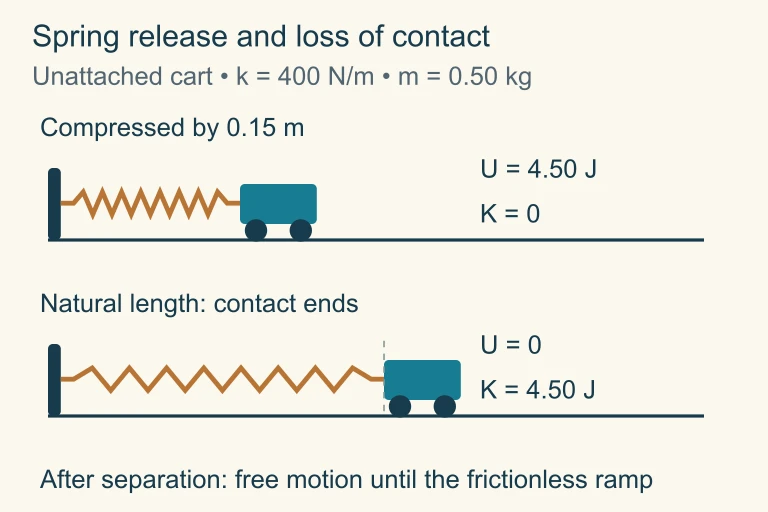 The cart is placed against the spring, not attached. Contact ends when the spring reaches its natural length; the cart then travels freely to the ramp.
SECTION 7
Gravitational vs. Elastic Potential Energy — Comparisons
Although gravitational and elastic potential energy both represent stored energy due to configuration, they differ in several important respects. Understanding these distinctions will help you avoid common errors on the AP exam, particularly when problems involve both types simultaneously (e.g., a spring-mass system on a vertical track).
| Feature | Gravitational PE (Ug = mgh) | Elastic PE (Us = ½kx²) |
|---|---|---|
| Dependence on displacement | Linear — doubles when height doubles | Quadratic — quadruples when displacement doubles |
| Associated force | Gravity (constant near Earth's surface) | Spring force (varies linearly with displacement) |
| Sign of energy | Can be negative, zero, or positive depending on reference | Always ≥ 0 (squared term) |
| Reference point | Freely chosen; h = 0 is arbitrary | Fixed at equilibrium (natural length); x = 0 is not arbitrary |
| Direction sensitivity | Depends on the sign of h (above or below reference) | Independent of direction — both stretch and compression store energy |
| Graphical representation | U vs. h is a straight line through the origin | U vs. x is a parabola opening upward |
Side-by-side comparison of the two potential energy types on the AP Physics 1 exam.
KEY TAKEAWAY
SECTION 8
Connection to Advanced Theory
The potential energy expressions Ug = mgh and Us = ½kx² are special cases of much deeper formulations encountered in more advanced physics. AP Physics 1 restricts gravitational potential energy to the near-surface approximation where g is constant, but in AP Physics C and beyond, the full inverse-square law leads to a different expression. Similarly, elastic potential energy with Hooke's law is the simplest case of a restoring potential—more complex potentials arise in molecular physics, nuclear physics, and general relativity.
| Concept | AP Physics 1 Treatment | Advanced Treatment |
|---|---|---|
| Gravitational PE | Ug = mgh (uniform g) | Ug = −GMm/r (inverse-square law) |
| Elastic PE | Us = ½kx² (linear spring) | Generalized U(x) = −∫F(x)dx for any conservative force |
| Energy conservation | Algebraic: KE + U = constant | Hamiltonian mechanics: H(q, p) = T + V |
| Potential energy curves | Qualitative interpretation only | F = −dU/dx; turning points, equilibria from U(x) graph |
How AP Physics 1 potential energy concepts extend into more advanced coursework.
If you continue to AP Physics C: Mechanics, you will learn to derive potential energy expressions using calculus and to extract force from a potential energy function via the derivative F = −dU/dx. You will also encounter potential energy diagrams—plots of U(x) versus position—that allow you to identify stable and unstable equilibria, turning points, and bound versus unbound motion, all from a single graph. The algebra-based treatment you master now provides the conceptual scaffolding for these powerful techniques.
SECTION 9
Practice Problems
Question 1: CONCEPTUAL
- A. Kinetic energy is at its maximum; gravitational potential energy is at its maximum.
- B. Kinetic energy is zero; gravitational potential energy is at its maximum.
- C. Kinetic energy is zero; gravitational potential energy is zero.
- D. Kinetic energy is at its maximum; gravitational potential energy is zero.
Show answer (B)
Question 2: BASIC CALCULATION
- A. 0.40 J
- B. 0.80 J
- C. 1.60 J
- D. 10.0 J
Show answer (B)
Question 3: INTERMEDIATE
- A. 0.24 m
- B. 0.34 m
- C. 0.49 m
- D. 0.59 m
Show answer (C)
Question 4: APPLIED
7 ptsShow answer
Question 5: CRITICAL THINKING
6 ptsShow answer
SUMMARY
Summary — Potential Energy
Summary
Potential energy is energy stored in a system due to the configuration of its objects rather than their motion. On the AP Physics 1 exam, you must master two forms: gravitational potential energy (Ug = mgh), which is linear in height and depends on a freely chosen reference level, and elastic potential energy (Us = ½kx²), which is quadratic in displacement and always non-negative. Both arise from conservative forces, meaning the work done is path-independent and only changes in potential energy (ΔU) are physically meaningful.
The central principle linking these ideas is conservation of mechanical energy: when only conservative forces do work, KE + Ug + Us remains constant. When non-conservative forces such as friction act, they do work Wnc that changes the system's total mechanical energy: Wnc = ΔKE + ΔU. Use LOL (energy bar chart) diagrams to systematically identify which energy terms are zero, set up the correct equation, and solve for unknowns. Master these tools and you will be well prepared for both the multiple-choice and free-response sections of the exam.