
SECTION 1
Historical Context & Motivation
Before Isaac Newton published his Principia Mathematica in 1687, natural philosophers struggled to explain why forces always seem to come in pairs. Aristotelian physics treated motion as something imposed on an object by an external mover, with no systematic account of how objects push back on whatever pushes them. The scientific revolution gradually shifted this view, but it required Newton's synthesis to formalize the symmetry of interactions into a universal law. Understanding this historical progression reveals that Newton's Third Law was not an isolated insight but the culmination of centuries of inquiry into the nature of force and motion.
1638 • Galileo's Two New Sciences
1668 • Collision Experiments
1687 • Newton's Principia Published
1743 • D'Alembert's Principle
The central question Newton's Third Law addresses is deceptively simple: if object A pushes on object B, what happens to object A? The law answers that B simultaneously pushes back on A with a force of equal magnitude and opposite direction. This reciprocity is not a special case—it holds for every interaction in the universe, from gravitational attraction between galaxies to the normal force between your feet and the floor. Grasping this symmetry is essential for correctly drawing free-body diagrams and applying Newton's Second Law to multi-body systems.
SECTION 2
Core Principles & Definitions
Newton's Third Law is often paraphrased as 'for every action there is an equal and opposite reaction,' but this shorthand obscures important subtleties. A more precise statement is: whenever two objects interact, the force that object A exerts on object B (FA on B) is equal in magnitude and opposite in direction to the force that object B exerts on object A (FB on A). These two forces always act on different objects, which is why they never cancel each other in a free-body diagram.
Action-Reaction Pairs
Same Type of Force
Different Objects
Independent of Motion
SECTION 3
Visual Explanation — Action-Reaction Force Pairs
Notice that in both scenarios the force arrows are equal in length (representing equal magnitudes) but point in opposite directions. A common misconception is that the 'reaction' force is somehow a consequence of the 'action' force, as if one causes the other after a brief delay. In reality, both forces arise simultaneously from the same interaction—there is no causal priority. Whether two objects interact through contact, gravity, or electromagnetic forces, the Third Law applies universally. When constructing free-body diagrams, always remember that an action-reaction pair spans two diagrams; if you see both forces on a single free-body diagram, something has gone wrong.
SECTION 4
Mathematical Framework
The mathematical statement of Newton's Third Law is compact, but its implications for problem-solving are profound. When you combine it with Newton's Second Law, you gain the tools to analyze systems of interacting objects, derive conservation of momentum, and solve for unknown internal forces.
NEWTON'S THIRD LAW
F⃗A on B is the force that object A exerts on object B. The negative sign indicates the reaction force F⃗B on A is equal in magnitude but opposite in direction. Both forces are vectors.
MAGNITUDE EQUALITY
The magnitudes are always equal regardless of the masses, velocities, or accelerations of A and B. A 50-kg person pushing a 2000-kg car exerts the same magnitude of force on the car as the car exerts back on the person.
Connection to Newton's Second Law
Consider two objects interacting with no other external forces. By the Third Law, F⃗A on B = −F⃗B on A. Applying Newton's Second Law to each object separately gives mBa⃗B = −mAa⃗A. This means that the less massive object experiences a larger acceleration—explaining why a dropped apple accelerates noticeably toward Earth while Earth's acceleration toward the apple is imperceptibly small.
MOMENTUM CONSERVATION DERIVATION
The Third Law directly implies conservation of momentum for an isolated two-body system. The total change in momentum is zero because the internal forces cancel in pairs.
SECTION 5
Detailed Breakdown — Common Third-Law Scenarios
Newton's Third Law manifests in every physical interaction, but certain scenarios appear repeatedly on the AP Physics 1 exam. Mastering these prototypical cases ensures you can identify action-reaction pairs quickly and avoid the most common errors on free-response questions.
| Interaction | Force on Object 1 | Force on Object 2 (Reaction) | Type |
|---|---|---|---|
| Earth ↔ Ball | Gravity pulls ball down (mg) | Ball pulls Earth up (mg) | Gravitational |
| Foot ↔ Ground | Ground pushes foot forward (friction) | Foot pushes ground backward (friction) | Friction |
| Bat ↔ Baseball | Bat pushes ball forward (contact) | Ball pushes bat backward (contact) | Normal/Contact |
| Rocket ↔ Exhaust | Rocket pushes exhaust gas down | Exhaust gas pushes rocket up | Contact/Pressure |
Examples of Third-Law pairs across different force types
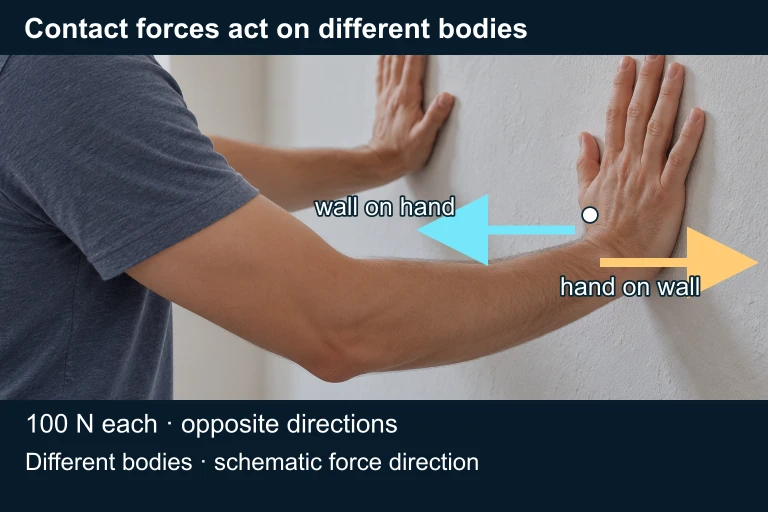 A hand exerts 100 N on a wall and the wall exerts 100 N on the hand in the opposite direction. These third-law forces act on different bodies and are not a net-force balance on one body.
SECTION 6
Worked Example — Atwood Machine with Third-Law Analysis
A modified Atwood machine consists of a 4.0-kg block (A) on a frictionless horizontal table connected by a light, inextensible string over a massless, frictionless pulley to a 2.0-kg hanging block (B). Find the acceleration of the system and the tension in the string. Identify all Third-Law pairs.
Worked example
- 1
Step 1 — Draw Free-Body Diagrams
For block A (on the table): the forces are tension T to the right, normal force N upward, and weight mAg downward. For block B (hanging): the forces are tension T upward and weight mBg downward. Since the string is light and the pulley massless, tension is the same throughout. - 2
Step 2 — Apply Newton's Second Law to Each Block
Block A (horizontal): T = mA × a. Block B (vertical, taking downward as positive): mBg − T = mB × a. Both blocks share the same magnitude of acceleration a because the string is inextensible. - 3
Step 3 — Solve for Acceleration
Add the two equations: mBg = (mA + mB)a. Therefore a = mBg / (mA + mB) = (2.0)(9.8) / (4.0 + 2.0) = 19.6 / 6.0.a ≈ 3.27 m/s² - 4
Step 4 — Solve for Tension
Substitute back into the equation for block A: T = mA × a = (4.0)(3.27).T ≈ 13.1 N - 5
Step 5 — Identify Third-Law Pairs
The string pulls block A to the right with force T; block A pulls the string to the left with force T (Third-Law pair 1, tension type). The string pulls block B upward with force T; block B pulls the string downward with force T (pair 2). Earth pulls block B down with mBg; block B pulls Earth up with mBg (pair 3, gravitational). The table pushes A up with normal force N; A pushes the table down with force N (pair 4, normal).
SECTION 7
Common Misconceptions & Clarifications
Newton's Third Law is conceptually simple yet generates persistent misconceptions, many of which are specifically targeted by AP exam questions. Clearing up these errors is often the difference between a 3 and a 5 on the exam.
| Misconception | Why It's Wrong | Correct Understanding |
|---|---|---|
| "If forces are equal and opposite, nothing can ever accelerate." | The two forces act on different objects. Only the net force on a single object determines its acceleration. | Apply ΣF = ma to each object separately using its own FBD. |
| "The bigger object exerts a bigger force." | The Third Law guarantees equal forces regardless of mass. The lighter object simply accelerates more. | F is the same; a = F/m is different for unequal masses. |
| "Weight and normal force are a Third-Law pair." | Both act on the same object and are different force types (gravitational vs. contact). | Weight's partner is the object pulling Earth up; normal's partner is the object pushing the surface down. |
| "The reaction happens after the action." | There is no time delay. Both forces exist simultaneously for the duration of the interaction. | "Action" and "reaction" are labels of convenience—neither has causal priority. |
Misconceptions frequently tested on the AP Physics 1 exam
SECTION 8
Connection to Advanced Theory
In AP Physics 1, Newton's Third Law is treated as an axiom. At more advanced levels, the law emerges from deeper symmetry principles and takes on a richer structure. Understanding these connections, even briefly, deepens your conceptual mastery and prepares you for university-level mechanics.
| AP Physics 1 Treatment | Advanced / University Treatment |
|---|---|
| Third Law is stated as an axiom for point-like contact and gravitational forces. | Derived from translational symmetry of space via Noether's theorem: conservation of momentum implies equal and opposite internal forces. |
| Forces are instantaneous; no time delay is discussed. | In special relativity and electrodynamics, the Third Law breaks down for electromagnetic fields at large separations because force information travels at finite speed (speed of light). Momentum is stored in the fields. |
| Applied to rigid bodies and point particles. | Extended to continuous media via stress tensors; internal stresses obey a generalized form of the Third Law (Newton's Third Law in differential form). |
| Leads to conservation of linear momentum for isolated systems. | Also underlies conservation of angular momentum (via the strong form of the Third Law, where forces are also central—acting along the line joining the two bodies). |
AP vs. Advanced Perspectives on Newton's Third Law
For the AP exam, the key takeaway is that Newton's Third Law is deeply connected to conservation of momentum. Whenever a question mentions an isolated system, the Third Law is the reason total momentum remains constant. Recognizing this link allows you to fluidly transition between force-based and momentum-based approaches, a skill the redesigned AP exam explicitly rewards.
SECTION 9
Practice Problems
Question 1: CONCEPTUAL
- A. The truck, because it has more mass.
- B. The car, because it has less mass.
- C. Both experience forces of equal magnitude.
- D. It depends on which vehicle was traveling faster.
Show answer (C)
Question 2: BASIC CALCULATION
- A. 686 N, gravitational
- B. 686 N, normal (contact)
- C. 343 N, normal (contact)
- D. 686 N, applied
Show answer (B)
Question 3: INTERMEDIATE
- A. 3.0 m/s²
- B. 4.9 m/s²
- C. 8.0 m/s²
- D. 4.8 m/s²
Show answer (A)
Question 4: APPLIED
Show answer
Question 5: CRITICAL THINKING