
AP Physics 1 • Torque and Rotational Dynamics

Newton's Second Law in Rotational Form

Understanding how net torque drives angular acceleration, the rotational analog of F = ma.

An orbit with symbols for force and motion.
Inside this lesson 10 sections 5 questions 8 figures

SECTION 1

Historical Context & Motivation

Newton's second law, published in 1687, initially described how a net force produces linear acceleration for a point mass. Yet engineers and natural philosophers quickly recognized that most real objects—wheels, levers, planets, and pendulums—do not simply translate; they rotate. Extending Newton's framework to spinning bodies required new quantities: torque, moment of inertia, and angular acceleration. The story of how physicists arrived at the rotational second law τnet = Iα spans centuries of insight, from Archimedes' lever principle to Euler's rigid-body equations.

~250 BCE • Archimedes' Lever Principle

Archimedes formalized the law of the lever, recognizing that a force's rotational effect depends on its distance from the pivot—a precursor to the concept of torque.

1687 • Newton's Principia

Isaac Newton published the three laws of motion governing translational dynamics, establishing the relationship Fnet = ma for point masses.

1750 • Euler's Rigid-Body Dynamics

Leonhard Euler extended Newton's laws to rotating rigid bodies, deriving the relationship between net torque and angular acceleration that forms the basis of τ = Iα.

1834 • Hamilton's Analytical Mechanics

William Rowan Hamilton and Joseph-Louis Lagrange provided powerful reformulations that unified translational and rotational dynamics under a single variational principle.

The central question driving this lesson is deceptively simple: If F = ma governs how objects speed up or slow down in a straight line, what governs how objects spin faster or slower? The answer—Newton's second law in rotational form—provides a direct, elegant parallel that lets us analyze everything from opening a door to the spin of a figure skater.

SECTION 2

Core Principles & Definitions

Before applying the rotational second law, you need a firm grasp of three quantities that mirror their translational counterparts. Just as force, mass, and linear acceleration form the triad behind F = ma, the rotational world is built on torque, moment of inertia, and angular acceleration. Understanding how each translational quantity maps to its rotational analog is the conceptual key to mastering this topic.

1

Torque (τ)

The rotational analog of force. Torque measures a force's tendency to cause rotation about a specific axis. Calculated as τ = rF sin θ, where r is the distance from the axis to the point of force application, F is the force magnitude, and θ is the angle between the force vector and the lever arm. Units: N·m.
2

Moment of Inertia (I)

The rotational analog of mass. Moment of inertia quantifies an object's resistance to angular acceleration. It depends not only on total mass but on how that mass is distributed relative to the rotation axis. A hoop has more rotational inertia than a disk of the same mass and radius because its mass sits farther from the center. Units: kg·m².
3

Angular Acceleration (α)

The rotational analog of linear acceleration. Angular acceleration is the rate of change of angular velocity with respect to time: α = Δω / Δt. A positive α indicates speeding up in the chosen positive rotational direction. Units: rad/s².
4

Net Torque (Στ)

Just as only the net force determines linear acceleration, only the net torque about a given axis determines angular acceleration. Torques are signed: by convention, counterclockwise torques are positive and clockwise torques are negative when viewed from above the axis.
✦

KEY TAKEAWAY

Think of a revolving door. Pushing near the hinge (small r) barely moves it, while pushing at the outer edge (large r) swings it easily—that's the lever-arm effect in torque. Now imagine the door is made of lead instead of glass: the same push produces far less angular acceleration because the moment of inertia is much larger. The rotational second law, Στ = Iα, captures both effects in a single equation—net torque drives angular acceleration, and moment of inertia resists it, exactly as net force and mass do in the translational world.

SECTION 3

Visual Explanation — Translational vs. Rotational Analogy

Translational (Linear)RotationalForce (F)Units: N (kg·m/s²)Torque (τ = rF sin θ)Units: N·mMass (m)Units: kgMoment of Inertia (I)Units: kg·m²Acceleration (a)Units: m/s²Angular Acceleration (α)Units: rad/s²ΣF = maNewton's 2nd Law (Linear)Στ = IαNewton's 2nd Law (Rotational)→ Perfect Structural Analogy →
The diagram above maps each translational quantity to its rotational counterpart. Force becomes torque, mass becomes moment of inertia, and linear acceleration becomes angular acceleration. The governing equations share the same structure: the net cause (force or torque) equals the resistance (mass or moment of inertia) multiplied by the resulting effect (linear or angular acceleration).

The diagram highlights a structural isomorphism that is central to AP Physics 1: every concept and equation in translational dynamics has a one-to-one rotational analog. Recognizing this mapping means you never have to memorize rotational formulas from scratch—you already know the linear versions, and you simply swap in the rotational variables. For instance, kinematic equations like v = v₀ + at become ω = ω₀ + αt, and the second law itself transforms from ΣF = ma to Στ = Iα. This analogy is the single most powerful organizational tool for the rotational dynamics unit.

SECTION 4

Mathematical Framework

The mathematical formulation of Newton's second law for rotation follows directly from the translational version when we apply it to a rigid body that can only rotate about a fixed axis. Consider a small mass element Δm located a distance r from the axis. A tangential force component Ft acting on it produces a tangential acceleration at = rα, so by Newton's second law, Ft = Δm × rα. The torque from this element is τ = r × Ft = Δm × r²α. Summing over every mass element in the body, and noting that α is the same for every element in a rigid body, gives us the master equation.

NEWTON'S SECOND LAW — ROTATIONAL FORM

Στ=IαΣτ = Iα

Στ = net torque about the axis (N·m); I = moment of inertia about the same axis (kg·m²); α = angular acceleration (rad/s²). The sign convention is that counterclockwise torques and angular accelerations are positive.

TORQUE FROM A SINGLE FORCE

τ=rFsinθτ = rF sin θ

r = distance from the axis to the point where the force is applied (m); F = magnitude of the applied force (N); θ = angle between the position vector r and the force vector F. The quantity r sin θ is called the lever arm (or moment arm).

MOMENT OF INERTIA — POINT MASSES

I=Σmiri2I = Σ mᵢrᵢ²

For a system of discrete point masses, I is the sum of each mass mᵢ multiplied by the square of its distance rᵢ from the rotation axis. For continuous bodies, the AP exam provides common results (e.g., I = ½MR² for a solid disk).

⚠

SIGN CONVENTIONS MATTER

On the AP exam, you must choose a positive rotational direction and remain consistent. If you define counterclockwise as positive, then a clockwise torque enters Στ as a negative value. A common exam mistake is forgetting to assign correct signs, leading to an angular acceleration with the wrong direction.

A hinged falling rod with a separated coin accompanies an exact initial-state torque diagram and distinct tip/coin acceleration arrows.At release, the rod has zero angular speed. Gravity’s torque can give its tip a downward tangential acceleration greater than g, allowing the freely falling coin to separate from the tip.
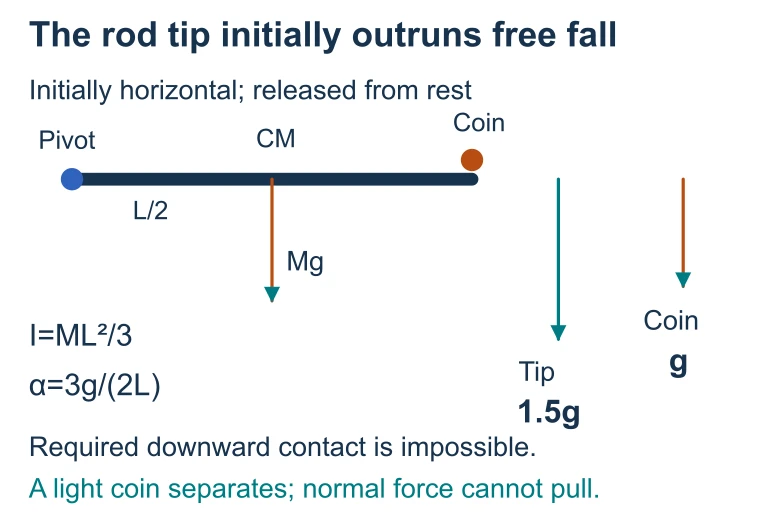
The rod tip initially outruns free fall. At release, the rod has zero angular speed. Gravity’s torque can give its tip a downward tangential acceleration greater than g, allowing the freely falling coin to separate from the tip.At release, the rod has zero angular speed. Gravity’s torque can give its tip a downward tangential acceleration greater than g, allowing the freely falling coin to separate from the tip.

SECTION 5

Moment of Inertia — Why Mass Distribution Matters

In translational dynamics, an object's resistance to acceleration depends solely on its mass. In rotational dynamics, resistance to angular acceleration—the moment of inertia—depends on both the total mass and how that mass is distributed relative to the axis of rotation. Moving mass farther from the axis increases I quadratically because each mass element contributes mr². This is why a hollow cylinder is harder to spin up than a solid cylinder of equal mass and radius: the hollow cylinder's mass is concentrated at the maximum possible distance from the axis.

Common Moments of Inertia (AP Physics 1 Reference)RThin HoopI = MR²(axis through center)RSolid Disk / CylinderI = ½MR²(axis through center)RSolid SphereI = ⅖MR²(axis through center)L/2Thin Rod (center)I = ¹⁄₁₂ML²LThin Rod (end)I = ⅓ML²Hollow SphereI = ⅔MR²(thin shell)All axes pass through the center of mass unless otherwise noted.
Six common moments of inertia provided on the AP Physics 1 equation sheet. Notice the pattern: shapes that concentrate mass farther from the axis (hoop, hollow sphere) have larger coefficients in front of MR² than shapes that distribute mass more evenly (solid disk, solid sphere). The rod about its end has a moment of inertia four times that about its center, illustrating the dramatic effect of axis choice.
ShapeMoment of InertiaCoefficient
Thin hoop (axis through center)I = MR²1
Hollow sphere (thin shell)I = ⅔MR²0.667
Solid disk / cylinderI = ½MR²0.500
Solid sphereI = ⅖MR²0.400
Thin rod (axis through center)I = ¹⁄₁₂ML²0.083
Thin rod (axis through end)I = ⅓ML²0.333

Common moments of inertia sorted by coefficient in front of MR² or ML²

SECTION 6

Worked Example — Pulley with a Hanging Mass

A solid disk pulley of mass M = 4.0 kg and radius R = 0.25 m is mounted on a frictionless axle. A light, inextensible string wrapped around the pulley supports a hanging block of mass m = 2.0 kg. The system is released from rest. Find the angular acceleration of the pulley and the linear acceleration of the hanging block.

Pulley–Hanging Mass System

  1. 1

    Step 1 — Identify Given Values and Unknowns

    Given: M = 4.0 kg (pulley mass), R = 0.25 m (pulley radius), m = 2.0 kg (hanging block), released from rest (ω₀ = 0). The pulley is a solid disk, so I = ½MR². We need to find the angular acceleration α of the pulley and the linear acceleration a of the block.
  2. 2

    Step 2 — Draw Free-Body Diagrams

    For the hanging block, two forces act: the weight mg downward and the tension T upward. Choosing downward as positive for the block, Newton's second law gives: mg − T = ma. For the pulley, the string exerts a tangential force T at the rim, creating a torque τ = TR about the axle. There is no friction torque.
  3. 3

    Step 3 — Apply Στ = Iα to the Pulley

    The only torque on the pulley is from the tension: τnet = TR. Substituting I = ½MR²: TR = (½MR²)α. Dividing both sides by R: T = ½MRα.
  4. 4

    Step 4 — Link Rotation and Translation via the Constraint a = Rα

    Because the string is inextensible and does not slip on the pulley, the linear acceleration of the block equals the tangential acceleration at the rim: a = Rα, so α = a/R. Substituting into T = ½MRα gives T = ½Ma.
  5. 5

    Step 5 — Solve the System of Equations

    From Step 2: mg − T = ma. Substituting T = ½Ma: mg − ½Ma = ma. Solving for a: a = mg / (m + ½M) = (2.0)(9.8) / (2.0 + 2.0) = 19.6 / 4.0.
    a = 4.9 m/s²
  6. 6

    Step 6 — Find Angular Acceleration

    Using α = a/R = 4.9 / 0.25:
    α = 19.6 rad/s²
  7. 7

    Step 7 — Check for Reasonableness

    The linear acceleration a = 4.9 m/s² is exactly half of g, which makes sense: the pulley's rotational inertia effectively doubles the resistance felt by the block (m + ½M = 2m). If the pulley were massless, a would equal g. The tension T = ½Ma = ½(4.0)(4.9) = 9.8 N, which is less than mg = 19.6 N, confirming the block accelerates downward.
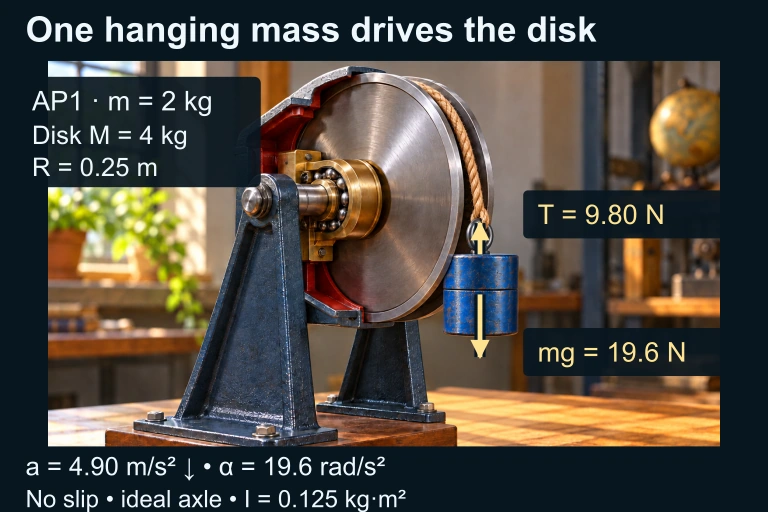
Separate AP1 single-mass preset, with tension and weight on the hanging massSeparate AP1 single-mass preset, with tension and weight on the hanging mass

An exposed pulley rotor supports a taut cord and a blue load suspended clear of the base.The falling load accelerates while cord tension supplies torque to the pulley. With no slip, the load acceleration and pulley angular acceleration satisfy a = Rα; tension is smaller than the load’s weight.
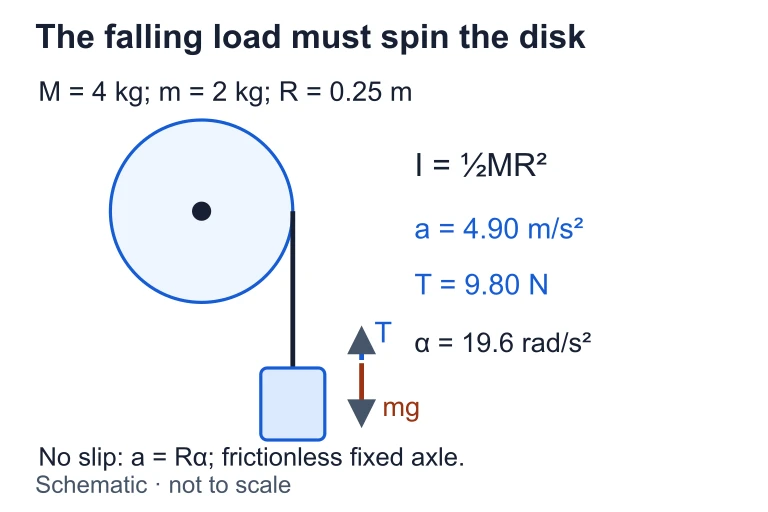
Pulley and falling load. For a 4 kg solid-disk pulley of radius 0.25 m and a 2 kg load, a = 4.90 m/s², T = 9.80 N and α = 19.6 rad/s². The cord does not slip and the fixed axle is frictionless.For a 4 kg solid-disk pulley of radius 0.25 m and a 2 kg load, a = 4.90 m/s², T = 9.80 N and α = 19.6 rad/s². The cord does not slip and the fixed axle is frictionless.

SECTION 7

Strengths, Limitations & Common Pitfalls

AspectStrengthsLimitations / Pitfalls
Ease of applicationDirect analog of F = ma; if you know the linear version, the rotational version is structurally identical.Only valid for rotation about a fixed axis (or the center of mass). Misidentifying the axis leads to incorrect I values.
Moment of inertiaCommon shapes have simple, memorizable formulas provided on the AP equation sheet.Students often forget that I depends on the axis choice. The same object has different I values about different axes.
Sign conventionsConsistent sign use allows algebraic solutions without guessing directions.A frequent AP mistake: mixing up signs for torques or choosing inconsistent positive directions for translational and rotational motion.
Coupled systemsThe constraint a = Rα links translational and rotational equations in systems like pulleys, rolling objects, and gears.Students sometimes apply a = Rα when the string slips or the object is not rolling without slipping—always verify the no-slip condition.

Strengths and common pitfalls when applying Στ = Iα

🎯

EXAM STRATEGY

On the AP exam, when you see a system involving both rotation and translation (e.g., a block on a string over a pulley, or a ball rolling down a ramp), always write two separate Newton's second law equations: ΣF = ma for the translating part and Στ = Iα for the rotating part. Then connect them with the constraint equation a = Rα (assuming no slipping). This three-equation approach solves virtually every rotational dynamics problem on the exam.

SECTION 8

Connection to Advanced Rotational Physics

While AP Physics 1 restricts analysis to rotation about a fixed axis, the concepts you learn here extend naturally into more powerful frameworks encountered in university physics. The rotational second law is a special case of Euler's equations of motion for rigid bodies, which handle rotation about axes that themselves change direction—essential for analyzing spinning tops, gyroscopes, and satellite attitude dynamics. Furthermore, conservation of angular momentum, which follows directly from Στ = Iα when the net external torque is zero, becomes a cornerstone of quantum mechanics, where electron orbital and spin angular momenta obey quantized versions of the same principle.

FeatureAP Physics 1 TreatmentAdvanced / University Treatment
Rotation axisFixed axis onlyArbitrary; requires full inertia tensor and Euler's equations
Torque representationScalar (positive/negative, signed)Vector cross product: τ⃗ = r⃗ × F⃗
Moment of inertiaSingle scalar value for each axis3 × 3 inertia tensor with products of inertia
Angular momentumL = Iω (scalar, fixed axis)L⃗ = Iω⃗ (vector; L⃗ may not be parallel to ω⃗)
Mathematical toolsAlgebra, basic trigonometryCalculus, linear algebra, differential equations

AP Physics 1 vs. university-level rotational dynamics

Despite these extensions, the conceptual heart remains unchanged: net torque causes changes in angular momentum. Mastering Στ = Iα at the AP level gives you the physical intuition that carries through every advanced course, from classical mechanics to astrophysics.

SECTION 9

Practice Problems

Question 1: CONCEPTUAL

A solid disk and a thin hoop have the same mass M and the same radius R. Both are initially at rest and are subjected to the same constant net torque about their central axes. After the same elapsed time, which object has the greater angular velocity?
  • A. The hoop, because it has more mass at the rim.
  • B. The solid disk, because it has a smaller moment of inertia.
  • C. Both have the same angular velocity, because they have the same mass.
  • D. It depends on the magnitude of the applied torque.
Show answer (B)
Correct answer: B. From Στ = Iα, with the same net torque τ, the object with the smaller moment of inertia experiences a larger angular acceleration α = τ/I. The solid disk has I = ½MR², while the hoop has I = MR². Since the disk's moment of inertia is half the hoop's, the disk's angular acceleration is twice as large, and after the same time interval (starting from rest), ω = αt gives the disk a greater angular velocity. Choice A is wrong because having more mass at the rim increases I, which reduces α, not increases ω. Choice C is wrong because mass alone does not determine rotational inertia—distribution matters. Choice D is wrong because the torque magnitude is the same for both; the only difference is I.

Question 2: BASIC CALCULATION

A uniform solid cylinder of mass 6.0 kg and radius 0.20 m is free to rotate about its central axis. A constant net torque of 3.0 N·m is applied. What is the angular acceleration of the cylinder?
  • A. 5.0 rad/s²
  • B. 12.5 rad/s²
  • C. 25 rad/s²
  • D. 50 rad/s²
Show answer (C)
Correct answer: C. First calculate the moment of inertia for a solid cylinder: I = ½MR² = ½(6.0)(0.20)² = ½(6.0)(0.04) = 0.12 kg·m². Then apply Στ = Iα → α = Στ/I = 3.0/0.12 = 25 rad/s². Choice A (5.0 rad/s²) results from incorrectly using I = MR² (the hoop formula) instead of ½MR². Choice B (12.5 rad/s²) comes from an arithmetic error such as doubling I. Choice D (50 rad/s²) results from forgetting the factor of ½ in I and also dividing by R instead of R².

Question 3: INTERMEDIATE

A lightweight rod of negligible mass and length L = 1.2 m is pivoted at its center. A 3.0 kg mass is attached at the left end and a 5.0 kg mass is attached at the right end. The system is released from a horizontal position. What is the magnitude of the initial angular acceleration of the rod? (Take g = 10 m/s².)
  • A. 3.5 rad/s²
  • B. 4.2 rad/s²
  • C. 8.3 rad/s²
  • D. 10.0 rad/s²
Show answer (B)
Correct answer: B. Each mass is at a distance r = L/2 = 0.60 m from the pivot. Taking counterclockwise as positive, the torque from the 3.0 kg mass is τ₁ = (3.0)(10)(0.60) = 18 N·m. The torque from the 5.0 kg mass is τ₂ = −(5.0)(10)(0.60) = −30 N·m. Net torque magnitude |Στ| = 12 N·m. The moment of inertia is I = (3.0)(0.60)² + (5.0)(0.60)² = (3.0 + 5.0)(0.36) = 2.88 kg·m². Thus, α = 12 / 2.88 ≈ 4.2 rad/s².

Question 4: APPLIED

5 pts
A student wants to experimentally verify that angular acceleration is inversely proportional to moment of inertia when net torque is held constant, confirming the relationship α = τ/I. The student has access to a turntable that can rotate freely about a vertical axis, a set of small identical masses, a ruler, a string-and-hanging-mass system to provide a constant torque, a stopwatch, and a protractor or angle-marking device. (a) Describe an experimental procedure the student should follow to collect data that can verify the relationship α ∝ 1/I at constant torque. Include enough detail that another student could replicate the experiment. (b) Describe what measurements should be taken and how angular acceleration would be determined from those measurements. (c) Describe how the collected data should be analyzed (including what should be graphed) to verify the inverse proportionality. (d) Describe one significant source of systematic error and how it could affect the results. (e) Describe one modification that would improve the accuracy of the experiment.
Show answer
Point-by-point rubric: (a) Experimental Procedure (1 point): The student should attach a string to the rim of the turntable, run it over a low-friction pulley at the edge of the table, and hang a fixed mass m from the string to produce a constant torque τ = mgR (where R is the radius at which the string is attached). The student should then systematically vary the moment of inertia by placing pairs of identical small masses at different measured distances r from the center of the turntable (e.g., at r = 5 cm, 10 cm, 15 cm, 20 cm, 25 cm). For each configuration, the turntable is released from rest and the time to rotate through a fixed angle (e.g., 2π radians) is recorded. At least five different mass configurations should be tested, and each trial should be repeated at least three times. (b) Measurements and Determining α (1 point): Record the radial positions of the added masses (r), the masses used (m_added), and the time (t) for the turntable to rotate through a known angle θ from rest. Since the system starts from rest and undergoes constant angular acceleration, θ = ½αt², so α = 2θ/t². The moment of inertia for each trial is I = I_turntable + 2m_added × r² (assuming symmetric placement of two masses). (c) Data Analysis (1 point): Plot α (y-axis) versus 1/I (x-axis). If α ∝ 1/I at constant torque, the graph should be linear and pass through the origin. The slope of the best-fit line should equal the net torque τ. Alternatively, plot α versus I on a log-log scale; a slope of −1 confirms inverse proportionality. (d) Systematic Error (1 point): Friction at the turntable's axle provides an opposing torque that reduces the net torque below mgR. This would cause all measured angular accelerations to be lower than predicted, and the y-intercept of the α vs. 1/I graph would be shifted downward (or the graph would not pass through the origin). The frictional torque is approximately constant, so it affects small-I (high-α) trials less proportionally than large-I (low-α) trials, potentially curving the graph. (e) Improvement (1 point): Use a photogate or rotary motion sensor to record angular position as a function of time with high precision, rather than relying on a stopwatch and protractor. This reduces reaction-time uncertainty and allows the student to fit a θ-vs-t² curve directly to extract α more accurately.

Question 5: CRITICAL THINKING

4 pts
A uniform thin rod of mass M and length L is pivoted at one end and released from rest in a horizontal position. (a) Derive an expression for the angular acceleration of the rod immediately after release. Express your answer in terms of M, L, and g. (b) Determine the linear acceleration of the free (unpivoted) end of the rod at the instant of release. Compare this to g and explain whether the result is physically reasonable. (c) A small coin sits on top of the rod at its free end. As the rod is released, will the coin remain in contact with the rod? Justify your answer using Newton's second law.
Show answer
Point-by-point rubric: (a) Deriving angular acceleration (1 point): The moment of inertia of a thin rod about one end is I = ⅓ML². The only torque about the pivot is due to gravity acting at the center of mass (L/2 from the pivot): τ = Mg(L/2). Applying Στ = Iα: Mg(L/2) = (⅓ML²)α. Solving: α = Mg(L/2) / (⅓ML²) = 3g / (2L). (b) Linear acceleration of the free end (1 point): The tangential acceleration of the free end (at distance L from the pivot) is ata_t = Lα = L × 3g/(2L) = 3g/2 = 1.5g. This exceeds the free-fall acceleration g. This is physically reasonable because the rod is a rigid body—the pivot provides a constraint force, and the rod's center of mass falls slower than g (since it is only at L/2), allowing the end to whip around faster than freefall. (c) Will the coin remain in contact? (2 points — 1 for correct answer, 1 for valid justification): No, the coin will lose contact with the rod. At the instant of release, the free end of the rod accelerates downward at 3g/2, but the coin, if it were in freefall, could only accelerate downward at g (the maximum acceleration gravity can provide an unsupported object). Since the rod's end accelerates faster than g, the rod would need to pull the coin downward, but the contact force can only push (normal force), not pull. The normal force on the coin would become zero and then the rod would separate from the coin. By Newton's second law applied to the coin: Mg_coin − N = m_coin × a. For the coin to keep up with the rod, a = 3g/2, requiring N = m_coin(g − 3g/2) = −m_coin(g/2), which is negative—an impossibility for a normal force. Therefore the coin separates immediately.

SUMMARY

Lesson Summary

Summary

Newton's second law in rotational form, expressed as Στ = Iα, is the master equation for rotational dynamics about a fixed axis. It states that the net torque on an object equals its moment of inertia multiplied by its angular acceleration. Torque (τ = rF sin θ) is the rotational analog of force, moment of inertia (I = Σmr²) is the rotational analog of mass, and angular acceleration (α) is the rotational analog of linear acceleration. The equation's structure is identical to F = ma, making the translational-rotational analogy one of the most powerful problem-solving tools in AP Physics 1.

When solving problems involving objects that both rotate and translate—such as pulleys, rolling objects, or Atwood machines with massive pulleys—you should write separate Newton's second law equations for each part of the system and connect them with the constraint equation a = Rα (valid when the string does not slip or the object rolls without slipping). Remember that moment of inertia depends on the axis of rotation, not just total mass, and always maintain consistent sign conventions for torques. Mastering this equation is essential preparation for angular momentum conservation and the broader rotational dynamics framework on the AP Physics 1 exam.

Varsity Tutors • AP Physics 1: Algebra-Based • Newton's Second Law in Rotational Form