

SECTION 1
Historical Context & Motivation
Before the seventeenth century, the prevailing Aristotelian worldview held that a sustained force was necessary to maintain any motion — remove the push, and the object stops. This intuitive but incorrect picture persisted for nearly two thousand years, in part because friction masked the deeper truth. The intellectual revolution that overturned Aristotle's framework unfolded across several decades of European science, culminating in Isaac Newton's monumental synthesis in the Principia Mathematica of 1687. Newton's Second Law provided, for the first time, a precise mathematical relationship between the forces acting on a body and the resulting change in its motion, transforming physics from a qualitative philosophy into a predictive, quantitative science.
1638 • Galileo's Kinematics
1687 • Newton's Principia
1743 • Euler's Formulation
1905 • Einstein's Relativity
The central question Newton addressed is deceptively simple: if multiple forces act on an object simultaneously, exactly how does the object's velocity change? His answer — that the net force equals the product of mass and acceleration — remains the bedrock of classical mechanics and the single most important equation on the AP Physics 1 exam.
SECTION 2
Core Principles & Definitions
Newton's Second Law connects three fundamental quantities — net force, mass, and acceleration — in a single vector equation. Understanding the precise meaning of each term, and how they relate, is essential before applying the law to problem-solving.
Net Force (ΣF)
Mass (m)
Acceleration (a)
The Law in Words
SECTION 3
Visual Explanation — Free-Body Diagram
The free-body diagram (FBD) is the essential first step in any Newton's Second Law problem. You isolate a single object, represent it as a point or simple shape, and draw every external force acting on it as an arrow originating from the object. The arrow's length should be roughly proportional to the force's magnitude, and its direction must be physically accurate. Once the FBD is drawn, you decompose forces into perpendicular components — typically along the x- and y-axes — and write ΣF = ma separately for each axis. This technique transforms a complex physical situation into a system of algebraic equations that you can solve for unknowns such as acceleration, tension, or friction.
SECTION 4
Mathematical Framework
NEWTON'S SECOND LAW (VECTOR FORM)
ΣF⃗ = net (resultant) external force vector (N) · m = mass of the object (kg) · a⃗ = acceleration vector (m/s²). The direction of a⃗ is always the same as the direction of ΣF⃗.
COMPONENT FORM — X-AXIS
Sum all force components along the chosen x-direction. If the object is in equilibrium along x, then ΣFₓ = 0 and aₓ = 0.
COMPONENT FORM — Y-AXIS
Sum all force components along the chosen y-direction. On a level surface with no vertical acceleration, Σ = 0, which lets you solve for the normal force.
Because force and acceleration are vectors, Newton's Second Law is really a set of independent equations — one for each spatial dimension. In AP Physics 1, you typically work in two dimensions, choosing axes aligned with the motion or with surfaces (especially on inclines). A critical implication: if the net force along an axis is zero, the acceleration along that axis is zero, which does not necessarily mean the object is at rest — it may be moving at constant velocity along that axis. This connects the Second Law back to the First Law (the special case where ΣF⃗ = 0).
WEIGHT
The gravitational force on an object near Earth's surface. g ≈ 9.8 m/s² (or 10 m/s² for quick estimates). Weight is a force (in newtons), not the same as mass (in kilograms).
SECTION 5
Applications — Inclines & Connected Objects
Inclined-plane problems illustrate a powerful strategy: tilt your coordinate system so that one axis runs parallel to the surface and the other runs perpendicular. This choice reduces the number of force components you must calculate. In the frictionless case, the only unbalanced force is mg sin θ along the incline, yielding a = g sin θ — remarkably, the acceleration is independent of mass, just as Galileo predicted. When friction is present, you add the friction force (opposing motion) to the parallel-axis equation: ΣF∥ = mg sin θ − f = ma.
For connected-object systems (e.g., two masses linked by a string over a pulley), you apply Newton's Second Law to each object separately, then combine the equations. If the string is ideal (massless and inextensible), both objects share the same magnitude of acceleration, and the tension is the same throughout the string. Writing ΣF = ma for each object and solving simultaneously is a technique tested frequently on AP Physics 1.
SECTION 6
Worked Example — Atwood Machine
An Atwood machine consists of two masses, m₁ = 6.0 kg and m₂ = 4.0 kg, connected by a massless, inextensible string over a frictionless, massless pulley. Find the acceleration of the system and the tension in the string.
Worked example
- 1
Step 1 — Draw Free-Body Diagrams
For m₁ (heavier): weight m₁g acts downward, tension T acts upward. For m₂ (lighter): weight m₂g acts downward, tension T acts upward. Because m₁ > m₂, m₁ accelerates downward and m₂ accelerates upward, both with magnitude a. - 2
Step 2 — Write ΣF = ma for Each Mass
Taking downward as positive for m₁ and upward as positive for m₂ (so both accelerations are positive): For m₁: m₁g − T = m₁a. For m₂: T − m₂g = m₂a. - 3
Step 3 — Solve for Acceleration
Add the two equations to eliminate T: m₁g − m₂g = (m₁ + m₂)a. Therefore a = (m₁ − m₂)g / (m₁ + m₂) = (6.0 − 4.0)(9.8) / (6.0 + 4.0) = (2.0)(9.8) / 10.0a = 1.96 m/s² ≈ 2.0 m/s² - 4
Step 4 — Solve for Tension
Substitute a back into either equation. Using the m₂ equation: T = m₂g + m₂a = m₂(g + a) = 4.0(9.8 + 1.96) = 4.0 × 11.76T = 47.0 N - 5
Step 5 — Sanity Check
The tension (47.0 N) should lie between the weights of the two masses: m₂g = 39.2 N < T = 47.0 N < m₁g = 58.8 N. ✓ This confirms the tension is large enough to accelerate m₂ upward but not as large as the full weight of m₁ (since m₁ is accelerating downward, not in equilibrium).
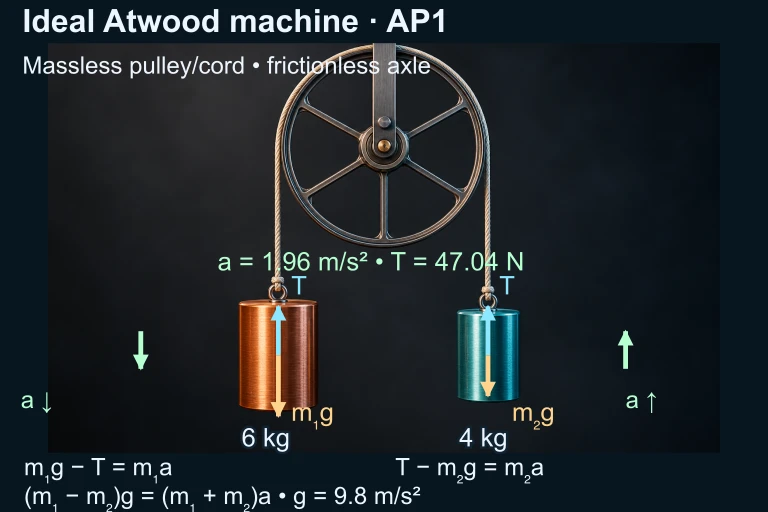 AP Physics 1 ideal Atwood machine: 6 kg descends and 4 kg rises with acceleration 1.96 m/s² and tension 47.04 N. The C companion uses 5 kg and 3 kg. Each model assumes a massless string and frictionless massless pulley.
SECTION 7
Common Mistakes & Exam Strategies
| Common Mistake | Why It's Wrong | Correct Approach |
|---|---|---|
| Using F = ma with a single force | The law requires the net force, not any individual force | Always write ΣF = ma; sum all forces on the object first |
| Confusing mass and weight | Mass (kg) is intrinsic; weight (N) depends on g | Weight = mg; never put kilograms where newtons belong |
| Including forces on other objects in the FBD | Only forces exerted on the system of interest belong in its FBD | Isolate one object, list contact and field forces acting on it only |
| Forgetting friction opposes relative motion | Drawing friction in the wrong direction flips the sign of net force | Always draw friction opposing the direction of sliding (or impending sliding) |
| Assuming a = 0 when velocity ≠ 0 | An object can move at constant nonzero velocity with zero acceleration | a = 0 means constant velocity (including zero); ΣF = 0 is the condition |
Top five student errors on Newton's Second Law problems
Key takeaway
SECTION 8
Connection to Advanced Concepts
| AP Physics 1 (This Course) | Beyond AP Physics 1 |
|---|---|
| ΣF = ma for point particles or rigid bodies in translation | Στ = Iα for rotational dynamics (AP Physics C / college) |
| Constant mass; speed ≪ c | Relativistic force: F = dp/dt with p = γmv (special relativity) |
| Applies to single objects or simple systems | Lagrangian & Hamiltonian mechanics generalize to complex systems and fields |
| Kinematics linked via constant-acceleration equations | Calculus-based: a = dv/dt, ΣF = m(dv/dt) solved via differential equations |
How Newton's Second Law expands in more advanced physics courses
Although AP Physics 1 limits you to the algebra-based form ΣF = ma, recognizing that this is actually a special case of the more general impulse-momentum theorem (ΣF = Δp/Δt) deepens your understanding. When mass is constant, Δp = mΔv and dividing by Δt recovers F = ma. The AP exam does test impulse and momentum in its own unit, and the Second Law provides the bridge. Similarly, Newton's Second Law for rotation — Στ = Iα — mirrors the translational form with torque replacing force, moment of inertia replacing mass, and angular acceleration replacing linear acceleration. Mastering ΣF = ma now builds the conceptual scaffolding for all these extensions.
SECTION 9
Practice Problems
Question 1: CONCEPTUAL
- A. The net force is in the direction of motion and equal to the puck's weight.
- B. The net force is zero.
- C. The net force is in the direction of motion but decreasing over time.
- D. The net force equals the normal force.
Show answer (B)
Question 2: BASIC CALCULATION
- A. 0.33 m/s²
- B. 3.0 m/s²
- C. 48 m/s²
- D. 432 m/s²
Show answer (B)
Question 3: INTERMEDIATE
- A. 4.3 m/s²
- B. 5.0 m/s²
- C. 8.7 m/s²
- D. 10 m/s²
Show answer (B)
Question 4: APPLIED
Show answer
Question 5: CRITICAL THINKING