

SECTION 1
Historical Context & Motivation
The question of how celestial bodies move has captivated thinkers for millennia, from ancient Greek astronomers who imagined crystalline spheres to Renaissance scientists who dared to place the Sun at the center of the solar system. The physics of orbiting satellites rests on a chain of discoveries that began with careful naked-eye observations and culminated in Newton's universal law of gravitation. Understanding this history reveals how a single force—gravity—can explain both the fall of an apple and the orbit of the Moon.
1609 • Kepler's Laws of Planetary Motion
1687 • Newton's Principia
1798 • Cavendish Measures G
1957 • Sputnik 1 — First Artificial Satellite
The central question this lesson addresses is deceptively simple: what determines the speed, period, and energy of a satellite in orbit? The answer ties together Newton's law of gravitation, circular-motion dynamics, and conservation of energy—three pillars that appear repeatedly on the AP Physics 1 exam.
SECTION 2
Core Principles & Definitions
An orbiting satellite is in perpetual free fall toward the central body; it simply moves forward fast enough that the curvature of its path matches the curvature of the planet beneath it. Three foundational ideas govern this motion and connect directly to the energy and momentum framework of rotating systems.
Gravitational Force as Centripetal Force
Orbital Speed Depends Only on Radius
Mechanical Energy Is Negative and Conserved
Angular Momentum Conservation
SECTION 3
Visual Explanation — Circular Orbit Force & Velocity
The diagram above captures the essential geometry of a circular orbit. Notice that the velocity vector is always perpendicular to the gravitational force vector. Because gravity does no work on the satellite—the force is perpendicular to the displacement at every instant—the kinetic energy and speed remain constant throughout the orbit. This perpendicularity is a hallmark of uniform circular motion and is central to deriving the orbital speed equation in the next section.
 The cabin and its loose objects fall together in orbit. Gravity remains present and points toward Earth while the orbital velocity is tangent to the path.
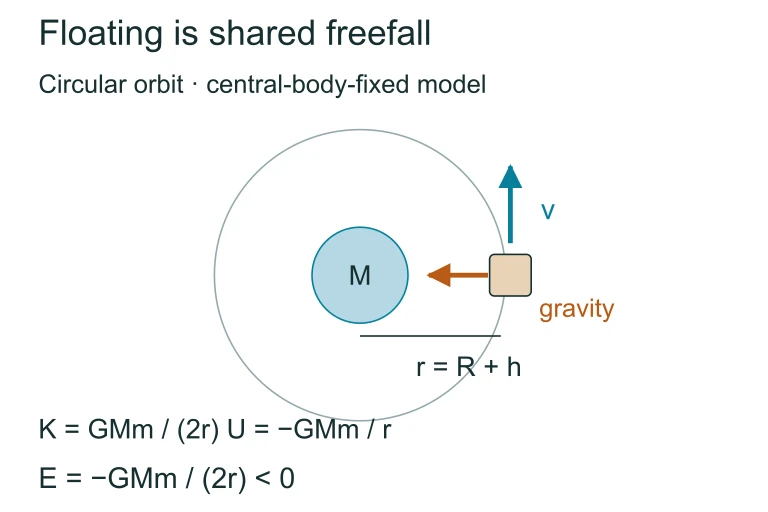 The cabin and its loose objects fall together in orbit. Gravity remains present and points toward Earth while the orbital velocity is tangent to the path.
SECTION 4
Mathematical Framework
Setting Newton's law of gravitation equal to the centripetal force requirement yields all the key orbital relationships for circular orbits. Each equation below can be derived from the single condition Fg = Fc.
GRAVITATIONAL–CENTRIPETAL CONDITION
G = gravitational constant (6.674 × 10⁻¹¹ N·m²/kg²), M = central body mass, m = satellite mass, r = orbital radius (center to center), v = orbital speed. The satellite mass m cancels, confirming that orbital speed is independent of satellite mass.
ORBITAL SPEED
Orbital speed decreases as the orbital radius increases. A satellite farther from Earth orbits more slowly—this is a direct consequence of the inverse-square nature of gravity.
ORBITAL PERIOD
T is the time for one complete orbit. Squaring both sides gives T² = (4π²/GM)r³, which is Kepler's Third Law for circular orbits: the square of the period is proportional to the cube of the radius.
TOTAL MECHANICAL ENERGY
K = ½mv² = GMm/(2r) is the kinetic energy. U = −GMm/r is the gravitational potential energy (zero at infinity). The total energy is negative, indicating a bound orbit. Note that |U| = 2K for any circular orbit.
SECTION 5
Energy & Radius Relationships
One of the most conceptually challenging aspects of satellite motion is the relationship between energy and orbital radius. Increasing a satellite's altitude requires adding energy (a thruster burn), yet the satellite ends up moving slower in the higher orbit. This apparent paradox resolves when you consider kinetic and potential energy separately.
The graph reveals three crucial relationships. First, kinetic energy is always positive and equals exactly half the magnitude of the potential energy: K = |U|/2. Second, the total mechanical energy is always negative for a bound orbit and equals −K. Third, moving to a higher orbit (larger r) means the total energy becomes less negative—the satellite gains energy overall—even though it slows down. This is because the increase in potential energy exceeds the decrease in kinetic energy by a factor of two.
| Quantity | Formula | As r increases |
|---|---|---|
| Orbital speed v | √(GM/r) | Decreases (∝ 1/√r) |
| Period T | 2π√(r³/GM) | Increases (∝ r³ᐟ²) |
| Kinetic energy K | GMm/(2r) | Decreases (∝ 1/r) |
| Potential energy U | −GMm/r | Increases (less negative) |
| Total energy E | −GMm/(2r) | Increases (less negative) |
| Angular momentum L | m√(GMr) | Increases (∝ √r) |
Summary of how key orbital quantities scale with radius for circular orbits.
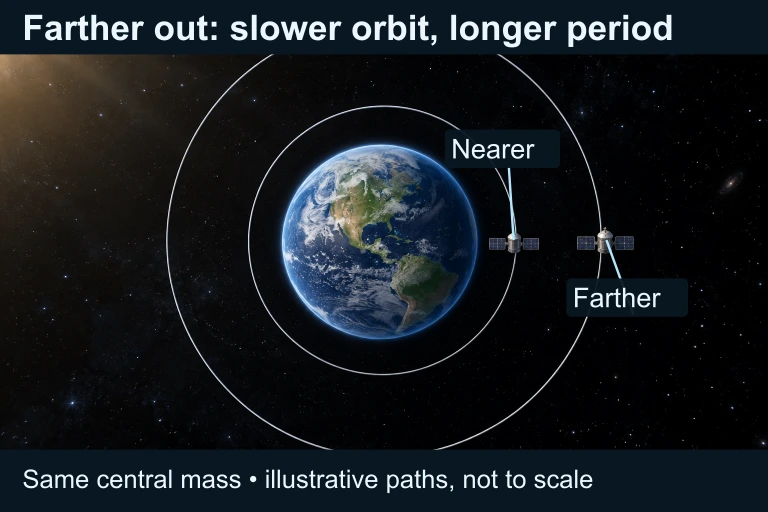 The orbital photograph is illustrative. The companion compares radii r₂ = 4r₁, giving v₂ = v₁/2, T₂ = 8T₁ and a₂ = a₁/16.
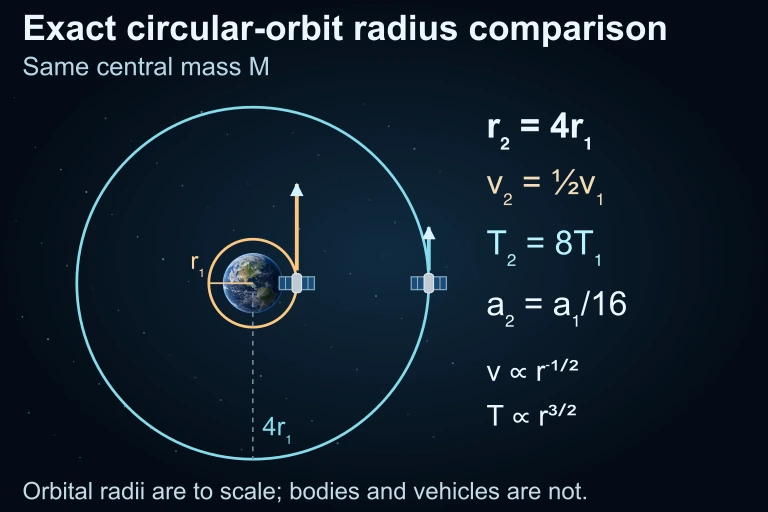 Exact 1:4 orbit-radius model and the resulting motion ratios.
SECTION 6
Worked Example — Geostationary Orbit
A geostationary satellite orbits Earth with a period of exactly 24 hours so that it remains above the same point on the equator. Determine the orbital radius, orbital speed, and total mechanical energy of a 500 kg geostationary satellite. Use ME = 5.97 × 10²⁴ kg and G = 6.674 × 10⁻¹¹ N·m²/kg².
Worked example
- 1
Step 1 — Identify Given Values
T = 24 h = 86 400 s, m = 500 kg, ME = 5.97 × 10²⁴ kg, G = 6.674 × 10⁻¹¹ N·m²/kg². - 2
Step 2 — Solve for Orbital Radius
From T = 2π√(r³/(GM)), square both sides: T² = 4π²r³/(GM). Rearranging: r³ = GMT²/(4π²). Substitute: r³ = (6.674 × 10⁻¹¹)(5.97 × 10²⁴)(86 400)² / (4π²) = (3.986 × 10¹⁴)(7.465 × 10⁹) / 39.48 = 7.534 × 10²² m³.r = (7.534 × 10²²)¹ᐟ³ ≈ 4.22 × 10⁷ m ≈ 42 200 km from Earth's center. - 3
Step 3 — Calculate Orbital Speed
v = 2πr / T = 2π(4.22 × 10⁷) / 86 400.v ≈ 3 070 m/s (about 3.07 km/s). - 4
Step 4 — Calculate Total Mechanical Energy
E = −GMm/(2r) = −(6.674 × 10⁻¹¹)(5.97 × 10²⁴)(500) / (2 × 4.22 × 10⁷).E ≈ −2.36 × 10⁹ J (negative, confirming a bound orbit). - 5
Step 5 — Verify with Alternate Method
Check: K = ½mv² = ½(500)(3070)² ≈ 2.36 × 10⁹ J. U = −GMm/r ≈ −4.72 × 10⁹ J. E = K + U ≈ −2.36 × 10⁹ J ✓. Also note |U| = 2K as expected for a circular orbit.
SECTION 7
Common Misconceptions & Pitfalls
| Misconception | Reality |
|---|---|
| Satellites in orbit are beyond Earth's gravity. | Gravity provides the centripetal force for the orbit. At the ISS altitude (~400 km), g is still about 8.7 m/s², roughly 89% of its surface value. |
| Heavier satellites need to orbit faster. | Satellite mass cancels in the derivation. Orbital speed depends only on M and r, not on m. |
| Moving to a higher orbit means the satellite speeds up. | Higher orbits have lower speeds (v ∝ 1/√r). The total energy increases, but the kinetic energy decreases. |
| There is an outward centrifugal force on the satellite. | In an inertial frame, only gravity (inward) acts. Centrifugal force is a fictitious force that appears only in a rotating reference frame. |
| Orbital radius equals altitude above the surface. | Orbital radius r = R (radius of planet) + h (altitude). Confusing r with h is one of the most common algebraic errors. |
Frequent misconceptions about satellite motion and their corrections.
SECTION 8
Connection to Advanced Topics
The circular orbit model presented here is a powerful starting point, but real satellite dynamics extend into richer territory. The AP Physics 1 framework focuses on circular orbits and energy conservation; AP Physics C and college-level mechanics introduce elliptical orbits, escape velocity, and transfer orbits. Recognizing where the AP 1 model ends helps you know when simplifying assumptions are valid.
| Topic | AP Physics 1 Treatment | Advanced Treatment |
|---|---|---|
| Orbit shape | Circular only; constant speed and radius | Elliptical (Kepler's 1st law); speed varies with position |
| Energy | E = −GMm/(2r), K and U fixed | E = −GMm/(2a) where a is the semi-major axis; K and U vary along the orbit |
| Escape velocity | Conceptual: E ≥ 0 means unbound | v_esc = √(2GM/r); derivable via energy conservation |
| Orbital transfers | Not covered | Hohmann transfer orbits; Δv budgets; bi-elliptic transfers |
| Angular momentum | L = mvr constant for circular orbit | L conserved in elliptical orbits; explains v_max at periapsis, v_min at apoapsis |
How the AP Physics 1 treatment compares with more advanced orbital mechanics.
Even within the scope of AP Physics 1, the satellite model connects beautifully to broader themes. The fact that gravitational potential energy is defined as zero at infinity mirrors convention choices you will encounter in electrostatics (AP Physics C) and quantum mechanics. The conservation of angular momentum you see in orbits reappears in spinning ice skaters, collapsing stars, and rotating galaxies—making this lesson a gateway to understanding rotating systems across many scales.
SECTION 9
Practice Problems
Question 1: CONCEPTUAL
- A. The speed would double.
- B. The speed would increase by a factor of √2.
- C. The speed would remain the same.
- D. The speed would decrease by half.
Show answer (C)
Question 2: BASIC CALCULATION
- A. 3 070 m/s
- B. 7 660 m/s
- C. 9 800 m/s
- D. 11 200 m/s
Show answer (B)
Question 3: INTERMEDIATE
- A. 2
- B. 4
- C. 8
- D. 16
Show answer (C)
Question 4: APPLIED
Show answer
Question 5: CRITICAL THINKING