

SECTION 1
Historical Context & Motivation
Long before Newton codified the laws of motion, natural philosophers recognized that a moving object possesses something beyond mere speed—a quantity that depends on both how massive the object is and how fast it travels. Medieval scholars working in the Islamic Golden Age and later European thinkers called this quantity impetus, an early precursor to the modern concept of momentum. The idea that something is conserved during impacts—that motion is not simply created or destroyed but transferred—drove centuries of inquiry and ultimately became one of the most powerful conservation laws in all of physics.
~1340 • Impetus Theory
1668 • Collision Rules at the Royal Society
1687 • Newton's Principia
1743 • D'Alembert's Principle
1918 • Noether's Theorem
The historical arc reveals a persistent question: when two objects interact, what quantity remains unchanged for the system as a whole? The answer—linear momentum—gives us a bookkeeping tool so reliable that it applies from subatomic particle collisions to spacecraft maneuvers. In this lesson you will learn how to define, calculate, and apply momentum and its conservation to a wide variety of AP Physics 1 problems.
SECTION 2
Core Principles & Definitions
Momentum is a vector quantity defined as the product of an object's mass and its velocity. Because it is a vector, momentum has both magnitude and direction, and every momentum calculation must respect sign conventions or component decomposition. The following foundational ideas form the backbone of every problem you will encounter on the AP Physics 1 exam.
Linear Momentum (p⃗)
Impulse (J⃗)
Conservation of Momentum
System vs. Surroundings
Newton's Second Law in Momentum Form
KEY TAKEAWAY
SECTION 3
Visual Explanation — Momentum and Impulse
The diagram above captures the essence of momentum conservation in a single glance. Before the collision, all the momentum resides in the cyan cart (m₁); the violet cart (m₂) is at rest and carries zero momentum. After the collision, the two carts form a single pink composite object whose momentum exactly equals the original 24 kg·m/s. No momentum has appeared or disappeared—it has merely been shared. This same bookkeeping applies whether the collision is perfectly inelastic (as shown), elastic, or somewhere in between; the only requirement is that no net external force acts on the system during the interaction.
SECTION 4
Mathematical Framework
The mathematics of momentum flows directly from Newton's Second Law in its most general form. In AP Physics 1 you are expected to manipulate momentum, impulse, and conservation equations fluently, and to connect each equation to its physical meaning.
DEFINITION OF MOMENTUM
p⃗ is linear momentum (kg·m/s), m is mass (kg), and v⃗ is velocity (m/s). Because velocity is a vector, momentum is also a vector quantity pointing in the same direction as the velocity.
IMPULSE–MOMENTUM THEOREM
J⃗ is impulse (N·s or equivalently kg·m/s), F⃗ₙₑₜ is the average net force, Δt is the time interval over which the force acts, and Δp⃗ is the change in momentum. Graphically, impulse equals the area under a force-vs-time curve.
CONSERVATION OF MOMENTUM
For a two-object system this becomes m₁v⃗₁ᵢ + m₂v⃗₂ᵢ = m₁v⃗₁f + m₂v⃗₂f. This equation is valid in each independent direction (x, y) and holds regardless of collision type.
NEWTON'S SECOND LAW — MOMENTUM FORM
This is equivalent to F = ma for constant mass, but it is more fundamental: it accommodates systems where mass enters or leaves (e.g., rockets). On the AP exam you may be asked to reason about force from a momentum-change perspective.
Sign Convention Reminder
SECTION 5
Classification of Collisions
All collisions conserve momentum (provided the system is isolated), but they differ in whether kinetic energy is also conserved. Understanding the three collision categories and the explosion case is essential for choosing the right equations on exam day.
| Collision Type | Momentum Conserved? | Kinetic Energy Conserved? | Objects After |
|---|---|---|---|
| Perfectly Elastic | Yes | Yes | Separate; bounce apart |
| Inelastic (general) | Yes | No — some KE lost to deformation, heat, sound | Separate; may deform |
| Perfectly Inelastic | Yes | No — maximum KE loss | Stick together; move as one |
| Explosion | Yes | No — KE increases (internal energy released) | Fly apart from initially together |
Summary of collision and explosion types for AP Physics 1
SECTION 6
Worked Example — Two-Cart Collision
A 3.0 kg cart (Cart A) traveling east at 5.0 m/s collides head-on with a 2.0 kg cart (Cart B) traveling west at 4.0 m/s. The carts stick together after the collision. Find the velocity of the combined carts after the collision and determine how much kinetic energy is lost.
Perfectly Inelastic Head-On Collision
- 1
Step 1 — Define the system and sign convention
The system consists of Cart A and Cart B. Choose east as positive. Therefore: vA,i = +5.0 m/s and vB,i = −4.0 m/s (west is negative). Because the carts stick together, this is a perfectly inelastic collision. - 2
Step 2 — Apply conservation of momentum
mAvA,i + mBvB,i = (mA + mB)vf. Substituting: (3.0)(+5.0) + (2.0)(−4.0) = (3.0 + 2.0)vf. - 3
Step 3 — Solve for the final velocity
15.0 + (−8.0) = 5.0 × vf → 7.0 = 5.0 vf → vf = +1.4 m/s. The positive sign means the combined mass moves east.= +1.4 m/s (east) - 4
Step 4 — Calculate kinetic energy before and after
KEi = ½(3.0)(5.0)² + ½(2.0)(4.0)² = 37.5 + 16.0 = 53.5 J. KEf = ½(5.0)(1.4)² = 4.9 J. - 5
Step 5 — Determine kinetic energy lost
ΔKE = KEf − KEi = 4.9 − 53.5 = −48.6 J. About 91% of the kinetic energy is converted to thermal energy, sound, and deformation during the collision. This large loss is characteristic of perfectly inelastic collisions.ΔKE = −48.6 J (lost to internal energy)
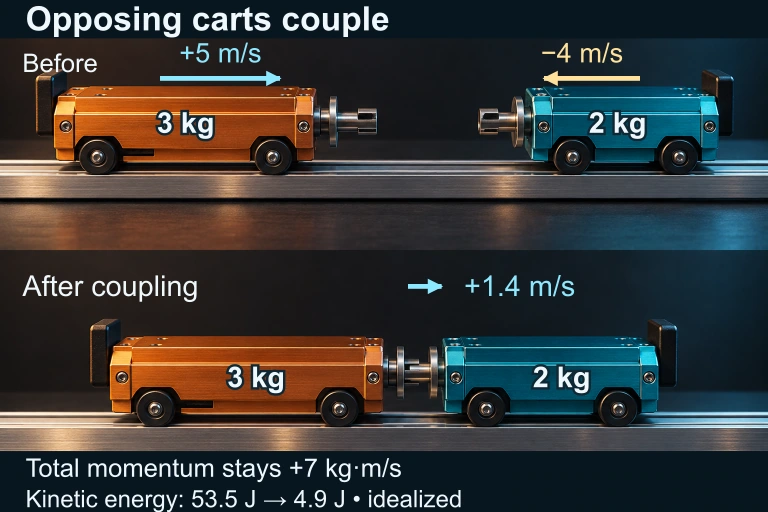 Carts of 3 kg at +5 m/s and 2 kg at −4 m/s couple at +1.4 m/s. Momentum remains +7 kg·m/s; kinetic energy decreases from 53.5 to 4.9 J.
SECTION 7
Impulse — Strengths, Limitations & Comparisons
The impulse–momentum theorem is a powerful problem-solving tool, but it is important to understand both what it can and cannot tell you. The table below contrasts momentum-based analysis with energy-based analysis—two complementary perspectives that together cover nearly every mechanics scenario on the AP exam.
| Feature | Momentum / Impulse Approach | Energy / Work Approach |
|---|---|---|
| Quantity type | Vector (has direction) | Scalar (no direction) |
| Conservation condition | No net external force on the system | No non-conservative work on the system |
| Best for | Collisions, explosions, recoil, force-time problems | Height changes, springs, friction over distance |
| Limitation | Cannot determine energy lost to heat/sound directly | Cannot determine final velocities in multi-object collisions alone |
| Relevant graph | F vs. t (area = impulse) | F vs. x (area = work) |
Momentum vs. Energy: choosing the right framework
KEY TAKEAWAY
SECTION 8
Connection to Advanced Theory
On the AP Physics 1 exam, you will always treat momentum as p = mv, but this is actually a low-speed approximation of a deeper relativistic expression. Connecting the algebra-based framework to its more advanced counterpart gives you a richer appreciation of why momentum is conserved and where the ideas lead in future coursework.
| Aspect | AP Physics 1 (Algebra-Based) | Advanced / University Physics |
|---|---|---|
| Momentum definition | p = mv (valid at v ≪ c) | p = γmv where γ = 1/√(1 − v²/c²) |
| Why conserved? | Newton's Third Law (internal forces cancel) | Noether's theorem: translational symmetry of space |
| Dimensions | 1-D and 2-D problems only | Full 3-D, including angular momentum and 4-momentum in spacetime |
| Variable mass | Mentioned qualitatively (rockets) | Rocket equation: F = v_exhaust × (dm/dt) |
| Center of mass | Qualitative understanding; velocity of center of mass | Formal CM frame analysis; reduced mass in two-body problems |
AP Physics 1 momentum vs. advanced treatments
The key message is that conservation of momentum is not merely a convenient problem-solving trick—it reflects a deep symmetry of nature. Emmy Noether's 1918 theorem proves that every continuous symmetry of physical law corresponds to a conserved quantity. Because the laws of physics do not change when you shift your laboratory to a different location (translational symmetry), momentum must be conserved. This perspective will become central if you study Lagrangian or Hamiltonian mechanics in a university physics course.
SECTION 9
Practice Problems
Question 1: CONCEPTUAL
- A. Skater A has a greater magnitude of momentum than Skater B.
- B. Skater B has a greater speed than Skater A.
- C. The total momentum of the system is directed toward Skater A.
- D. Both skaters have the same speed after pushing off.
Show answer (B)
Question 2: BASIC CALCULATION
- A. 1.0 N·s
- B. 3.0 N·s
- C. 7.0 N·s
- D. 4.0 N·s
Show answer (C)
Question 3: INTERMEDIATE
- A. 7.5 m/s
- B. 9.4 m/s
- C. 11.2 m/s
- D. 15.2 m/s
Show answer (B)
Question 4: APPLIED
5 ptsShow answer
Question 5: CRITICAL THINKING
4 ptsShow answer
SUMMARY
Lesson Summary
Summary
Linear momentum is defined as p⃗ = mv⃗ and is a vector quantity measured in kg·m/s. The impulse–momentum theorem states that the impulse J⃗ = F⃗ₙₑₜΔt equals the change in momentum Δp⃗, providing a bridge between force, time, and motion. The conservation of momentum holds for any isolated system (no net external force) and applies in every direction independently. This principle governs all collisions (elastic, inelastic, and perfectly inelastic) as well as explosions, which are simply reverse collisions where internal energy is converted into kinetic energy.
When solving problems, always define your system boundaries and sign conventions before writing equations. Remember that momentum is conserved regardless of collision type, while kinetic energy is only conserved in perfectly elastic collisions. For two-dimensional problems, apply conservation of momentum in the x- and y-directions separately. The momentum framework complements energy methods: together, they form the two most versatile analytical tools in AP Physics 1 mechanics.