

SECTION 1
Historical Context & Motivation
Humans have grappled with the consequences of friction since the earliest civilizations — the ancient Egyptians poured water ahead of wooden sleds transporting massive stone blocks, empirically discovering that a lubricant reduces the resistive force between two surfaces. Despite being one of the most familiar forces in everyday experience, a rigorous scientific treatment of friction took centuries to develop. The challenge was that friction, unlike gravity or elasticity, arises from complex microscopic interactions between surfaces rather than from a single, clean law of nature. Understanding this history is important because it reveals how physicists transitioned from purely empirical rules to the model-based treatment you will use on the AP Physics 1 exam.
1493 • Leonardo da Vinci's Friction Experiments
1699 • Amontons' Laws
1785 • Coulomb's Distinction
1950s • Microscopic Understanding
Coulomb's distinction between static and kinetic friction remains the operational model used in the AP Physics 1 course. The central question for this lesson is: How do we quantify the frictional forces that act between surfaces, and how do we apply Newton's second law when friction is present? Answering this question requires understanding the role of the normal force, the meaning of the coefficient of friction, and the key behavioral difference between the static and kinetic cases.
SECTION 2
Core Principles & Definitions
Friction is a contact force that acts parallel to the surfaces in contact and opposes the relative motion (or the tendency toward relative motion) between those surfaces. It is not a fundamental force of nature; rather, it is a macroscopic consequence of electromagnetic interactions between the atoms and molecules at the interface. For the AP Physics 1 framework, you should treat friction using the empirical model codified by Amontons and Coulomb, which relates the frictional force to the normal force through a dimensionless proportionality constant called the coefficient of friction.
Static Friction (fₛ)
Kinetic Friction (fₖ)
Normal Force (N)
Coefficient of Friction (μ)
KEY TAKEAWAY
SECTION 3
Visual Explanation — Free-Body Diagrams with Friction
The free-body diagram is the single most important tool for solving friction problems. The diagram below shows a block on a horizontal surface being pushed to the right by an applied force. All four forces acting on the block are labeled, and their relative lengths convey approximate magnitudes. Notice that the friction vector points to the left — it opposes sliding or the tendency to slide relative to the contacting surface.
When the block is at rest and you gradually increase the applied force, static friction increases in lockstep to keep the net horizontal force at zero. This continues until the applied force exceeds the maximum static friction, μₛN. At that threshold the block begins to slide, and the friction instantly transitions to the kinetic value μₖN, which is smaller. Because μₖ < μₛ, there is a sudden drop in the opposing force the moment the block starts moving — this is why a heavy piece of furniture seems to "break free" and then slides more easily once it is in motion.
 A parcel moving slower than a right-moving conveyor slips left relative to the belt, so kinetic friction on the parcel points right. Once both move steadily together with no other horizontal force, the required friction can be zero.
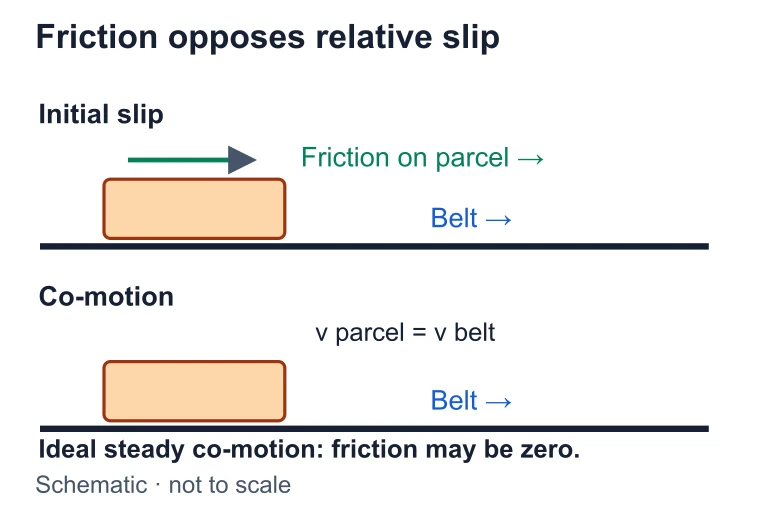 A parcel moving slower than a right-moving conveyor slips left relative to the belt, so kinetic friction on the parcel points right. Once both move steadily together with no other horizontal force, the required friction can be zero.
SECTION 4
Mathematical Framework
The mathematical treatment of friction in AP Physics 1 centers on two equations — one for static friction and one for kinetic friction — combined with Newton's second law. Mastering these equations means understanding when each applies and how to determine the normal force in various geometric configurations.
STATIC FRICTION (INEQUALITY)
fₛ = magnitude of static friction (N); μₛ = coefficient of static friction (dimensionless); N = normal force (N). The inequality means static friction adjusts from 0 up to a maximum of μₛN. Use the equality fₛ = μₛN only when the object is on the verge of sliding (the "threshold" or "impending motion" condition).
KINETIC FRICTION (EQUALITY)
fₖ = magnitude of kinetic friction (N); μₖ = coefficient of kinetic friction (dimensionless); N = normal force (N). Once sliding occurs, the frictional force has a fixed magnitude determined solely by the surface pair and the normal force. The direction of fₖ is always opposite the velocity of the sliding object relative to the surface.
NORMAL FORCE ON AN INCLINE
On a frictionless or friction-present incline of angle θ, the component of gravity perpendicular to the surface is mg cos θ. If no other forces act perpendicular to the surface, Newton's second law in the perpendicular direction gives N = mg cos θ. Always verify this by analyzing the perpendicular direction explicitly; additional forces (e.g., a push into or away from the surface) will modify N.
NEWTON'S SECOND LAW WITH FRICTION (HORIZONTAL)
For a block sliding to the right on a horizontal surface under applied force Fapp with kinetic friction opposing: the net force equals the applied force minus the kinetic friction, and this equals ma. Choosing a sign convention (positive in the direction of motion) is essential.
AP Exam Tip
SECTION 5
Friction on Inclined Planes
Inclined-plane problems are the most frequently tested friction scenario on the AP Physics 1 exam. The key strategy is to tilt your coordinate axes so that one axis lies along the surface and the other is perpendicular to it. Gravity then decomposes into two components: mg sin θ parallel to the surface (pulling the block down the incline) and mg cos θ perpendicular to the surface (pressing the block into the surface). The perpendicular equation immediately yields N = mg cos θ (assuming no other perpendicular forces), and the parallel equation involves friction, the gravitational component down the incline, and any applied forces.
A particularly elegant result emerges when you ask: At what angle θ will the block be on the verge of sliding? Setting fₛ = μₛN at impending motion, substituting N = mg cos θ and the parallel component mg sin θ, and noting that a = 0 at the threshold, the mass cancels and you obtain tan θ = μₛ. This means the coefficient of static friction can be measured simply by tilting a surface until the object just begins to slide, then taking the tangent of that angle. This is a common AP laboratory question and a useful conceptual benchmark.
CRITICAL ANGLE FOR IMPENDING MOTION
θc = the angle at which the block is on the verge of sliding. This result is independent of mass — a light block and a heavy block on the same surface begin to slide at the same angle.
SECTION 6
Worked Example — Block Pulled Across a Surface
A 12.0 kg block sits on a horizontal surface. The coefficients of friction between the block and surface are μₛ = 0.45 and μₖ = 0.30. A horizontal force of 60.0 N is applied to the block. Determine whether the block moves and, if so, find its acceleration.
Worked Example: Horizontal Pull with Friction
- 1
Step 1 — Identify the Normal Force
Since the surface is horizontal and the applied force is horizontal, the vertical forces are just the weight and the normal force. Applying Newton's second law in the vertical direction with ay = 0: N − mg = 0, so N = mg = (12.0 kg)(9.8 m/s²).N = 117.6 N - 2
Step 2 — Calculate Maximum Static Friction
The maximum static friction is fₛ,max = μₛN = (0.45)(117.6 N).fₛ,max = 52.9 N - 3
Step 3 — Compare Applied Force to Maximum Static Friction
The applied force is 60.0 N, which exceeds fₛ,max = 52.9 N. Therefore, the block does begin to move, and kinetic friction applies.60.0 N > 52.9 N → Block slides - 4
Step 4 — Calculate Kinetic Friction
Once sliding, fₖ = μₖN = (0.30)(117.6 N).fₖ = 35.3 N - 5
Step 5 — Apply Newton's Second Law for Acceleration
Taking the positive direction as the direction of the applied force: ΣF = Fapp − fₖ = ma. Substituting: 60.0 N − 35.3 N = (12.0 kg) × a, which gives a = 24.7 N / 12.0 kg.a ≈ 2.06 m/s²
Problem-Solving Strategy
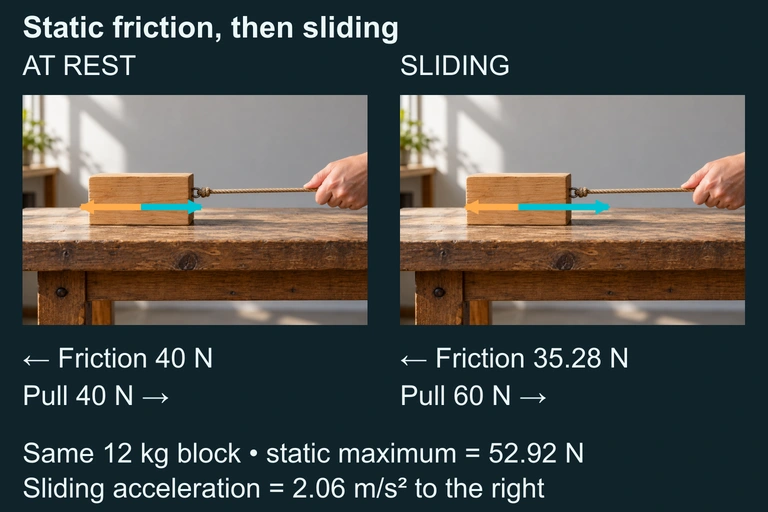 AP Physics 1: static friction balances a 40 N pull on a 12 kg block. A 60 N pull exceeds the 52.92 N static limit; kinetic friction is 35.28 N and acceleration is 2.06 m/s². The incline companions use the separate AP Physics C model.
SECTION 7
Static vs. Kinetic Friction — Key Comparisons
Although static and kinetic friction share the same general form (proportional to the normal force through a coefficient), they differ in critical ways that matter for problem solving and for the AP exam. The following table summarizes these differences in a format that is useful for quick review.
| Property | Static Friction (fₛ) | Kinetic Friction (fₖ) |
|---|---|---|
| When it acts | Object is not sliding relative to the surface | Object is sliding relative to the surface |
| Mathematical form | fₛ ≤ μₛN (inequality) | fₖ = μₖN (equality) |
| Magnitude | Adjustable: 0 to μₛN | Fixed at μₖN |
| Direction | Opposes the tendency of motion | Opposes the velocity of sliding |
| Typical coefficient | Larger (μₛ) | Smaller (μₖ) |
| Depends on speed? | N/A (object is not moving) | Approximately independent of speed in the AP model |
Comparison of static and kinetic friction properties
KEY TAKEAWAY
SECTION 8
Limitations & Connections to Advanced Topics
The Coulomb friction model (fₖ = μₖN and fₛ ≤ μₛN) is remarkably useful, but it is an approximation that breaks down in certain regimes. Understanding its limitations deepens your conceptual understanding and prepares you for questions that probe the boundaries of the model.
| AP Physics 1 Model | Advanced / Real-World Extension |
|---|---|
| μₖ is constant (independent of speed) | At very high or very low speeds, μₖ can depend on velocity (e.g., viscous drag in lubricated systems) |
| Friction is independent of contact area | For soft or deformable materials (rubber tires on asphalt), the real contact area changes, making friction area-dependent |
| Friction acts at the surface; no torques considered | In rotational dynamics, friction produces torques (rolling friction, static friction enabling rolling without slipping) |
| μ is a fixed property of the surface pair | μ depends on temperature, humidity, contamination, and surface wear — it is an empirical parameter, not a material constant |
AP model versus real-world complexity
In AP Physics 1, you will encounter friction again when studying rotational dynamics — specifically, the condition for rolling without slipping requires static friction at the contact point to provide the necessary torque. In AP Physics C and university-level mechanics, the microscopic origin of friction is explored through models involving adhesion and deformation of surface asperities, linking the macroscopic coefficients to material science. For now, the Coulomb model is fully sufficient for all AP Physics 1 problems and provides a solid conceptual foundation for these more advanced treatments.
SECTION 9
Practice Problems
Question 1: CONCEPTUAL
- A. 0 N
- B. 14.7 N
- C. 15 N
- D. 24.5 N
Show answer (C)
Question 2: BASIC CALCULATION
- A. 2.0 N
- B. 19.6 N
- C. 78.4 N
- D. 39.2 N
Show answer (B)
Question 3: INTERMEDIATE
- A. The block slides; friction = 23.8 N
- B. The block is stationary; friction = 19.6 N
- C. The block is stationary; friction = 23.8 N
- D. The block slides; friction = 19.6 N
Show answer (B)
Question 4: APPLIED
5 ptsShow answer
Question 5: CRITICAL THINKING
4 ptsShow answer
SUMMARY
Kinetic and Static Friction — Summary
Summary
Friction is a contact force that opposes relative motion between surfaces and is central to nearly every force problem in AP Physics 1. Static friction acts when the object is not sliding and satisfies the inequality fₛ ≤ μₛN, adjusting its magnitude to prevent motion up to a maximum threshold. Kinetic friction acts when the object is sliding and has a fixed magnitude given by fₖ = μₖN. The coefficient of static friction is always greater than the coefficient of kinetic friction for a given surface pair, which explains why it is harder to start an object moving than to keep it moving.
To solve friction problems, always begin with a free-body diagram and apply Newton's second law in both the parallel and perpendicular directions. On inclined planes, decompose gravity into components along and perpendicular to the surface, yielding N = mg cos θ and a gravitational pull of mg sin θ down the incline. The critical angle at which sliding begins satisfies tan θ = μₛ. Remember that static friction is an inequality: use fₛ = μₛN only at the threshold of sliding, and use Newton's second law to find the actual static friction in all other cases.